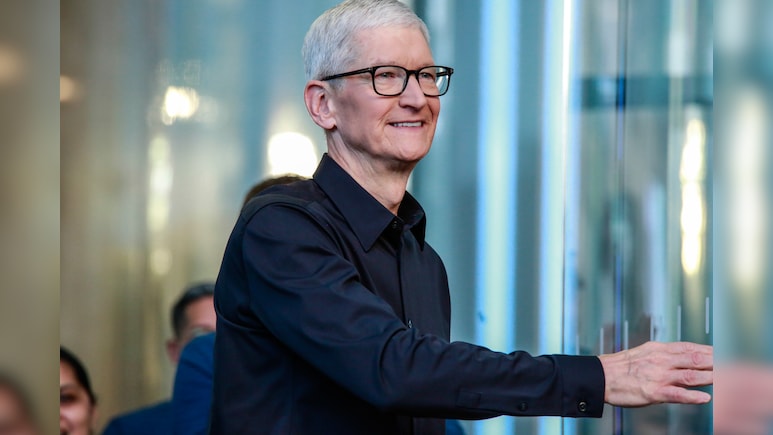
In an announcement on Monday, tech giant Apple confirmed Tim Cook would step down from role of CEO in September. He will be replaced by John Ternus, who currently leads hardware engineering.
The position has carried considerable weight since the company was established half a century ago by Steve Jobs and Steve Wozniak.
Here's a look at some of the notable CEOs in Apple history, alongside future-CEO Ternus' contributions.
Michael Scott (1977-81)
Within a year of Apple's founding by the young Steve Jobs and Steve Wozniak, Mike Scott was recruited from Fairchild Semiconductor and National Semiconductor to bring maturity to the fledgling company. Speaking to Business Insider in 2011, he said his responsibilities centred on managing practical matters, from setting up manufacturing to overseeing key business operations.
ALSO READ: From $350 Billion To $4 Trillion: How Apple Stock Performed Under Tim Cook
Mike Markkula (1981-83)
Often described as Apple's third co-founder, Mike Markkula was the company's earliest investor and later its chairman, working closely with Steve Jobs and Steve Wozniak. While serving as CEO, he contributed on the technical side as well, writing portions of the early software that powered the Apple II.
John Sculley (1983-'93)
John Sculley, who joined Apple after a successful stint at Pepsi, including a period as president, oversaw a sharp rise in the company's fortunes. Over 10 years, revenue climbed from $800 million to $8 billion. His tenure was also marked by a bitter dispute with Steve Jobs over leadership and vision, which ended with Jobs leaving Apple in 1985.
Michael Spindler (1993-'96)
Former chief operating officer Michael Spindler drew sharp criticism from both customers and shareholders during his time as Apple CEO. The company struggled under his leadership with inaccurate demand projections, declining market share and a damaging price war that eroded profitability.
Gil Amelio (1996-'97)
Brought in from National Semiconductor, where he had served as president, and already a member of Apple's board, Gil Amelio assumed the role of CEO amid a financial crisis. He moved quickly to rein in spending, cancelling projects such as an in-house operating system and cutting around a third of the staff. It was under his leadership that Apple purchased NeXT, Steve Jobs's post-1985 venture, for $427 million to replace the shelved system.
Steve Jobs (1997-2011)
Steve Jobs, who co-founded Apple at just 21, went on to become its most defining CEO, though his path was far from smooth. Ousted by Apple's board of directors in 1985 after a dispute with John Sculley, he went on to establish NeXT, a computer company aimed at higher education and professional users.
His return to Apple in 1997 marked a turning point, as he steered the struggling firm back to growth. Under his leadership, Apple introduced a string of landmark products: the iMac, iPod, iPhone and iPad.
Tim Cook (2011-2026)
Tim Cook succeeded Steve Jobs as Apple's CEO after Jobs died of cancer in 2011. Having arrived at the company in 1998 from Compaq, Cook rose to chief operating officer in 2007, where he overhauled inventory systems and established the global infrastructure behind Apple's vast production scale.
During his tenure as CEO, Apple's valuation surged past $4 trillion, with annual revenues exceeding $110 billion, alongside major advances in supply chain efficiency, services growth and engagement with policymakers in the United States and China.
John Ternus (September 2026)
John Ternus will assume the role of CEO on Sept. 1, 2026.
Having begun his Apple career in 2001 within the product design team, Ternus was promoted to vice president of hardware engineering in 2013. He joined the company's senior leadership in 2021 as SVP of the same division.
During his tenure, he has overseen engineering work spanning multiple breakthrough products, contributing to the rollout of new lines like the iPad and AirPods, as well as numerous generations of iPhone, Mac and Apple Watch.
ALSO READ: Apple's Next CEO Faces Three Big Tests As John Ternus Prepares To Take Over
Essential Business Intelligence, Sharp Market Insights, Practical Personal Finance Advice, Daily Fuel, Gold and Silver Prices and Latest Stories — On NDTV Profit.