The 2026 Asian Games have produced an unexpected medal opportunity for India, with Quimcy Joaquim Dsouza putting the country within touching distance of a historic podium finish in Teqball. As one of six new disciplines at the continental event, the sport has also put the 24-year-old Indian in the spotlight.
Quimcy Dsouza was denied a place in the women's singles teqball final at the 2026 Asian Games after a three-set defeat to Indonesia's Ima Sumaya. She dictated the early exchanges and secured the first set 12-7, only for Sumaya to hit back strongly in the next, winning it 12-9.
The Indian started the deciding set on the front foot, opening up a 3-0 advantage.
Also Read | Layoffs Are Rising In Tech, But These Skills Are Helping People Unlock Better Pay
Sumaya refused to be overpowered and gradually turned the contest around before sealing the set 12-7.
Dsouza's title hopes have now come to an end, though a podium finish remains within reach. She will meet Japan's Yiuna Sakamoto in the bronze-medal playoff on Sunday.
ALSO READ: India At Asian Games 2026 Day 1: Full Schedule, Timings And Medal Events For September 19
What Is Teqball?
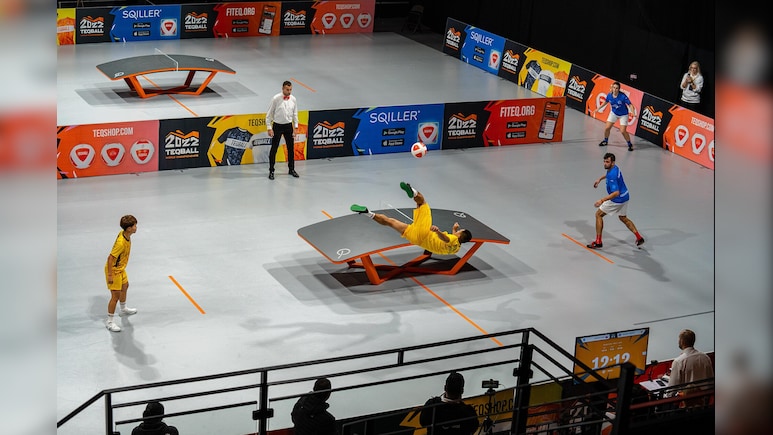
Teqball originated in Hungary a little over 10 years ago and is played on a distinctive curved table designed specifically for the sport. Players use a standard football, with singles and doubles formats available and a scoring system broadly modelled on table tennis.
Teqball places a premium on precision, quick reactions and an acute sense of positioning. Players cannot use their hands or arms to control the ball, relying instead on other parts of the body to keep it in play. Each player is allowed up to three touches before sending the ball back over the curved net.
The rules add another layer of difficulty by preventing the same body part from being used twice consecutively.
A player, for example, cannot control the ball with the chest twice in a row before making the next move. Physical contact is also off limits, both between competitors and with the table, making technique and control central to the sport.
The International Teqball Federation (FITEQ) says the sport has established governing bodies in close to 150 countries, underlining its rapid expansion across the globe. Teqball has also moved into the mainstream of international multi-sport events, featuring at the European Games and African Games before making its Asian Games debut. Its growing presence forms part of a wider push to earn Olympic status by 2032.
Teqball has found a particularly receptive audience in South-East Asia, where its athletic demands bear similarities to the region's traditional Sepak takraw.
The sport's spectacular style features bicycle kicks, powerful headers and highly controlled movements, all executed around the curved playing surface.
ALSO READ: Asian Games 2026 Schedule: Dates, Timings, India Events, Live Streaming And Telecast Details
Essential Business Intelligence, Sharp Market Insights, Practical Personal Finance Advice, Daily Fuel, Gold and Silver Prices and Latest Stories — On NDTV Profit.