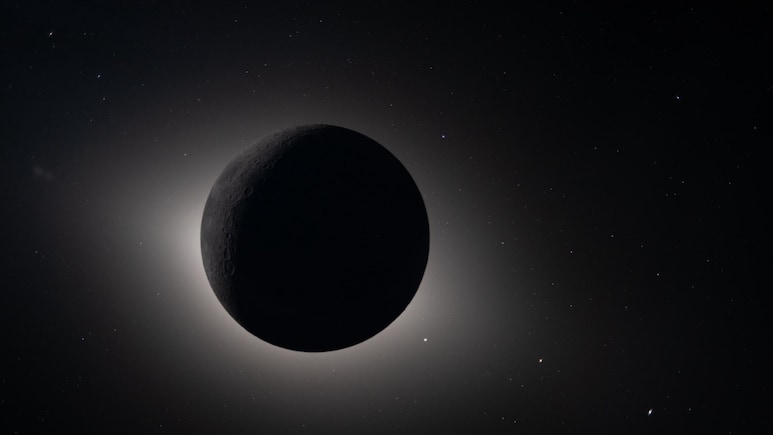
NASA has shared a glimpse of the entire far side of the moon. As part of the highly anticipated Artemis II mission, four astronauts flew around the Moon on Monday, clicking photographs and observing key details out of the window of their Orion spacecraft.
Among the four NASA astronauts are Reid Wiseman, Victor Glover and Christina Koch, as well as Canadian astronaut Jeremy Hansen. They have taken images of the moon's rugged terrain.
"The Artemis II eclipse. April 6, 2026. Totality, beyond Earth. From lunar orbit, the Moon eclipses the Sun, revealing a view few in human history have ever witnessed," read the joint post shared by NASA and White House on Instagram.
In another post, NASA also dropped a picture from the far side of the Moon.
"Humanity, from the other side. First photo from the far side of the Moon. Captured from Orion as Earth dips beyond the lunar horizon," the US space agency wrote.
According to NBC News, the four astronauts spent nearly seven hours taking images and gathering notes about surface features on the Moon during the flyby.
Notably, this makes them the first people to witness the lunar far side. This side is not visible from the planet because it permanently faces away from the Earth.
The astronauts were not able to view much of the moon's far side during the Apollo missions as well because of the paths and timing of their flights.
Early observations of the astronauts elicited celebrations from the lunar science team of the mission throughout the flyby.
According to NASA, Glover was captivated by the jagged topography along the moon's terminator, which is the dividing line between the illuminated side and the other dark side.
“Boy, I am loving the Terminator. There's just so much magic in the terminator — the islands of light, the valleys that look like black holes. You'd fall straight to the centre of the moon if you stepped in some of those. It's just so visually captivating,” he radioed to Mission Control, according to NBC News.
The four-member astronaut team even talked about the Moon's brightness, colours, and surface features. They radioed key descriptions in real time to mission controllers in Houston.
They are said to have seen brown and green hues on the near side of the Moon and even mentioned the brightness of small, new craters that might have been created by recent meteorite impacts.
As per NASA, the Artemis II images of craters, ridges and ancient lava flows on the lunar surface might be helpful for researchers to understand how the Moon was formed.
Essential Business Intelligence, Continuous LIVE TV, Sharp Market Insights, Practical Personal Finance Advice and Latest Stories — On NDTV Profit.