Researchers at the Indian Institute of Technology (IIT) Bombay have developed a low-cost blood-testing technology to screen for severe anaemia and sickle cell disease, potentially improving access to testing in remote areas with limited laboratory facilities.
The technology measures how far a drop of blood spreads across a glass slide to assess blood viscosity. A separate imaging-based method estimates haemoglobin levels from the colour intensity of a dried blood film, while another procedure screens for sickle cell disease and could help monitor treatment response.
The research, led by Professor Mahesh Tirumkudulu of IIT Bombay's Department of Chemical Engineering, was published in the journal Lab on a Chip. Dr Mahrukh Mir, a former doctoral researcher in his laboratory, is the study's first author, with Bhavesh Raicha of Valsad Raktdan Kendra as a co-author.
Also Read | Layoffs Are Rising In Tech, But These Skills Are Helping People Unlock Better Pay
How The Technology Works
Blood smears are routinely examined in pathology laboratories to assess blood cells and detect certain diseases. However, manual preparation can produce variations in the thickness and length of the smear.
To standardise the process, the researchers developed an automated device that spreads a drop of blood across a glass slide at a controlled angle and speed using two slides.
The team found that more viscous blood spreads less easily, producing a shorter and thicker smear under the same conditions. Blood viscosity depends on several factors, including the proportion of red blood cells, plasma viscosity and the cells' ability to change shape. These properties can vary with certain blood disorders.
ALSO READ | Can A Single Selfie Predict Cancer Survival? New AI Tool Says Yes
To evaluate the approach for severe anaemia screening, the researchers studied 516 individuals and compared blood viscosity measurements with haemoglobin levels.
The method correctly identified 95.1% of people with severe anaemia, defined as haemoglobin below 8 grams per decilitre (g/dL), and 86% of those without the condition. The reported haemoglobin accuracy was approximately ±0.8 g/dL.
A separate imaging-based method was tested on more than 1,000 clinical patients. It estimated haemoglobin levels with an accuracy of approximately ±0.5 g/dL compared with standard measurements and could detect levels as low as 2 g/dL.
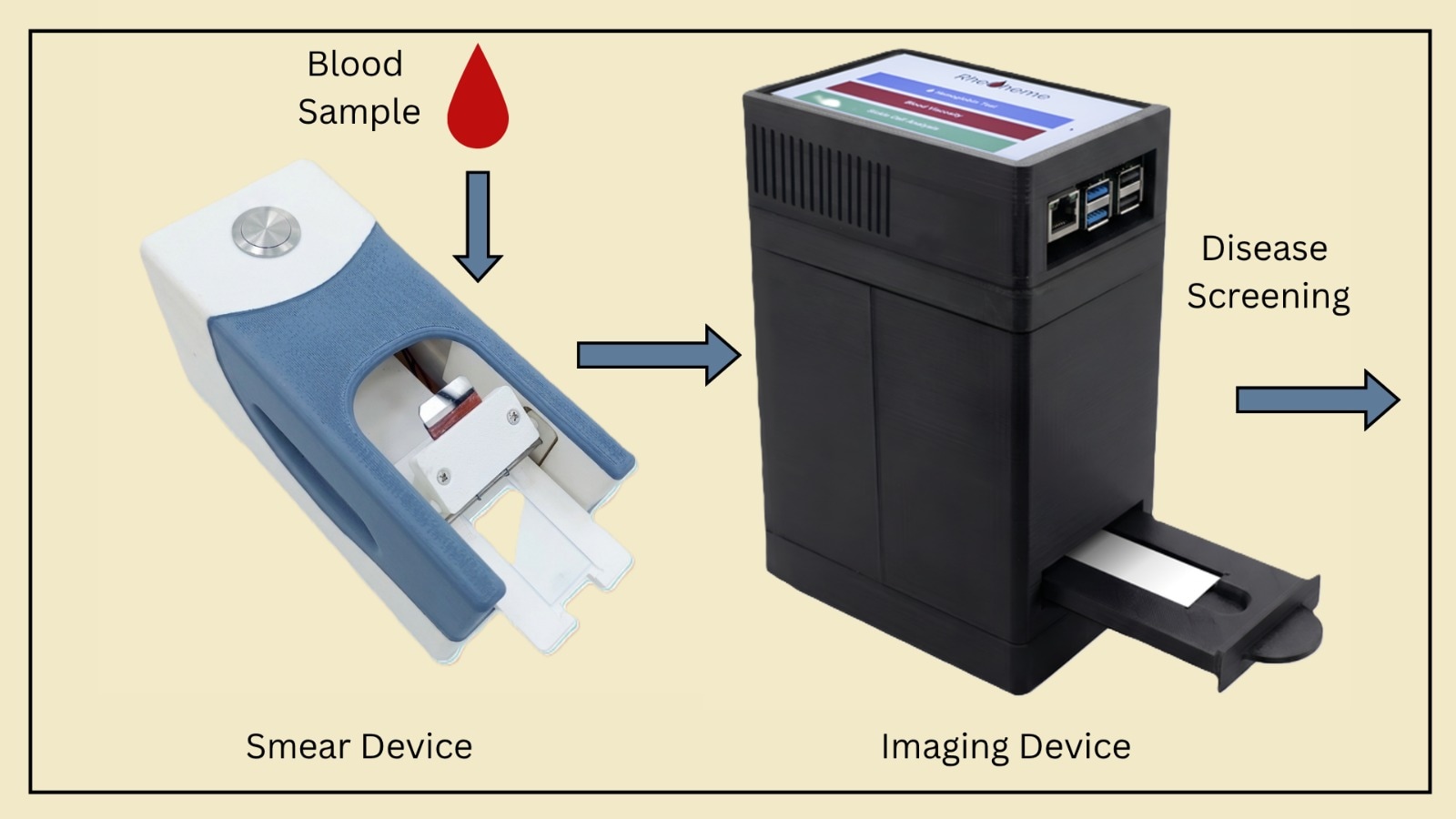
Devices developed by the researchers. Left: Smear device. Right: Imaging Device.
Photo Credit: Rheoheme Private Limited
Sickle Cell Screening And Treatment Monitoring
Sickle cell disease is a genetic disorder involving abnormal haemoglobin that can cause red blood cells to become rigid and obstruct small blood vessels.
For screening, the researchers developed a separate procedure that measures changes in blood viscosity after oxygen is removed from a sample.
Using sodium metabisulfite, an inexpensive chemical, the team deoxygenated blood samples and compared their smear lengths before and after treatment.
Field tests involving 394 people in tribal areas of Maharashtra and central India found that viscosity increased by less than 17% in healthy individuals, by 17% to 70% among people with the sickle cell trait, and by more than 70% in those with sickle cell disease.
The method correctly identified affected individuals and distinguished healthy people in about 95% of cases during the field tests.
The researchers also tested the approach in patients receiving hydroxyurea, a medicine used to treat sickle cell disease. In these patients, the increase in viscosity after deoxygenation fell from around 125% to approximately 70%, suggesting that the test could help assess treatment response.
Researchers Pursue Regulatory Approval
The patented automated device is licensed to Rheoheme Private Limited, an IIT Bombay startup. The test requires basic equipment, including a pipette, glass slides, vials for sample treatment, an inexpensive chemical and a ruler or imaging device to measure smear length.
The researchers are working with the National Institute for Research in Tribal Health, Jabalpur, and the All India Institute of Medical Sciences (AIIMS), Nagpur, towards regulatory approval.
ALSO READ | WHO Warns Against Obesity Drugs For Under-10s, Says Long-Term Evidence Is Limited
They cautioned that screening thresholds can vary across population groups because genetic differences may affect how blood responds to reduced oxygen levels. The anaemia test may also be less reliable in certain conditions, including hyperviscosity syndrome, in which blood plasma is unusually thick.
The team is exploring whether the technology could be adapted to measure blood clotting time and glucose levels.
If validated and approved for clinical use, the approach could offer an additional screening option in areas where conventional diagnostic facilities are difficult to access.
Essential Business Intelligence, Sharp Market Insights, Practical Personal Finance Advice, Daily Fuel, Gold and Silver Prices and Latest Stories — On NDTV Profit.