Swiggy vs Eternal: Food Delivery's Two Rivals Are No Longer In The Same Race
Eternal is building a private AI assistant, dark.ai. Swiggy is still working out how to make Instamart pay, with an operating loss of Rs 895 crore in the July-September quarter while Blinkit stayed profitable.
‘Objects in mirror are closer than they appear,' goes the warning in Jurassic Park. For Swiggy, in Zomato's rear-view mirror for years, the objects have stopped getting closer. Swiggy and Eternal, the parent of Zomato and Blinkit, have reported their July-September quarter (Q2 FY27) results. Swiggy's food delivery business kept improving, yet the gap to Zomato did not close. In quick commerce, the race to deliver groceries within minutes, the gap widened. The two companies are now chasing very different futures.
The Grocery Gap Is Now A Gulf
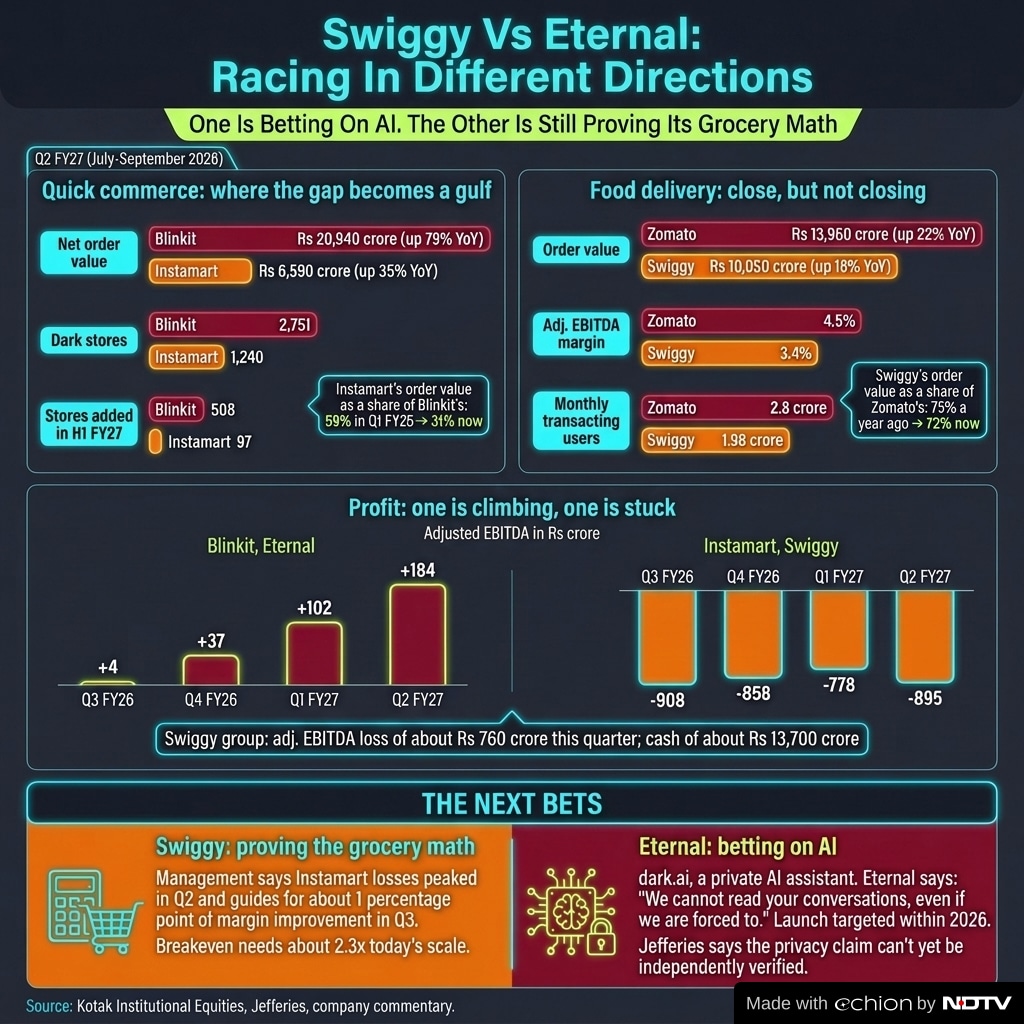
Blinkit's net order value (NOV), the value of orders after discounts and other deductions, was Rs 20,940 crore, up 79% from a year ago. Swiggy's Instamart logged Rs 6,590 crore, up 35%. In April-June 2024, Instamart's order value was 59% of Blinkit's. It is now 31%.
The store network shows the same divide. Blinkit runs 2,751 dark stores, the small warehouses that fulfil quick commerce orders, against 1,240 for Instamart. In the first half of FY27, Blinkit added 508 stores and Instamart 97. Kotak Institutional Equities expects Blinkit's faster expansion to strain Instamart's growth and profitability further.
Profits tell the rest of the story. Blinkit's adjusted EBITDA, a measure of operating profit, was a positive Rs 184 crore, up from Rs 4 crore in October-December 2025. Instamart lost Rs 895 crore. Swiggy's management says those losses peaked in Q2 and guides for about 1 percentage point of margin improvement in Q3. Breakeven needs about 2.3 times today's scale.
Swiggy vs Eternal after their Q2FY27 report cards
Photo Credit: NDTV Profit
Food Delivery: Closer, But Not Closing
Zomato's gross order value (GOV), the total value of orders placed, was Rs 13,960 crore, up about 22%. Swiggy's was Rs 10,050 crore, up 18%. A year ago, Swiggy's order value was 75% of Zomato's. It is now 72%.
Zomato also earns more on each order. Its adjusted EBITDA margin was 4.5% of GOV, against 3.4% for Swiggy. Swiggy did post a record food delivery profit of Rs 341 crore, with the margin up about 0.6 percentage points from a year ago.
Two Very Different Bets
Swiggy's big new bet in food is Toing, a budget food app now live in 50+ cities. Two in three Toing users are new to Swiggy or had stopped ordering. Management says Toing could lift combined food delivery growth to 25-30%, from the current 18-20% guidance, but it needs one to two more quarters to judge the unit economics.
Eternal's bet is dark.ai, an AI assistant that promises private conversations. Its pitch: "We cannot read your conversations, even if we are forced to." Founder Deepinder Goyal is aiming it first at privacy-sensitive users such as founders and researchers. It runs on open-weight models that Eternal fine-tunes and hosts on its own servers, and it is due to launch within 2026. Management itself calls the outcome binary, and Jefferies says Eternal has not yet shared enough detail to verify the privacy claim.
On market value, the gap is plain. Eternal is worth about Rs 3 lakh crore and Swiggy about Rs 61,400 crore, and Swiggy's shares are down about 51% in a year. Jefferies, Citi and Kotak all cut their Swiggy targets after the quarter, and all kept a Buy rating.
ALSO READ: Ola Electric Shares Downgraded To Sell, Target Price Cut, Here's What Worries Goldman Sachs
-
Where You Live Shapes How You Get To Work | The Reason Why

Two-wheelers are the most popular way to get to work in India, accounting for nearly 43% of workplace commutes.
-
High US Salaries, No Green Card Certainty: The Financial Calculation Facing Indian H-1B Families
The suspension of PERM processing at eight technology employers does not cancel existing H-1B visas. What it does is force a question many Indian families have been avoiding: is the US salary worth tying your career and family plans to one employer?
-
Unhedged Position: Can India See An Indonesia-Style Time Correction?
The Nifty is trading below levels it first clocked in 2024. Is there, then, as I have suggested in the headline, potential that the current time correction drags on painfully for the next three-five, even ten years?
-
Navigating Friction And Energy Realities: An Analysis Of Marco Rubio's October Visit To India
Occurring at a critical juncture marked by stalled trade negotiations and escalating geopolitical pressures over global energy supplies, the visit offers a profound window into modern US-India relations.
-
India Exports Capital. Why Not Export Trusteeship?
The big question, then, is whether India can build an institution that global borrowers, investors, banks, and lawyers can trust, even without an Indian connection.
-
France's Economy & Politics Are In Crisis | The Reason Why
Let's look at how the French economy and politics evolved under Nicolas Sarkozy, Franois Hollande and Emmanuel Macron.
-
You May Inherit The Business. You Must Earn Its Credibility.
Succession tests the founder's ability to share authority as much as it tests the next generation's readiness to assume it.
-
Signing Deals Is One Thing; Making Them Work Is Another | The Week In Whys
Sometimes, things don't turn out as planned. Indian companies have lost some bids to rivals, some projects won't produce until 2030.
-
FOMC Wall, PERM Suspension, Hospital Stocks | Talking Points This Week
A PERM suspension would directly affect green-card sponsorship rather than H-1B visas, so the near-term earnings impact could remain relatively limited. The key question is whether this marks a new phase in US scrutiny of Indian IT.
-
Everything, Everywhere, All At Once: Dalal Street's Week To Forget | Joining The Dots
Visa curbs, a Starlink spat and cancer drug caps: what connects this week's shocks for Indian markets









