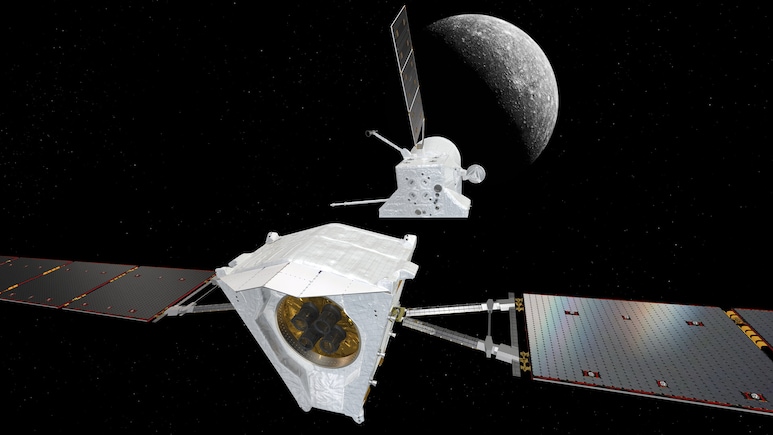
The joint European Space Agency (ESA) and Japan Aerospace Exploration Agency (JAXA) BepiColombo mission has entered the final phase of its nearly eight-year journey to Mercury, marking a crucial stage in efforts to study the Solar System's innermost planet.
Launched in October 2018, BepiColombo has travelled billions of kilometres through the inner Solar System. The spacecraft used the gravitational pull of Earth, Venus and Mercury to gradually adjust its trajectory and shed enough speed to eventually enter orbit around Mercury.
Also Read | Layoffs Are Rising In Tech, But These Skills Are Helping People Unlock Better Pay
During its journey, the mission completed nine planetary flybys, including one of Earth, two of Venus and six of Mercury.
A major milestone was reached on Sept. 3, 2026, when the Mercury Transfer Module (MTM) separated from the two scientific orbiters after providing propulsion for most of the journey. ESA confirmed that the spacecraft remained healthy following the separation.
The two science orbiters are ESA's Mercury Planetary Orbiter (MPO) and JAXA's Mercury Magnetospheric Orbiter, Mio. They are scheduled to enter orbit around Mercury on Nov. 21, 2026, before separating to begin their individual scientific missions.
MPO will study Mercury's surface, interior and composition, while Mio will examine the planet's magnetic environment and its interaction with the solar wind. Together, the spacecraft will investigate Mercury's thin atmosphere, magnetic field, iron-rich interior and geological features.
Scientists are particularly interested in Mercury's polar craters, where permanently shadowed areas may contain water ice. The mission will also study mysterious surface formations known as “hollows” and investigate how Mercury formed and evolved so close to the Sun.
The orbiters are expected to separate on Dec. 9-10, with MPO reaching its final operational orbit by March 2027. Routine scientific observations are scheduled to begin in April 2027.
ALSO READ | UN Backs New World Map to Show Africa's True Size, Challenges Mercator Projection
BepiColombo will be the first mission to place two spacecraft in orbit around Mercury simultaneously and only the second mission ever to orbit the planet. Its complex trajectory and solar-electric propulsion were necessary because reaching Mercury requires a spacecraft to shed substantial speed against the Sun's powerful gravitational pull.
The mission's arrival phase marks the beginning of a new chapter in the exploration of Mercury, with BepiColombo expected to provide fresh insights into one of the least explored planets in the inner Solar System.
Essential Business Intelligence, Sharp Market Insights, Practical Personal Finance Advice, Daily Fuel, Gold and Silver Prices and Latest Stories — On NDTV Profit.