Reading Between The Lines: The Rs 8.7 Lakh Crore Question — Are Mass-Market Insurance Policies Failing Buyers?
In FY24-25, the latest year for which numbers are available, 86 lakh individual life insurance policies lapsed. The lapses were likely concentrated in the traditional small-ticket endowment end of the market.
In reply to a question raised in the monsoon session of the Rajya Sabha about low renewals of life insurance policies, the minister of state for finance, Pankaj Chaudhary, put some numbers to it. Between 60 and 83 of every 100 policies were still in force after the first year, but only 22 to 59 of every 100 survived beyond five years. The figures come from the Insurance Regulatory and Development Authority of India (IRDAI) data for FY24-25 (the latest year for which persistency data is available).
Persistency measures how many policies keep paying as premiums fall due. IRDAI reports it at the 13th, 25th, 37th, 49th and 61st month after a policy is sold. I dug into the numbers and discovered some interesting patterns. The sums involved are large. About 86 lakh individual policies lapsed in FY 2024-25 across insurers, wiping out around Rs 8.7 lakh crore of cover.
Persistency across insurers by number of policies.
ALSO READ: Reading Between The Lines: Illusion Of Protection? Why High Premiums Leave Indians Underinsured
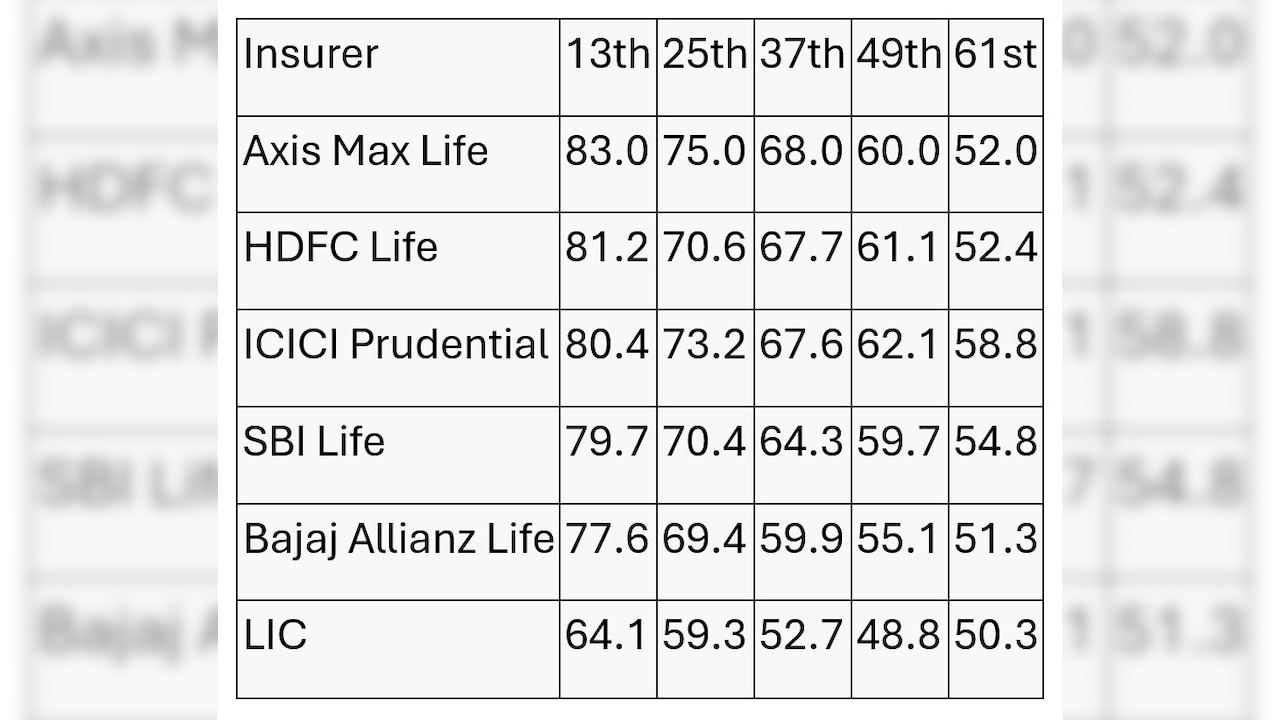
FY 2024-25 (%)
Among large insurers, LIC sits at the bottom of the table with only 64% of its policies persisting after year one and 50% after year five. While the regulator reports persistency by number of policies, insurers report persistency by premium amount. By premium, LIC reports 13th-month persistency of 74.8% for the year ended March 2025, almost 11 points above its by-count figure of 64.1%. The gap holds across every stage of the policy's life.
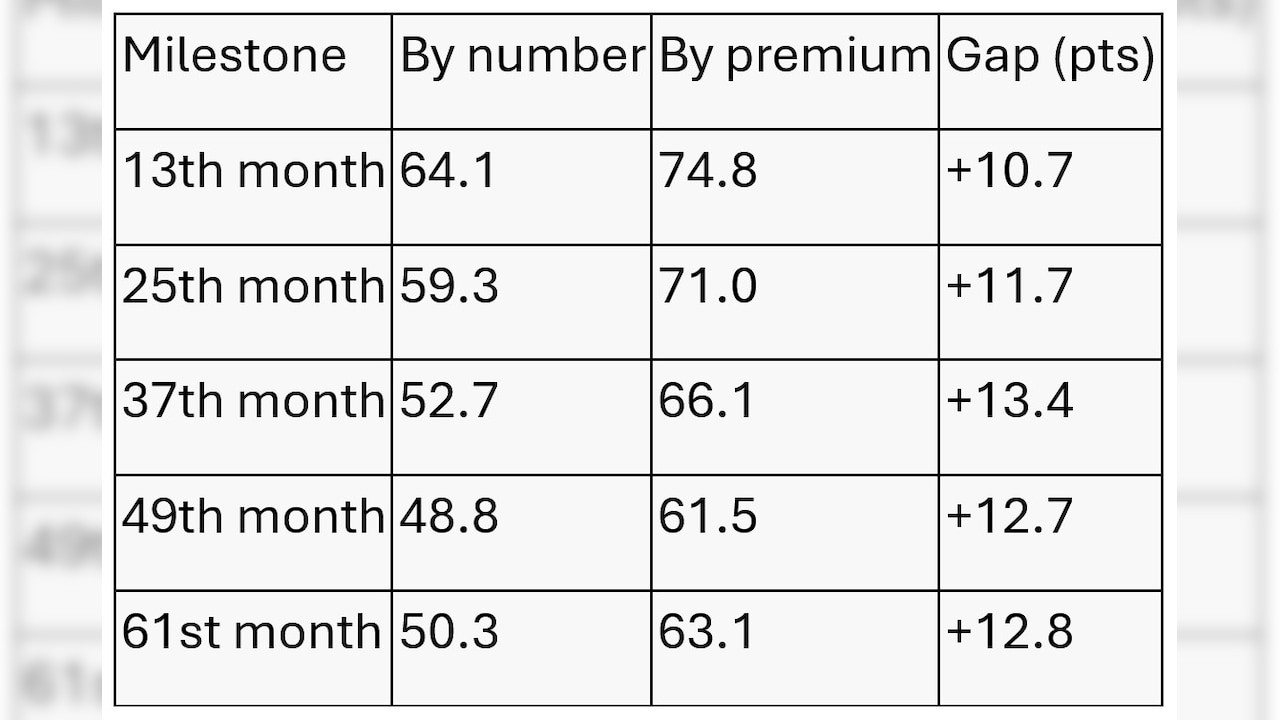
LIC persistency: by number of policies vs by premium, FY 2024-25 (%)
By number: IRDAI Handbook 2024-25. By premium: LIC Form L-22, year ended 31 March 2025 (regular/limited premium, individual business). That gap is a more interesting story. When the persistency by premium is more flattering than persistency by number of policies, the policies lapsing are likely the smaller ticket ones. These are typically the mass-market savers, who buy modest endowment and money-back plans from LIC's army of 14 lakh agents.
ALSO READ: Reading Between The Lines: FY26 Premium Data Shows The Insurance Industry's Shifting Dynamics
The gap is common across the industry. Premium-weighted persistency is generally higher than the by-count figure. But no insurer shows a gap close to LIC's, and none writes small-ticket business at its scale. The gap widens with time. At the 61st month, LIC's premium-basis persistency is 63.1%, against 50.3% by policy count, a difference of nearly 13 points. After five years, the small-policy leak has compounded.
As the regulator sharpens focus on how an insurance policy is sold, persistency numbers will be on its radar. Among other things, a policy that lapses in its first year or two often points to a product that did not fit the buyer. And, going by the analysis above, these lapses fall most heavily on small-ticket policyholders.
Ashok Hegde is the founder of Gyansurance.com, a term insurance education platform.
Disclaimer: The views expressed in this article are solely those of the author and do not necessarily reflect the opinion of NDTV Profit or its affiliates. Readers are advised to conduct their own research or consult a qualified professional before making any investment or business decisions. NDTV Profit does not guarantee the accuracy, completeness, or reliability of the information presented in this article.
-
Extracting Value From Battery Scrap Could Be Challenging For India | The Reason Why

A discarded lithium-ion battery still contains valuable materials such as lithium, nickel and cobalt. These can be recovered and reused. When such batteries are crushed and shredded, they produce a dark powder called black mass.
-
One El Nino, India Can Handle. Two Could Break The Granary
India's grain stocks can absorb one bad year, but a second El Nino could drain the buffer in two to three years, economists say.
-
India's Troika Of Good Luck | Joining The Dots
As Jensen Huang's exit drags Nvidia down, a cooling AI trade and resilient earnings have revived investor interest in India. A likely RBI rate hike looms.
-
Talking Points This Week: Leadership Shock At Nvidia, Earnings Strength, And The Fog Over Hormuz
The Anthropic IPO pricing and first trading day, Nvidia's upcoming earnings, and any fresh signals from Iran will set the tone for the following week.
-
Signature Play: The Classic Cocktail Is Dead. Or Is It?
Classic cocktails are disappearing from India's cocktail menus. But they're still being ordered, taught to bartenders and borrowed from. So, who's really having the last drink?
-
A New Samvat Wishlist: Inclusive Prosperity And Human Development
India has strengthened its economic foundations through infrastructure, digital access and enterprise. Its next growth chapter must deepen productivity, create better livelihoods and widen participation in prosperity.
-
Love, Sex Aur Dhokha: The Audacious Plot To Spy On Jensen Huang
A Taipei dinner, a Singapore chip buyer and a suspected Chinese asset: inside the alleged spy operation that got close to NVIDIA's Jensen Huang.
-
Ten Things I Learnt This Samvat
Patience can be a trap. Cheap stocks can stay cheap. Leverage can wipe you out. What did Samvat 2082 teach us? Niraj Shah writes on 10 lessons from the year gone by.
-
Talking Points This Week: Tech Nerves, FII Buying, And A Faraway Banking Shock
The global markets are not shining this Diwali. The exception in the large markets is, India.
-
Midterm Rally Lasted A Day. The Hard Reality Of A Divided US May Last Two Years | Opinion
Between a contested AI boom, a debt ceiling that arrives in 2027 and a president with every incentive to act alone, the next two years may prove more volatile than the first day's rally suggests.









