- Vishal Mega Marts' stock fell 35% despite 18.7% revenue growth in Q1 FY27
- Private labels made up 75.2% of revenue, aiding pricing control and margins
- Company operates 819 stores, with 10% same-store sales growth reported
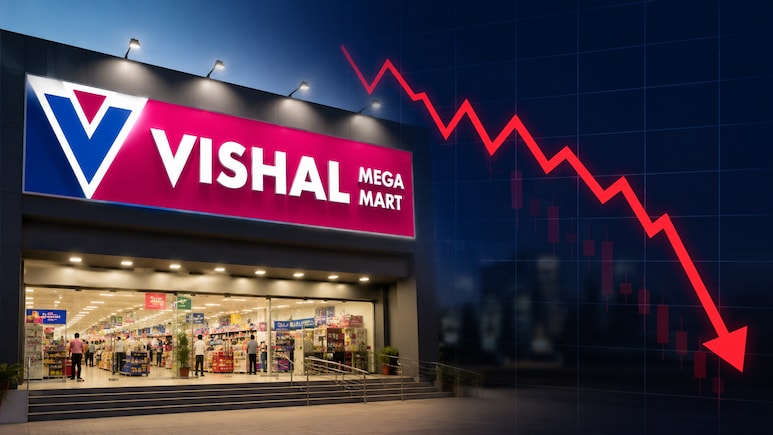
Vishal Mega Mart's business continues to grow, but its stock has moved in the opposite direction.
The retailer's shares have fallen 35% from their peak of Rs 158 and are trading close to their listing price of Rs 104. The decline has come despite revenue rising 18.7% year-on-year in the first quarter of FY27 and net profit increasing 26%.
The company's own brands accounted for 75.2% of revenue, same-store sales grew 10% and it continued to expand its store network.
Also Read | Layoffs Are Rising In Tech, But These Skills Are Helping People Unlock Better Pay
The gap between Vishal Mega Mart's operating performance and its share price points to concerns beyond quarterly earnings. Its private-label strategy, store expansion and quick-commerce network provide growth opportunities, but promoter selling, uncertainty over the ownership structure and the succession of its MD and CEO had been the key concerns for investors.
ALSO READ: VIP Industries Is Finally Turning Around. Can It Restore Margins And Market Share?
Sales Growth
Vishal Mega Mart operated 819 physical stores across 559 cities as of June 2026. Apparel remained its largest business, contributing 47.4% of revenue, or Rs 1,766 crore. General merchandise accounted for 27.3%, while FMCG contributed 25.2%.
Revenue from operations rose 18.7% year-on-year to Rs 3,727 crore in Q1FY27, supported by 10% same-store sales growth.
New customer acquisitions increased 7%-8%, while purchase volumes from existing customers rose 3%.
The company also reported higher profitability. Gross margin rose 30 basis points year-on-year to 28.7%. Operating EBITDA increased 19.3% to Rs 387 crore, while the margin expanded 10 basis points to 10.4%.
The smaller expansion in EBITDA margin reflected higher employee and operating costs.
Net profit rose 26% to Rs 259 crore, while the net profit margin expanded 30 basis points to 6.9%. However, other income increased 94.9% to Rs 33 crore from Rs 17 crore.
Excluding this increase, net profit grew about 18%, indicating that underlying earnings growth was lower than the reported figure.
ALSO READ: CleanMax's Amazon, Apple Link Is Growing. Can AI Keep The Momentum Going?
Private Labels
Own brands contributed 75.2% of Vishal Mega Mart's revenue during the quarter, with sales rising 18% to Rs 2,803 crore.
The company's private-label presence is highest in apparel, where own brands account for all revenue. Private labels account for 75% of general merchandise revenue and 60% of FMCG volumes.
The model gives Vishal Mega Mart greater control over pricing, sourcing and margins. When national brands raise prices, the gap between their products and the company's own brands can widen, potentially drawing customers towards lower-priced alternatives.
The company has a loyalty database of 17.5 crore customers, accounting for 95% of revenue and supporting repeat purchases.
This is particularly relevant for apparel, its largest revenue contributor, which reported same-store sales growth of 13.9% during the quarter.
Store Expansion
Vishal Mega Mart operates across 30 states and Union Territories and has 423 stores in Tier III markets.
South India contributed 23.4% of revenue, compared with 39.5% from North India and 28.5% from East India. South India was the company's fastest-growing region in Q1FY27, with revenue rising 33.5%.
The company opened 27 gross stores during the quarter, including 10 in South India, and added 24 net stores. It plans to add 105-115 net stores annually.
Vishal Mega Mart is also developing a smaller store format for towns where larger outlets may not be economically viable. These stores are about half the size of standard outlets, with 16 already operational.
Management estimates that the format could eventually support 3,000 stores across India. The smaller stores currently generate revenue per square foot and returns on capital similar to those of larger outlets.
If those levels continue, the format could extend the company's store network without weakening returns.
ALSO READ: Belrise Industries Has Multiple Growth Bets. Is The Market Pricing In Too Much?
Quick Commerce
Vishal Mega Mart's quick-commerce network has expanded to 767 stores across 520 cities and serves more than 1.4 crore users.
Quick commerce contributes 2%-9% of individual store revenue. Mature stores contribute more than 5%, while the top-performing locations contribute 9%-10%.
The average basket value remains around Rs 800, similar to offline stores.
The channel also brings new customers to the retailer. About 20% of quick-commerce customers are new to Vishal Mega Mart, making the platform an additional customer acquisition channel.
These trends support the company's operating growth. The stock's performance, however, reflects concerns outside its near-term financial numbers.
Promoter Selling
Promoter ownership fell to 40.1% in June 2026 from 54.2% in June 2025.
With the lock-in period expiring in July 2026, investors remain focused on the possibility of further promoter selling and the ownership structure after private equity investors exit.
"Uncertainty around promoter shareholding and ownership once the private equity investors fully exit continues to worry institutional investors," Motilal Oswal states.
Executive continuity is another concern. The market remains focused on the future of Vishal Mega Mart's long-standing MD and CEO, whose current term expires in June 2027.
ALSO READ: Shadowfax Has Over 50% Of Quick-Commerce 3PL Market. Can It Sustain The Growth?
Valuation Concerns
Vishal Mega Mart trades at a price-to-earnings multiple of 53.8 times, below Avenue Supermarts at 84 times and Baazar Style at 122 times.
However, its valuation remains broadly comparable with V-Mart at 46 times and V2 Retail at 49 times.
The stock's discount to some peers therefore reflects more than valuation alone. Promoter selling and uncertainty over the company's eventual ownership structure remain key concerns for investors.
However, one major overhang has now been resolved, with VMM extending the tenure of its MD and CEO for another five years through August 2031. This provides greater clarity on management continuity and removing the near-term uncertainty around succession.
The key question for the stock is whether its operating growth can offset the overhang from promoter selling and ownership uncertainty.
Disclaimer: The views expressed in this article are solely those of the author and do not necessarily reflect the opinion of NDTV Profit or its affiliates. Readers are advised to conduct their own research or consult a qualified professional before making any investment or business decisions. NDTV Profit does not guarantee the accuracy, completeness, or reliability of the information presented in this article.
Essential Business Intelligence, Sharp Market Insights, Practical Personal Finance Advice, Daily Fuel, Gold and Silver Prices and Latest Stories — On NDTV Profit.