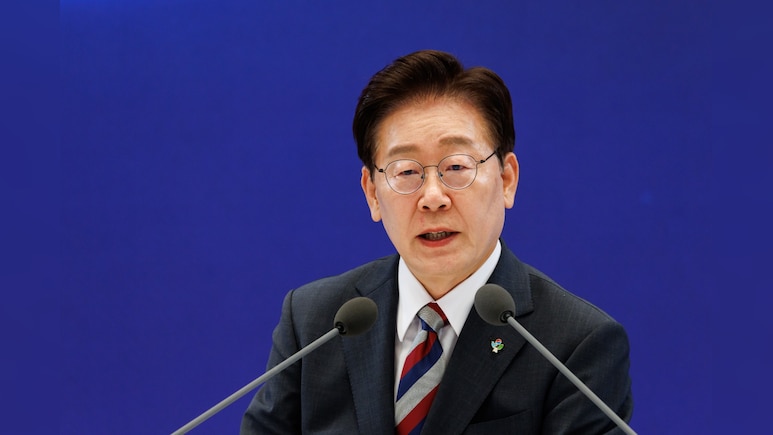
As South Korea's world-beating stock market surged in January, authorities saw a chance to attract more capital and bolster the won by offering high-risk products for notoriously adrenaline-loving retail investors. Now that gamble is backfiring on President Lee Jae Myung.
Alarm spread among top officials last week as the benchmark Kospi index plunged some 40% from its peak a month earlier, according to people familiar with the matter, who asked not to be identified discussing private talks. Stuck halfway around the world in South America as part of an 11-day diplomatic tour, Lee and much of his key staff watched and clambered for ways to stem the market meltdown from afar.
The heads of the country's two top regulators both canceled planned vacations, while Finance Minister Koo Yun Cheol apologized to irate lawmakers before calling an emergency meeting of key economic policymakers on Wednesday. The late-night gathering included a top representative from the presidential office, an unusual development that underscored how seriously the Blue House was taking the situation, one of the people said.
Also Read | Layoffs Are Rising In Tech, But These Skills Are Helping People Unlock Better Pay
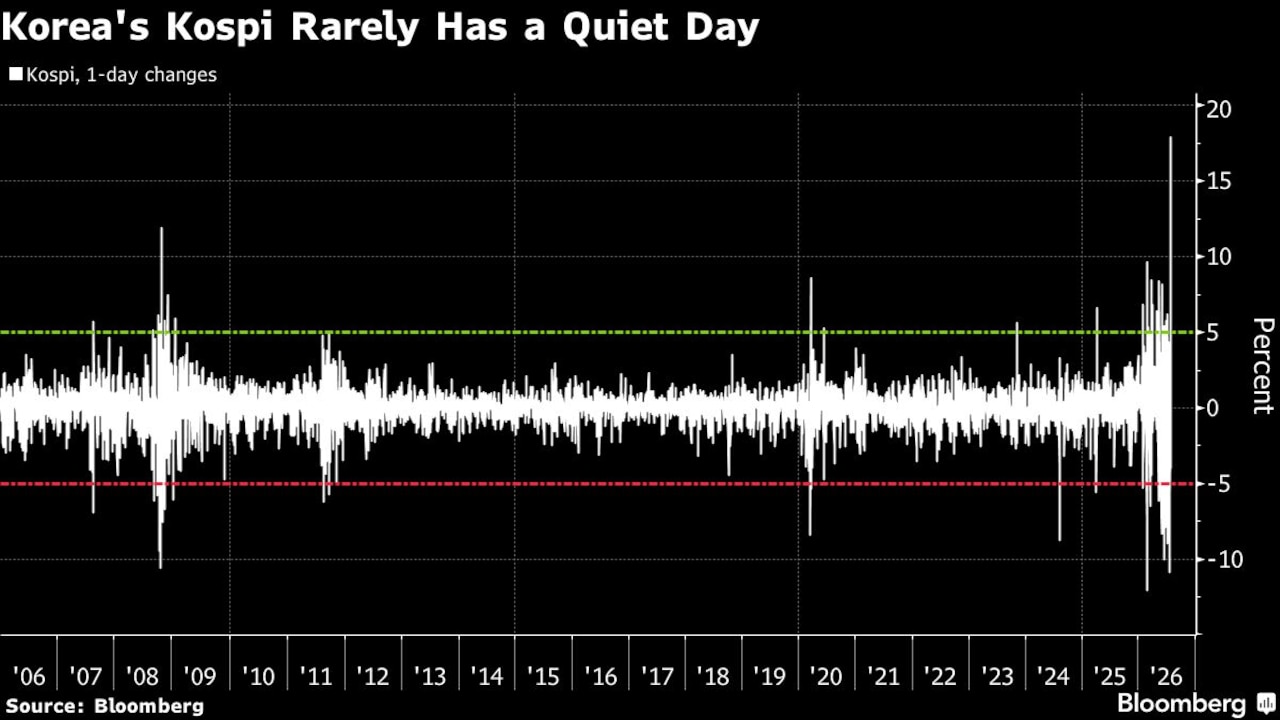
At the meeting, which was first delayed and then overran, officials including Bank of Korea Governor Shin Hyun Song hashed out an urgent response to the volatility. The Finance Ministry followed through with a slew of measures to curb retail investments in leveraged exchange-traded funds, helping the market to soar almost 18% on Friday - its biggest gain ever.
Yet even if the market stabilized, at least for a day, the political fallout appears to be just beginning.
"The damage has been done," said Kim Dong Woo, a 33-year-old retail investor who blamed the government for failing to act fast enough. "There are so many victims."
South Korea's equity market is easily the top performer this year among the world's biggest economies, rising more than 50% as of Monday morning. That's due in large part to a global AI boom fueling demand for memory chips from SK Hynix Inc. and Samsung Electronics Co., which together account for more than half of the Kospi's market value.
But the index has also seen its most volatile year since trading began in the 1980s: The Kospi has gained or lost 5% or more on 32 occasions - roughly one in every four sessions, according to data compiled by Bloomberg.
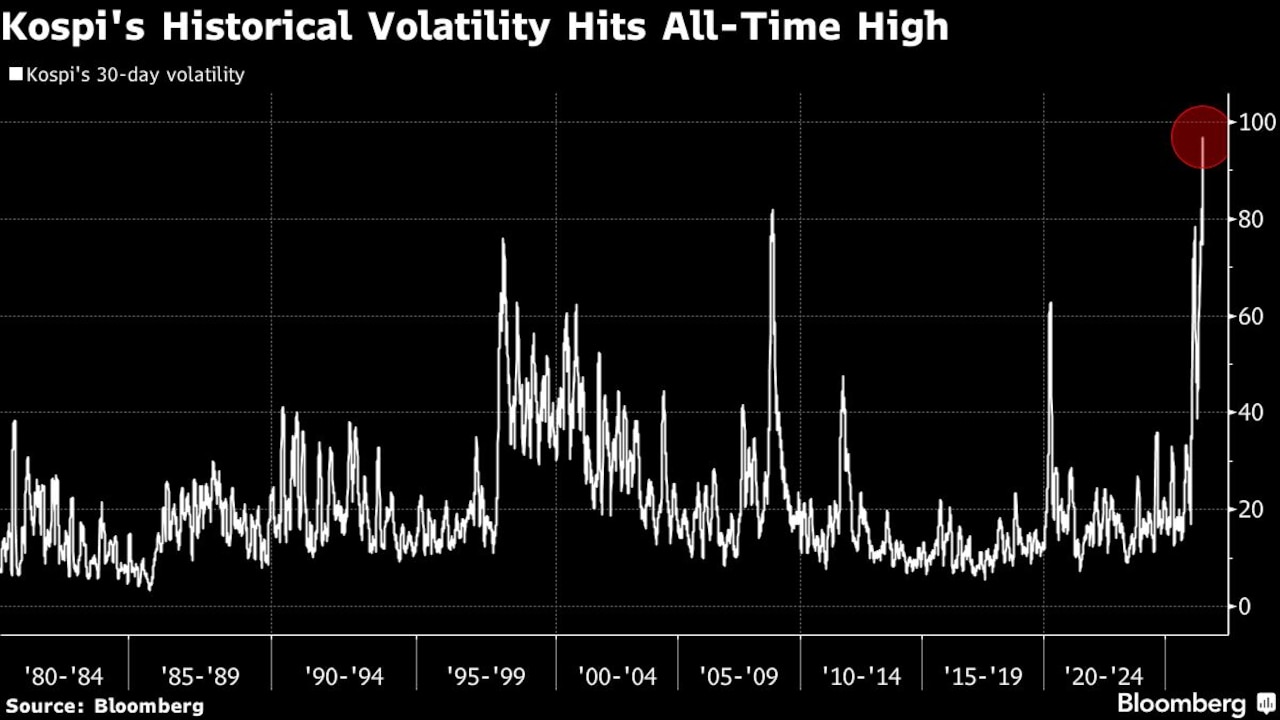
Those wild swings are what's now plaguing Lee, a former failed day trader who swept to power in 2025 with a bold pledge to boost the stock market past the 5,000 level, a milestone he quickly blew past in January. He's repeatedly encouraged Koreans to invest in equities instead of property, as part of a drive to ease pressure on Seoul's red-hot housing market.
While that worked for a while, things began to turn for the worse after authorities allowed the establishment of more than a dozen leveraged exchange-traded funds tracking Samsung and SK Hynix, a vehicle that uses derivatives and debt to amplify daily returns of underlying assets, typically by a factor of two. Usually only bought by professionals in much of the world, in South Korea they are owned mostly by retail investors. Together with the two chipmaker stocks they track, at one point this year they accounted for more than 70% of daily traded value.
"What is particularly ironic is that the government claims it is trying to contain the situation, yet it was the government itself that created this gambling table," said Jung Eui-jung, the 67-year-old head of the Korean Stockholders' Alliance, which has 64,000 members.
In response to questions, South Korea's presidential office said the leveraged ETFs were introduced to give investors more options and provide access to products that were previously only available overseas. A "period of heightened market volatility" that coincided with their launch made it necessary to implement measures to stabilize the market and protect investors, it added.
"The government has been closely monitoring market reaction and is preparing additional measures," Lee's office said in the statement. "The Blue House is aware of the market reaction and concerns and is making every effort."
Lee is just 14 months into a single five-year term, holds a comfortable majority in parliament and doesn't face any immediate elections. Still, any drop in popularity or a stock market plunge that impacts broader spending threatens to complicate his efforts to achieve ambitious revenue targets, boost social spending, increase regulation on big conglomerates and build infrastructure around a proposed new chip hub.
ALSO READ: South Korea Rolls Out F-1-D 'Workation' Visa: 3-Year Stay, Lower Income Bar For Youth
In angry parliamentary hearings last week as the market tanked, lawmakers from across party lines demanded answers as they sought to piece together what happened: did South Korea's rollout of leveraged ETFs outpace regulatory safeguards and put retail investors needlessly at risk?
Approving Leveraged ETFs
The hearings indicated that it all started in January, when Lee's top policy adviser, Kim Yong-beom, convened a meeting with heads of top securities firms. Growing retail investment in US stocks was seen as contributing to capital outflows and weighing on the won even as semiconductor exports generated record current-account surpluses.
The government had long been trying to redirect household savings away from property and overseas investments into the local capital market, and approving new leveraged ETFs formed part of that strategy. So by late May, after regulators fast-tracked the approval process, the first single-stock leveraged ETFs tied to Samsung Electronics and SK Hynix had launched on the domestic market.
"It was pushed through at an extraordinary pace," Park Soo-young, an opposition lawmaker from the People Power Party and member of the National Assembly's Strategy and Finance Committee, told Bloomberg News by phone. "This kind of speed wouldn't have been possible without direction from the presidential office."
Park argued that the controversy extends beyond the ETFs themselves. Governments should not set stock-market targets, he said, because doing so creates the perception that policymakers will continue supporting prices regardless of market conditions.
He also accused Lee's administration of becoming increasingly ambitious as the rally gathered pace, pointing to the leveraged ETFs and higher equity allocations by the National Pension Service as evidence that boosting the market had become a policy objective rather than simply developing capital markets.
"They pressed ahead despite negative feedback from asset managers, and without meaningful public discussions, launching the products about a week before the June local election," Park said. "They've turned South Korea's capital market into a giant casino bigger than Las Vegas."
'Blood Is on the Street'One person familiar with the deliberations told Bloomberg News that Lee's team had always been very cautious about publicly celebrating market performance, saying they were trying to keep their distance and avoid fanning the fire. Yet at a June 8 press briefing marking his first year in office, Lee dismissed the Kospi's retreat below 8,000 at the time as temporary, saying South Korean equities were still undervalued. Kim, his policy chief, struck an even more optimistic tone later in the month, predicting South Korea would become one of the world's three largest equity markets by market capitalization within two or three years. Even global investment banks including JPMorgan Chase & Co. and Goldman Sachs Group Inc. were bullish on South Korean stocks. Goldman raised its Kospi target to 9,000 in May, and a week later JP Morgan set the bull case to 10,000. "Politically, there was a case for introducing these products because of the currency issue, but it was also clear that just because such products exist in other countries did not mean they would necessarily work here," Lee Yoonsoo, professor of economics at Seoul National University, said by phone. "Even if there was nothing inherently wrong with the products themselves, failing to account for the Korean market's unique characteristics and the risks they could create leaves room to argue that it was a policy failure." Jung In Yun, chief executive officer at Fibonacci Asset Management Global in Singapore, put things more bluntly. "Always remember, Squid Game is the mentality of Koreans," he said, referring to the Netflix hit about a game in which contestants risk getting killed to win a life-changing fortune. "Literally, blood is on the street." |
(This story has not been edited by NDTV staff and is auto-generated from a syndicated feed.)
Essential Business Intelligence, Sharp Market Insights, Practical Personal Finance Advice, Daily Fuel, Gold and Silver Prices and Latest Stories — On NDTV Profit.