- State-run oil companies absorb crude costs as global oil exceeds $105 a barrel
- Refiners earn strong margins from crude-to-fuel spread amid high crude prices
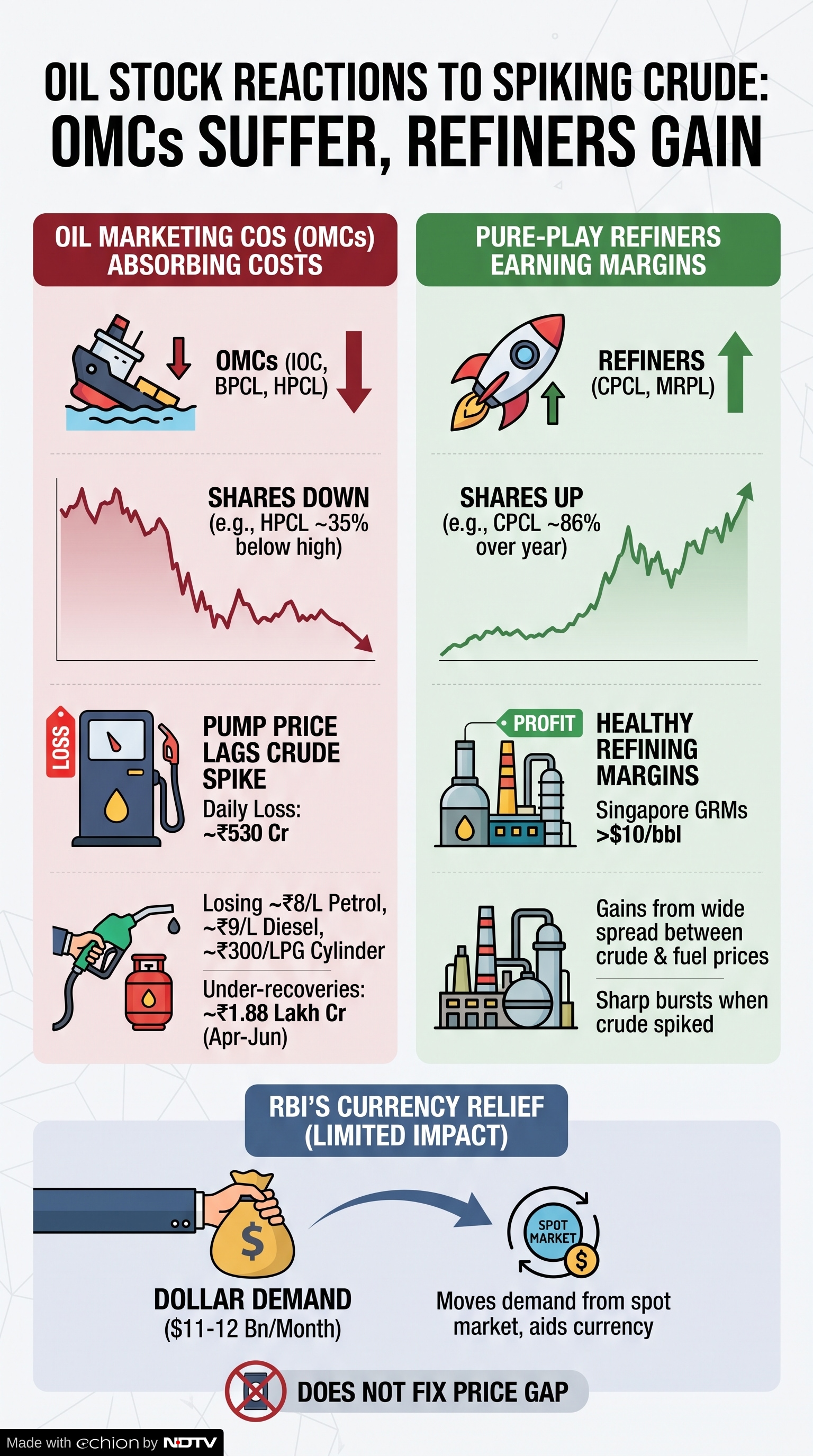
- OMCs face losses as pump prices lag behind sharply rising crude costs
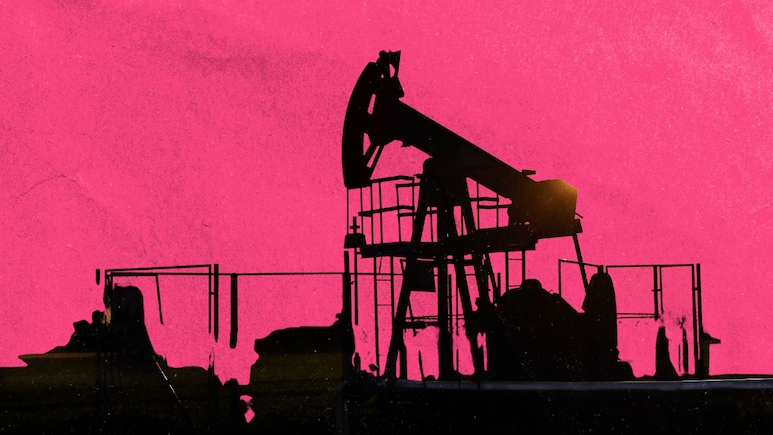
Not all oil stocks move the same way when crude spikes. With global crude back above $105 a barrel on Monday, state-run oil marketing companies (OMCs) are absorbing the cost of expensive crude, refiners are earning healthy margins on turning it into fuel, and upstream producers have limited room to benefit.
That is how WealthMills Securities' director for equity strategy, Kranthi Bathini, reads the sector. “OMCs will stay under pressure until crude is elevated,” he told NDTV Profit. “The refining industry is in a sweet spot, while exploration companies have limited space.”
Monday's trade was messier than that script. The Sensex fell 548 points to 71,924.68 and the Nifty closed at 22,363.35, down 0.7%, even as the Nifty Smallcap 100 rose 1.42%. Hindustan Petroleum (HPCL) gained more than 2% intraday, after the RBI's dollar window for state-run oil companies took effect, while Reliance Industries touched a fresh 52-week low.
Also Read | Layoffs Are Rising In Tech, But These Skills Are Helping People Unlock Better Pay
Why OMCs Are Stuck
The problem for OMCs is simple: crude has risen far faster than the pump price. The Indian crude basket had hit $123 a barrel on September 24, against an average of about $66 in 2025-26, while domestic petrol and diesel prices had not been revised to match.
ICRA estimates that IOC, BPCL and HPCL were losing about Rs 8 a litre on petrol and Rs 9 a litre on diesel, with an under-recovery of roughly Rs 300 on each domestic LPG cylinder. It put the combined daily loss at about Rs 530 crore.
The damage has been large. Under-recoveries came to Rs 1.88 lakh crore in April-June in quarter, as OMCs sold petrol, diesel and LPG below their cost.
The shares have tracked crude. HPCL, BPCL and IOC were trading near all-time highs at the end of February, but they have corrected sharply since Brent surged from about $60 at the start of the year to a peak of $126.41 on April 30. HPCL is now about 35% below its 52-week high of Rs 508.45, IOC about 33% below its high of Rs 188.90 and BPCL about 27% below Rs 391.85.
The RBI's dollar window, which analysts estimate moves $11-12 billion of monthly dollar demand away from the spot market, adds some relief on the currency side. It does nothing about the gap between crude costs and pump prices.
ALSO READ: RBI Curbs May Support Rupee, But Oil Prices Remain A Risk: Nomura's Sonal Varma
Where Refiners Are In The Clear
Refiners earn from the spread between crude and the fuels they sell, and that spread has been wide. Singapore gross refining margins have stayed above $10 a barrel since the West Asia crisis began, as per ICRA.
Chennai Petroleum (CPCL) and Mangalore Refinery (MRPL), the pure-play standalone refiners, show how that has played out. CPCL has gained about 86% over the past year and about 33% in the last three months, which makes it one of the biggest winners in the oil complex while the fuel retailers have slid. MRPL has risen about 18% over the year and about 15% over three months, a smaller but steady gain over the same period.
Their gains have come in sharp bursts when crude spiked and margins widened, rather than in a steady climb. CPCL was already up about 69% for the year by August, and both stocks jumped again in early October as Brent pushed back above $100. Both have since given back part of that run, with CPCL down about 7% over the past month, so investors are not paying for the margin upside without question.
| Company | Type | 3-month | 1-year | From 52-wk high* |
|---|---|---|---|---|
| HPCL | OMC | −16.9% | −28.8% | −35% |
| IOC | OMC | −8.6% | −18.6% | −33% |
| BPCL | OMC | −6.8% | −16.3% | −27% |
| CPCL | Pure-play refiner | +32.6% | +86.4% | -12.1%. |
| MRPL | Pure-play refiner | +15.0% | +18.4% | -18.1% |
The sweet spot has limits. The government levies a special additional excise duty on diesel exports, which was cut to Rs 16 a litre from Rs 20 from October 1, according to a Central Excise notification.
Reliance is a reminder that not every refiner is a pure play. India's largest refiner closed at Rs 1,170.30 on Friday, down about 9.6% in a month and 13.2% in six months, and touched a fresh 52-week low on Monday. Its fortunes, however, are not tied to refining alone.
What To Watch
For OMCs, relief can come from only a few places: lower crude, a larger pump price increase, or the compensation they have asked for. Bathini said he is watching geopolitics, especially the Middle East, along with crude oil and the earnings season.
Until crude eases, the divide between refiners and fuel retailers is likely to hold, even if individual days do not follow the script.
ALSO READ: Three Packages, One Year, Rupee Still 4% Weaker: Can RBI's Hedging Curbs Break The Pattern?
Essential Business Intelligence, Sharp Market Insights, Practical Personal Finance Advice, Daily Fuel, Gold and Silver Prices and Latest Stories — On NDTV Profit.