
- Indian markets fell sharply on Monday morning due to escalating Middle East tensions and risk aversion
- Nifty dropped over 400 points to below 22,700, marking its worst monthly decline since 2020
- All sectors traded lower, with Nifty Metal down over 3.5% and PSU Bank falling more than 3%
Indian markets were under heavy pressure in Monday's session as escalating tensions in the Middle East triggered a broad risk‑off move.
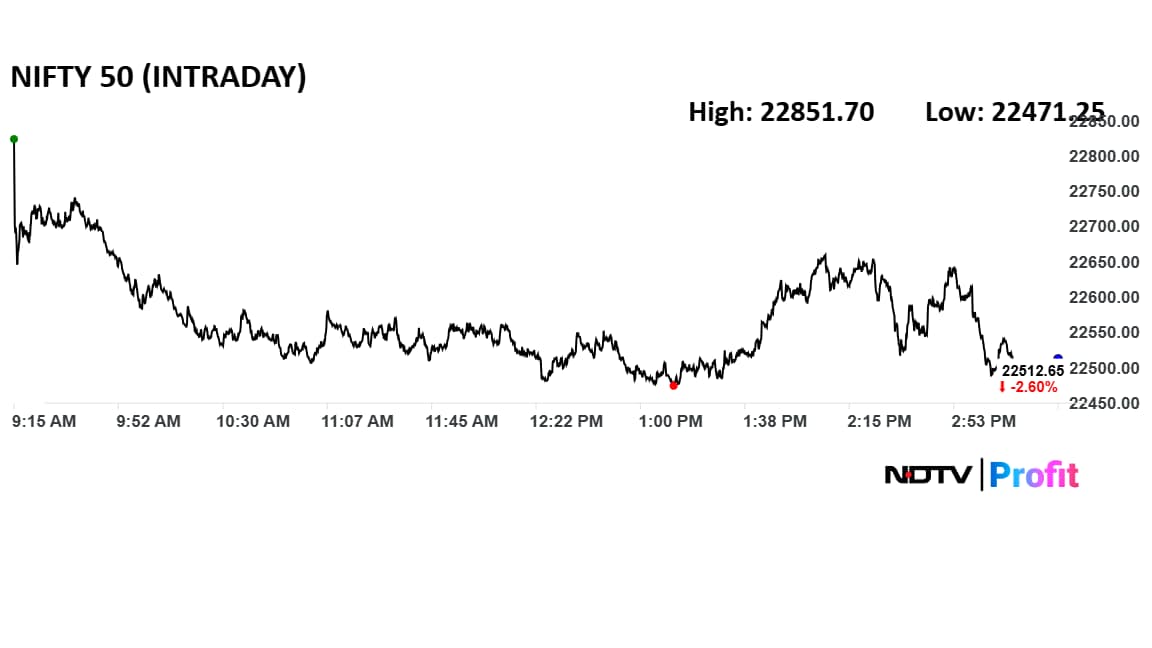
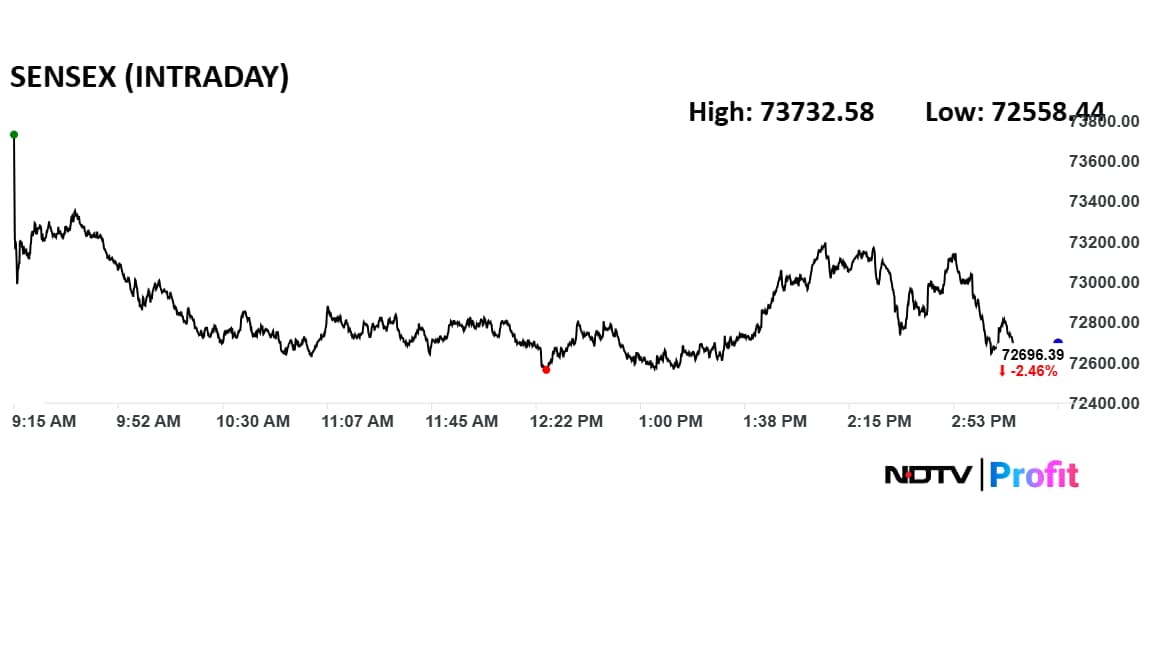
At 3:30 pm, the Nifty ended more than 600 points (down 2.60%) to below 22,512 while the Sensex dropped over 1,800 points (down 2.46%) to end at nearly 72,696.
The Nifty index slipped to its lowest level since April 9, 2025, extending a steep decline that has already seen it drop more than 10% in March alone. This marks its worst monthly performance since March 2020.
Also Read | Layoffs Are Rising In Tech, But These Skills Are Helping People Unlock Better Pay
With the latest fall, the benchmark is now down over 14%—or more than 3,700 points—from its all‑time high, underscoring the depth of the ongoing market correction.
In the Nifty 50, 30 stocks were down more than 20% from their historic highs, while 25 stocks were down more than 20% from their 52-week highs. In the Nifty 500, 421 stocks were down more than 20% from their historic highs and 317 stocks were down more than 20% from their 52-week highs.
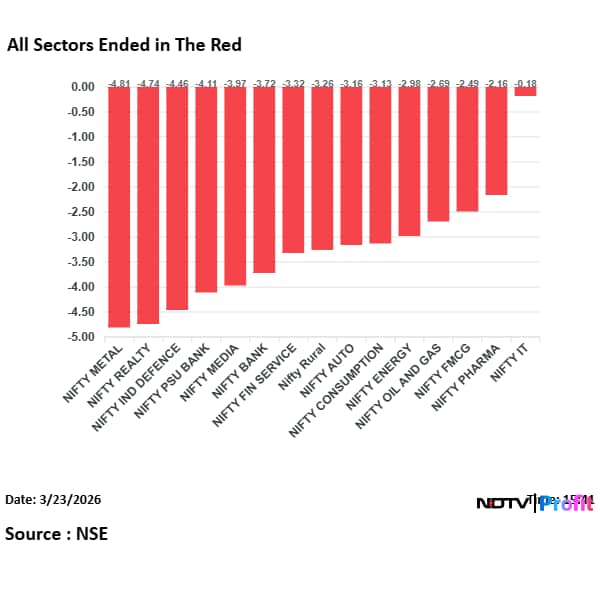
All sectors ended in the red, with Nifty Metal and Realty falling the most by over 4.5%, followed by Defence, and PSU Bank plunging by over 4%.
The broader market faced even more pressure, with the Nifty Smallcap 250 falling almost 3.78%, and the Nifty Midcap 150 dropping about 3.86%.
Here are three key reasons dragging the markets on Monday.
Middle East Tensions
Monday marked the 24th day of the ongoing hostilities involving the US, Israel, and Iran, with no signs of tensions easing on any side. The conflict, which began on February 28, has continued to escalate despite US President Donald Trump stating last week that he was considering scaling back operations. So far, the fighting has claimed more than 2,000 lives, unsettled global markets, and driven a sharp rise in oil prices.
Oil prices showed limited movement today despite heightened geopolitical rhetoric, as traders weighed fresh threats around the Strait of Hormuz. Brent crude hovered just below $112 per barrel, while US benchmark WTI remained near $98, reflecting a market that is alert-but not panicked.
ALSO READ: Brent Crude Holds Steady At $112 As Hormuz Tensions Escalate With Trump's Ultimatum
The rupee opened at a fresh record low of 93.83 against the US dollar, slipping 12 paise at the start of Monday's session. The currency continued to weaken in early trade, declining further by 13 paise to touch 93.84, extending its downward trajectory amid persistent pressure.
The yellow metal rate on India's MCX plunged nearly 5% on Monday, March 23, amid ongoing geopolitical tensions. At 9:01 am on Monday, the MCX gold April futures contract fell 4.98% to Rs 1,37,399 per 10 grams, while MCX silver May futures contract dropped 5.95% to Rs 2,13,290 per kg.
ALSO READ: Gold Price Today: Yellow Metal Tumbles 5% On MCX Amid Geopolitical Tensions
FPI Selling
The recent correction in Indian stocks have been aggravated by relentless selling by foreign portfolio investors. The FPIs have been net sellers for the last 16 sessions, offloading shares worth Rs 1 lakh crore between Feb. 25 and March 20.
During this period, the blue-chip Nifty 50 and BSE Sensex have declined 9% and 9.5%, respectively. Buying from domestic institutional investors over the last 18 consecutive sessions have lent some support to the markets.
READ MORE: Market Crash: FPIs Withdraw Rs 1 Lakh Crore In 16 Sessions — Key Reasons
Global Cues
Asian equities extended their decline, with South Korea's Kospi tumbling 5.8%, Japan's Nikkei 225 sliding 3.5%, Hong Kong's Hang Seng dropping 3.4%, China's Shanghai Composite slipping 2.5%, and Australia's ASX 200 easing 0.8%. Japan's broader Topix index also fell sharply, losing 4.4%, while South Korea's Kosdaq retreated nearly 5%.
Trading in South Korea was temporarily halted after Kospi 200 futures plunged more than 5%, triggering circuit‑breaker rules.
Asian equities declined for a third straight session and were on the brink of a correction, while bond markets also weakened as investors grew worried that the prolonged conflict could fuel inflation, dampen economic growth, and potentially force central banks to revisit rate‑hike options. Futures pointed to continued losses in Europe and the US.
Global financial markets have been shaken by the Middle East turmoil, with both stocks and bonds slipping last week as concerns over rising prices and slowing growth mounted. Policymakers are feeling the pressure as well, with Federal Reserve Chair Jerome Powell noting that the central bank needs clearer evidence of cooling inflation before considering further rate cuts.
Gaurav Udani, Founder - Thincredblu Securities, says, "Nifty witnessed a sharp sell-off today, closing at 22,500, down nearly 600 points, reflecting continued risk-off sentiment across markets. The intensity of the decline suggests that selling pressure remains dominant, with participants reducing exposure amid heightened uncertainty."
He added that, "From a technical perspective, the index is now approaching the 22,200–22,000 support zone, which could act as the next important demand area. However, the current structure indicates that any pullbacks may face resistance as confidence remains fragile. Market behaviour at this stage is being driven more by sentiment than fundamentals, and sharp moves in either direction cannot be ruled out."
Get the latest updates from our market coverage here.
Essential Business Intelligence, Sharp Market Insights, Practical Personal Finance Advice, Daily Fuel, Gold and Silver Prices and Latest Stories — On NDTV Profit.