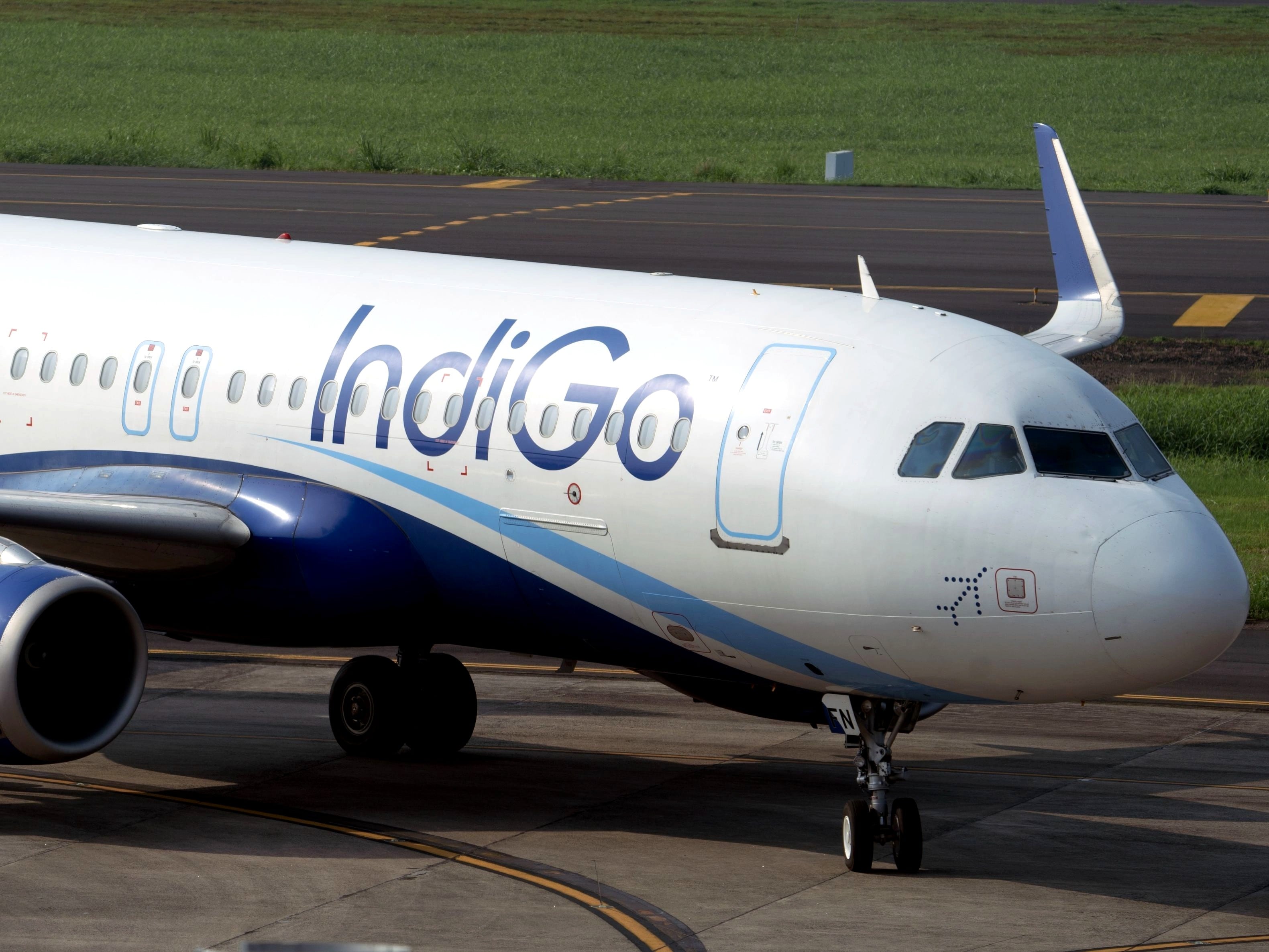
Shares of Interglobe Aviation Ltd. hit a 52-week high on Wednesday as brokerages expect Go First woes to benefit IndiGo in terms of market share, airfares, and fuel prices.
However, brokerages also flagged that supply will remain a key constraint amid robust demand following the insolvency of the low-cost carrier.
The market disruption caused by the shutdown of Go First's operation is likely to reduce the competitive intensity and could benefit air fares, especially amid the recent strong traffic trends seen in the Indian aviation sector, according to Jefferies.
Also Read | Layoffs Are Rising In Tech, But These Skills Are Helping People Unlock Better Pay
Macquarie Research expects near-term yields to be robust as 4% of the total operational capacity, which is 7% of the scheduled domestic capacity, will be grounded after Go First's insolvency. While Credit Suisse anticipates that lessors may be keen to allocate some of the Go First aircraft to Indigo within India itself, given the similar fleet type. This happened in favour of Spicejet when Jet Airways shut operations based on fleet type overlap.
Go First, in a statement on Tuesday, said that it was forced to file for bankruptcy proceedings as "defective and failing engines" by U.S. engine maker Pratt & Whitney had rendered 50% of its aircraft grounded, leading to a financial crunch.
"Pratt & Whitney is committed to the success of our airline customers, and we continue to prioritise delivery schedules for all customers," Pratt & Whitney said in a statement after Go First blamed the company for insolvency. "P&W is complying with the March 2023 arbitration ruling related to Go First. As this is now a matter of litigation, we will not comment further," it said.
Credit Suisse On IndiGo
Credit Suisse maintains an "outperform" rating with a target price of Rs 2,450 apiece, implying an 18.3% upside or downside risk from the current price.
Go First bankruptcy can benefit Indigo in terms of higher market share, stronger yields in a capacity-constrained environment, and increasing leverage with global OEMs of engines and planes.
As per the brokerage, lessors may be keen to allocate some of the Go First aircraft to IndiGo within India itself, given the similar fleet type.
Key downside risks to the brokerages' target price include lower-than-expected demand growth, a sharp rise in fuel prices, weaker-than-expected yields, and an aggressive stance by competition.
Upside risk, on the other hand, originates from a sharp crude price decline and a better-than-expected yield environment.
Macquarie On IndiGo
Maintains an "outperform" rating with a price target of Rs 2,600 apiece, implying a 28.6% upside or downside risk over the next 12 months.
As per the brokerage, incumbents could see further upside to yields near term in a supply-constrained environment with robust demand.
Interglobe Aviation along with Tata Group could account for nearly 80% of market share in medium term.
The airline had a 100% overlap with Go First with respect to destinations, thus, brokerage expects Air India and Vistara to benefit in the near term.
The Airbus A320 fleet that Go First operates is compatible with IndiGo, Vistara, Air Asia and Air India; however, given the ongoing concerns regarding Pratt and Whitney engine supplies; brokerage expects incumbents to look at very short-term leases.
Brokerage sees IndiGo's market share moving closer to 60%, temporarily, until clarity emerges on Go First.
Jefferies On Indian Aviation Space
Jefferies, in the long term, expects airlines to add capacity and avail the constrained slots vacated by Go First in key metros, to grab the market share.
The Indian Aviation sector is currently going through a purple patch, says Jefferies. This as strong demand trends and the changes in fuel prices are mildly turning from a headwind to a tailwind.
Brokerage anticipates that weaker players will sail and benefit from the Industry tailwinds. The Jefferies note also claims that it anticipated an event like the exit of a weaker player to unfold in within a 12-24 month period.
Go First exit would be a margin positive for the sector, as this would mean one less player in the market.
Shares of IndiGo rose 5.15% to Rs 2,173.95 apiece, compared to 0.40% decline in the benchmark NSE Nifty 50 as of 11:15 a.m. The stock rose as much as 8.20% intraday, the most since May 26, 2022. The stock hit a 52-week high to rise to Rs 2,236.95 apiece intraday.
The total traded volume so far in the day stood at 25.1 times its 30-day average. The relative strength index was at 84, implying that the stock may be overbought.
Out of the 27 analysts tracking the company, 22 maintain a 'buy' rating, three recommend a 'hold' and two suggest a 'sell' on the stock, according to Bloomberg data. The average 12-month consensus price target implies a potential upside of 10.6%.
Essential Business Intelligence, Sharp Market Insights, Practical Personal Finance Advice, Daily Fuel, Gold and Silver Prices and Latest Stories — On NDTV Profit.