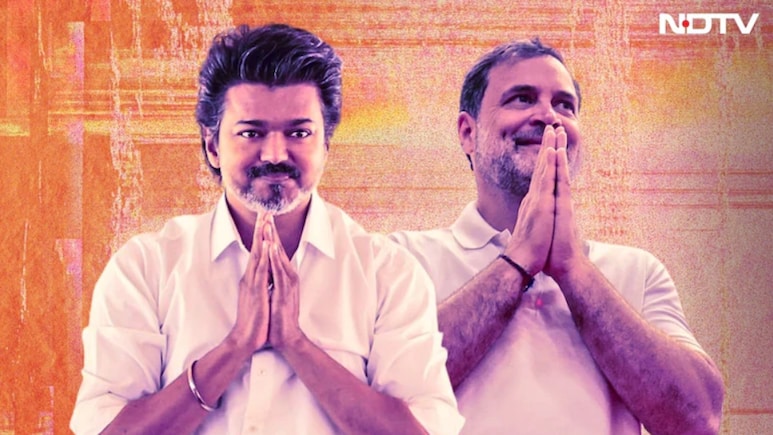
When Congress formally broke its decades-old alliance with the DMK on Wednesday to back actor-turned-politician Vijay's TVK in forming the Tamil Nadu government, many described it as a sudden, opportunistic pivot triggered by a hung assembly.
In reality, it was the culmination of years of accumulated grievances, careful back-channel diplomacy, and a calculated bet by Rahul Gandhi on the most unlikely political newcomer in recent Indian history.
Here is a full breakdown of how one of Indian politics' most durable state alliances came apart:
Also Read | Layoffs Are Rising In Tech, But These Skills Are Helping People Unlock Better Pay
The TVK- Congress Coalition
On May 6, AICC in-charge Girish Chodankar and General Secretary K.C. Venugopal formally announced the new alliance, founded on the principle of "shared responsibility."
The alliance is not merely a government-forming pact but a long-term electoral commitment extending to local body and future Lok Sabha contests. Congress pledged it would back TVK on one non-negotiable condition: that the party never maintain ties with the BJP.
The announcement sent shockwaves through Tamil Nadu's political establishment — the Congress-DMK alliance had been one of the most consistent electoral partnerships in the state's modern political history.
Why Did Congress Break With DMK?
The short answer, as per political analysts, is that the DMK stopped treating Congress as a partner and started treating it as a captive. The collapse of the alliance was driven by a deep-seated sense of suffocation among the Congress rank-and-file, who felt marginalised by the DMK's persistent "big brother" attitude.
From a strategic perspective, the partnership had become parasitic — Congress provided secular legitimacy while the DMK monopolised the machinery of power, preventing the national party from functioning as an independent entity.
With Tamil Nadu delivering a solid number of seats for the Congress-led alliance at the Centre in recent elections, the DMK began to feel that Congress had nowhere else to go and could therefore be kept away from power-sharing at the state level.
ALSO READ | TVK Chief Vijay Crosses Majority Mark, Meets Tamil Nadu Governor For Fourth Time To Form Government
The Rahul-Vijay Personal Equation
What made a Congress-TVK alliance possible was not just political arithmetic but an unusual personal relationship stretching back nearly two decades.
Congress MP Jothimani confirmed that Vijay had met Rahul Gandhi as far back as 2009 to discuss possibly joining the Congress party, though it did not happen then. That early connection, however, planted the seeds of a relationship that would quietly deepen over the years.
Congress MPs close to Rahul Gandhi — including Manickam Tagore and Praveen Chakravarty — were working behind the scenes to build ties with TVK even before the elections, reports said. In December 2025, Praveen Chakravarthy — considered a close aide of Rahul Gandhi — held a surprise one-to-one meeting with Vijay at the TVK office in Pattinapakkam. The meeting, which was not publicly announced, triggered intense political speculation at a time when Congress-DMK alliance talks were already underway.
TVK General Secretary Aadhav Arjuna had publicly confirmed the connection, saying: "Our leader and Rahul Gandhi share a good friendship. Rahul Gandhi spoke to our leader Vijay." He also noted that the Congress cadres in Tamil Nadu had already begun gravitating toward TVK: "You see, Rahul Gandhi, though campaigning in Tamil Nadu, is not with the DMK. Congress cadres are now with the TVK. They have moved."
The turning point came after the Karur stampede in September 2025, which claimed 41 lives, when Rahul Gandhi personally called Vijay to express condolences — a direct outreach that effectively bypassed the DMK leadership and established a high-level diplomatic channel with a rising rival.
Although Congress leaders publicly described the gesture as humanitarian, the context and timing — following Gandhi's call to then CM M.K. Stalin — raised eyebrows across political circles.
Rahul's subsequent refusal to share a dais with M.K. Stalin, whom he had previously termed his "elder brother", during the 2026 campaign served as the definitive electoral signal that the divorce was imminent.
After the results, Rahul Gandhi reportedly called Vijay directly to congratulate him and promised full support — with Kharge, Rahul Gandhi, and K.C. Venugopal later holding a meeting in Delhi to finalise the decision
What Does Each Side Gain?
The calculation is straightforward on both sides. For Congress, this synergy is the ability to finally join a ministry in Tamil Nadu for the first time in nearly six decades — a tangible incentive for their base. The ideological framework of this partnership invokes the glory days of K. Kamaraj, the social justice ideals of Thanthai Periyar, and the constitutional vision of Dr. B.R. Ambedkar.
With this arrangement, Congress will be in power in four out of five states in the south.
For Vijay, allying with Congress provides his fledgling TVK with immediate national visibility and a secular and progressive seal of approval. This partnership allows him to position himself as a national player, while Congress uses TVK's momentum to strengthen its roots ahead of the 2029 Lok Sabha elections.
ALSO READ | 'To Prevent President's Rule': VCK President On Why Party Extended Support To Vijay's TVK
The Bigger Picture
Tamil Nadu has now produced one of the most consequential political realignments in South India in recent memory.
A first-time party has won the most seats, dethroned both the DMK and the AIADMK, broken a 59-year Dravidian stranglehold, and assembled a working coalition in under four days.
With VCK, IUML, CPI and CPI(M) also backing Vijay, his coalition commands 120 seats in the 234-member house. Whether the coalition holds — and whether Vijay can govern as effectively as he campaigned — is the question Tamil Nadu now waits to have answered.
Essential Business Intelligence, Sharp Market Insights, Practical Personal Finance Advice, Daily Fuel, Gold and Silver Prices and Latest Stories — On NDTV Profit.