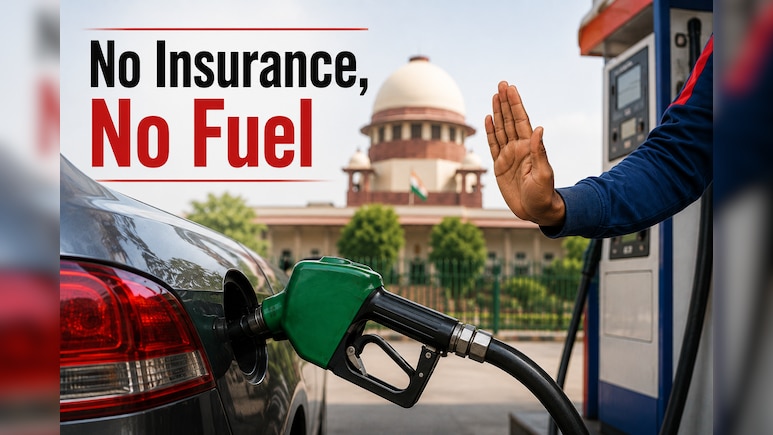
The Supreme Court has directed the insurance regulator to explore linking fuel sales at petrol pumps to valid vehicle insurance, as it moved to tackle what it called the "shocking" scale of uninsured vehicles on Indian roads.
A bench of Justices Sanjay Karol and Prashant Kumar Mishra, disposing of an appeal by National Insurance Co Ltd, said it was "shocking to learn that nearly 56% of vehicles plying on Indian roads remain uninsured", as per a Standing Committee on Finance report from December 2024, putting the absolute figure at 16.54 crore uninsured vehicles out of 30.48 crore registered nationwide.
The court noted 22% of road accidents involve uninsured vehicles, defeating the purpose of mandatory third-party cover under Section 146 of the Motor Vehicles Act and leaving accident victims without timely compensation.
Also Read | Layoffs Are Rising In Tech, But These Skills Are Helping People Unlock Better Pay
The bench directed the Insurance Regulatory and Development Authority (IRDA) and the road transport ministry to jointly develop a pilot project denying fuel to vehicles without valid insurance until the owner rectifies the lapse, noting the Ministry of Petroleum and Natural Gas had no objection in principle.
It also ordered that Automatic Number Plate Recognition cameras already deployed on highways be integrated with data from the Insurance Information Bureau and the VAHAN portal to issue automatic e-challans, and that state police be equipped with handheld devices or apps to verify insurance status on the spot.
ALSO READ: Supreme Court Orders Longer Third-Party Insurance: 4 Years For Cars, 6 Years For Two-Wheelers
Separately, the court extended the mandatory insurance period fixed in its 2018 ruling in S. Rajaseekaran v. Union of India, raising it from three to four years for new cars and from five to six years for new two-wheelers at the time of purchase or registration.
The underlying case involved a 1996 accident in Andhra Pradesh in which Ramu, a seafood trader, died after his car was struck by a lorry; the Tribunal had initially denied his family compensation, a decision the Telangana High Court overturned.
The Supreme Court upheld the High Court's ruling, holding the insurer liable under the comprehensive policy.
All stakeholders have been asked to file compliance affidavits by August 14, with the matter next listed on August 18.
ALSO READ: 'Prior Environmental Clearance Is The Rule': Supreme Court Says, Quashes Centre's 2021 Order
Essential Business Intelligence, Sharp Market Insights, Practical Personal Finance Advice, Daily Fuel, Gold and Silver Prices and Latest Stories — On NDTV Profit.