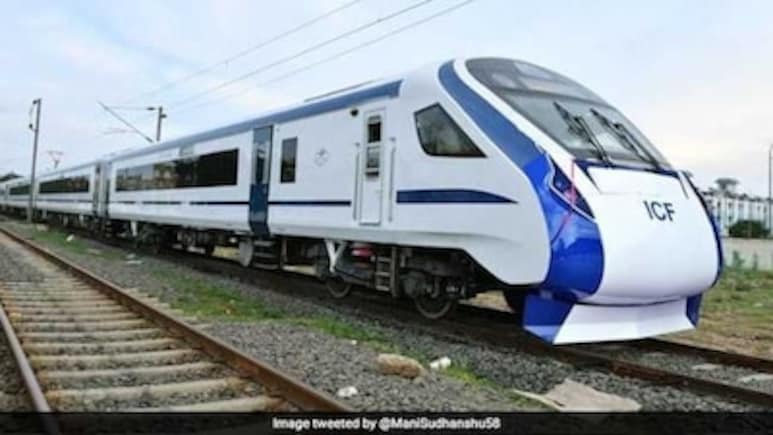
- Jammu and Srinagar will soon get direct Vande Bharat train connectivity starting April 30.
- The train is designed to operate in extreme sub-zero temperatures with advanced heating systems.
- It will reduce travel time and include stops at key stations like Katra and Bi
The Kashmir Valley is set to receive all-weather rail connectivity, as the Jammu-Srinagar Vande Bharat train—capable of operating even in sub-zero winter temperatures and snowy conditions—will start from April 30.
“From April 30, the Vande Bharat train will travel from Jammu, the winter capital of J&K, to Srinagar, the summer capital," news agencies reported a Railway official as saying.
Union Railways Minister Ashwini Vaishnaw is scheduled to flag off the first direct Vande Bharat Express between Jammu and Srinagar.
Also Read | Layoffs Are Rising In Tech, But These Skills Are Helping People Unlock Better Pay
Operating at speeds up to 160 km/h, the train will cover the 267-km journey in approximately 5 hours and 15 minutes. While previous trial services used 8-car rakes, this direct route is expected to feature an upgraded 20-coach rake to meet high demand. The service will include stops at Katra and Bijbehara.
Previously, it was commuting between Katra and Srinagar.
ALSO READ: Ashwini Vaishnaw Announces New Train Ticket Rules, Tweaks Cancellation, Refund Charges
In a first for the national carrier, Indian Railways has deployed advanced self-regulating heating cables to ensure uninterrupted water supply in sub-zero conditions. The technology is being implemented primarily along the high-altitude stretches.
According to railway officials, these specialised cables are designed to prevent water pipelines from freezing, a common challenge in the Himalayan region during peak winter.
Officials confirmed that stainless steel covers have been installed to shield pneumatic valves located near water tanks. These covers act as a critical defense against "ballast flying."
To combat the challenge of water freezing in sub-zero temperatures, officials have implemented a multi-layered heating strategy for the train's plumbing. Powerful 1800W silicon heating pads have been fitted directly onto the water tanks to maintain a consistent temperature.
Special heating arrangements have been extended to the bio-vacuum toilets and auxiliary tanks. This ensures that the sanitation and waste disposal systems remain fully functional.
The driver's cabin features a main windshield with embedded heating elements for clear visibility.
Essential Business Intelligence, Sharp Market Insights, Practical Personal Finance Advice, Daily Fuel, Gold and Silver Prices and Latest Stories — On NDTV Profit.