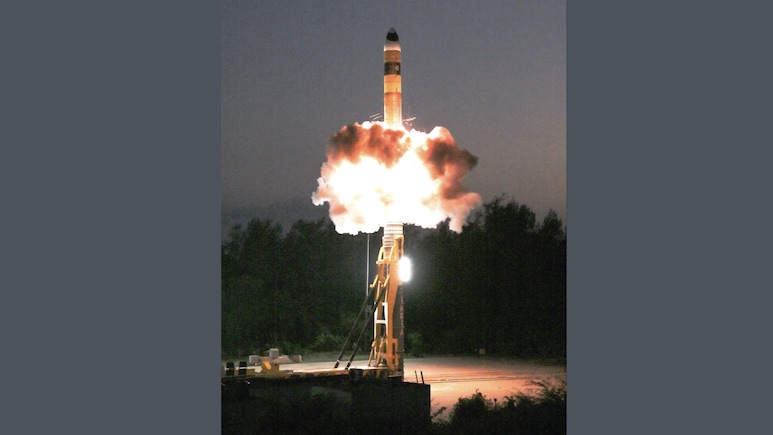
India successfully conducted a flight trial of an advanced Agni missile equipped with Multiple Independently Targeted Re-Entry Vehicle (MIRV) technology from Dr. APJ Abdul Kalam Island off the Odisha coast, the Ministry of Defence announced on Saturday.
The missile was flight-tested with multiple payloads targeted at different locations spatially distributed over a large geographical area in the Indian Ocean Region, with flight data confirming that all mission objectives were met. Defence Minister Rajnath Singh praised DRDO, the Indian Army, and Industry for the achievement.
ALSO READ | Labour Reforms: Government Fully Operationalises Four New Codes By Publishing Rules
Also Read | Layoffs Are Rising In Tech, But These Skills Are Helping People Unlock Better Pay
Advanced Agni missile with MIRV (Multiple Independently Targeted Re-Entry Vehicle) system was successfully tested from Dr. APJ Abdul Kalam Island, Odisha on 08th May 2026.
— DRDO (@DRDO_India) May 9, 2026
The missile was flight tested with Multiple payloads, targeted to different targets spatially distributed… pic.twitter.com/W7ufT7pwbt
Key Features of the Trial
- The missile was tested with multiple payloads, each targeted at a different location spread across a large geographical area in the Indian Ocean Region.
- Telemetry and tracking were carried out by multiple ground and ship-based stations, which tracked the entire missile trajectory from lift-off to the impact of all payloads.
- The test incorporated a Hypersonic Glide Vehicle payload along with MIRV technologies — marking the first integration of the two systems on an ICBM (Inter- Continental Ballistic Missile) range platform.
- The trial was witnessed by senior scientists of DRDO and personnel of the Indian Army.
- The missile has been developed by DRDO laboratories with the support of industries across the country.
What MIRV Means
With this successful trial, India demonstrated the capability to target multiple strategic targets using a single missile system.
MIRV technology allows a single missile to deliver multiple nuclear warheads to separate targets. Missiles armed with MIRVs can release warheads at different speeds and directions, enabling them to strike targets as far apart as 1,500 kilometres.
The presence of multiple warheads and decoys can overwhelm ballistic missile defence systems — strengthening India's deterrence posture, particularly against China, which possesses BMD (Ballistic Missile Defense) capabilities.
Building on Earlier Milestones
In March 2024, India conducted its first flight test of Agni-5 with MIRV technology under 'Mission Divyastra', demonstrating a three-to-four warhead capacity with independently targeted warheads.
A user validation trial by the Strategic Forces Command followed on August 20, 2025. The Friday test incorporated a Hypersonic Glide Vehicle payload along with MIRV technologies — marking the first integration of the two systems on an ICBM-range platform.
Rajnath Singh's Reaction
Defence Minister Rajnath Singh complimented DRDO, the Indian Army, and Industry on the successful flight test, saying it "will add an incredible capability to the country's defence preparedness against the growing threat perceptions."
Essential Business Intelligence, Sharp Market Insights, Practical Personal Finance Advice, Daily Fuel, Gold and Silver Prices and Latest Stories — On NDTV Profit.