Government Allows 10 Central Agencies To Monitor, Decrypt Any Computer Data
A late-night order by India's Home Ministry that authorised 10 central agencies to intercept, monitor and decrypt all data contained in any computer triggered cries about possible state surveillance. The government later clarified that the law wasn't new and that it only had identified which agencies needed such powers. Moreover, they needed approval from a competent authority to do it.
The 10 agencies have been authorised “for the purpose of interception, monitoring and decryption of any information generated, transmitted, received or stored in any computer resource under Section 69 of the IT Act, 2000”, said the order passed late Thursday night by the cyber and information security division of the Union Home Ministry.
The powers to monitor data, under the IT (Procedure and Safeguards for Interception, Monitoring and Decryption of Information) Rules 2009, will be approved by the competent authority which is the Union home secretary for the central government and the chief secretary for the state government, the clarification issued today said.
The Union home secretary, according to an earlier order, is empowered to authorise or sanction the intelligence and security agencies for undertaking tapping and analysis of phone calls under the provisions of the Indian Telegraph Act.
The Friday night order also said the subscriber or service provider or any person in charge of the computer resource will be bound to extend all facilities and technical assistance to the agencies. Failing to do so will invite seven-year imprisonment and fine.
That led to a furore with activists and opposition leaders across social media calling it “unconstitutional” and “Orwellian”.
This is overbroad, has a chilling effect and is liable to be struck down in toto: still amazing how many government actions on online regulation have been straight up, ex-facie unconstitutional. https://t.co/nOhI8vA2Tx
December 21, 2018Opposition leaders called it an assault on fundamental rights. The Congress, CPI(M), Samajwadi Party, Rashtriya Janata Dal and Trinamool Congress said they will oppose it.
“From Modi Sarkar to stalker sarkar, clearly the string of losses has left the BJP government desperate for information,” the Congress said on its official Twitter handle.
“If anybody is going to monitor the computer, including your computer, that is the Orwellian state,” said senior Congress leader P Chidambaram. “George Orwell is around the corner. It is condemnable.”
Today's session of the Rajya Sabha had to be adjourned because of the uproar created due to the order. Finance Minister Arun Jaitley said in the upper house that the same order of authorisation has been repeated since 2009 and there is no cause for a concern. “You are making a mountain where a molehill does not exist.”
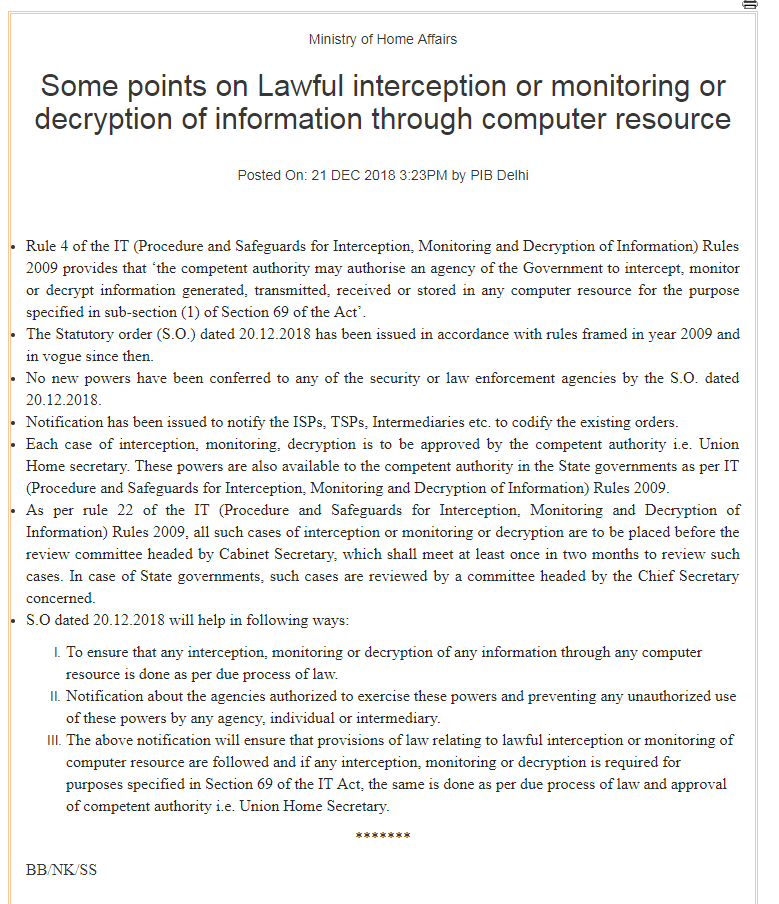
According to the government's clarification, the order posted last night was only issued to notify service providers to codify the existing orders, and it will help ensure that all monitoring and interception of any information is done as per the due process of law. The order, it said, would prevent unauthorised agency or individual from using it.
Here's the government's clarification

-
Signature Play: The Classic Cocktail Is Dead. Or Is It?

Classic cocktails are disappearing from India's cocktail menus. But they're still being ordered, taught to bartenders and borrowed from. So, who's really having the last drink?
-
A New Samvat Wishlist: Inclusive Prosperity And Human Development
India has strengthened its economic foundations through infrastructure, digital access and enterprise. Its next growth chapter must deepen productivity, create better livelihoods and widen participation in prosperity.
-
Love, Sex Aur Dhokha: The Audacious Plot To Spy On Jensen Huang
A Taipei dinner, a Singapore chip buyer and a suspected Chinese asset: inside the alleged spy operation that got close to NVIDIA's Jensen Huang.
-
Ten Things I Learnt This Samvat
Patience can be a trap. Cheap stocks can stay cheap. Leverage can wipe you out. What did Samvat 2082 teach us? Niraj Shah writes on 10 lessons from the year gone by.
-
Talking Points This Week: Tech Nerves, FII Buying, And A Faraway Banking Shock
The global markets are not shining this Diwali. The exception in the large markets is, India.
-
Midterm Rally Lasted A Day. The Hard Reality Of A Divided US May Last Two Years | Opinion
Between a contested AI boom, a debt ceiling that arrives in 2027 and a president with every incentive to act alone, the next two years may prove more volatile than the first day's rally suggests.
-
Blue Wave Will Derail the AI Trade but Won't Dismantle the AI Era | Unhedged Position
The Democrats' sweep of the US Congress will see politics collide with economic forces both over the long and short term.
-
It's Time To Take The GST Council's Bet On Trust Global
Payment records can prove India's services exports, and clear, proportionate rules can bring foreign digital sellers into the tax net.
-
Opinion | India at 38: From Innovation Overperformer to Innovation Powerhouse
India now has 453 VC-backed deep science startups, 18 of them late-stage, after 117 percent growth since 2020. Laurus Labs, at USD 9.3 billion, is the most valuable deep science company in any middle-income economy outside China.









