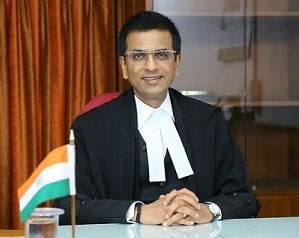
Chief Justice of India DY Chandrachud said all liberal democracies purport to protect the right to ‘free speech and expression'. However, what remains contested is the application of this principle to concrete situations, Justice Chandrachud said on Friday while delivering the 14th Justice VM Tarkunde Memorial Lecture on the topic 'Upholding Civil Liberties in the Digital Age: Privacy, Surveillance and Free Speech'.
When it comes to content moderation of online speech, there is a complex moral dilemma that arises in attempting to balance two key values: firstly, the upholding of freedom of expression and secondly, the prevention of harm caused by misinformation, he said.

-
 Indian Markets Turning Corner After Two Tough Years, Says Sandeep Tandon
-
 NDTV Profit Ignite 2026: Experts See Opportunity In Equities, Stay Bullish For Long-Term
-
 Buy Right, Sit Tight Does Not Work for Individual Stocks, Says Dinshaw Irani
-
 'Worst Is Behind': Quant MF Sees Market Bottom, Flags 'Extreme Euphoria' In Midcaps
-
 India's Mutual Fund Industry Could Become A $1 Trillion Opportunity, Say Fund Managers
-
 'Foreign Investors Are Baraatis': Raamdeo Agrawal's Take On LTCG Tax
-
 Stay Invested Through Market Cycles: Raamdeo Agrawal at NDTV Profit Ignite
-
 Ramesh Damani Remains Bullish On India For Next 20-30 Years, Sees Bargains Amid Market Weakness
-
 CAS Came After A Long Consultation Process: SEBI Chairman Tuhin Kanta Pandey AT NDTV PROFIT IGNITE
-
 Aim To Cut FPI Onboarding Time From Mth To Five Days: SEBI Chairman Tuhin Kanta Pandey AT NDTV PROFI
There has been a plethora of discussion in recent times about the consequences of disinformation, the need for a regulatory mechanism and the free-speech concerns raised by such legislation or policies, Chandrachud said.
Also Read | Layoffs Are Rising In Tech, But These Skills Are Helping People Unlock Better Pay
He said that most criticisms of global ‘anti-fake news' legislations are based on concerns that such legislations are over-broad and prone to misuse, thus, restricting legitimate speech as well.
Chandrachud explained that the theory of a ‘marketplace of ideas' has found its way into Indian jurisprudence. Broadly, this theory is based on the concept of friction-less exchange of ideas.
It postulates the concept that just like a free market of goods, where consumer demand helps the best products rise to the top, a democratic public sphere with the free exchange of ideas will let the best ideas prevail.
However, the CJI said that demonstrably false facts are not protected by traditional free speech theories.
Citing a study conducted by the Massachusetts Institute of Technology, which studied 126,000 false stories on social media, he said that it was found that false news spreads faster, deeper, and wider than the truth in all informational categories.
Simply by virtue of the scale of dissemination, fake news drowns out true information, replacing the character of discourse from truth-seeking to the loudest voice, he said.
Disinformation therefore has the power of impairing democratic discourse forever, pushing a marketplace of free ideas to the point of collapse under the immense weight of fake stories.
Traditionally, freedom of speech and expression was deemed to be an essential part of civil rights activism because of the fear that the government would prevent certain kinds of speech from entering the marketplace.CJI DY Chandrachud
However, he added that with the advent of troll armies and organised disinformation campaigns across different social media platforms, the fear is that there is an overwhelming barrage of speech that distorts the truth.
In this backdrop, CJI said that we cannot fall back on traditional notions of free speech and must find new theoretical frameworks to locate free speech on the internet.
Essential Business Intelligence, Sharp Market Insights, Practical Personal Finance Advice, Daily Fuel, Gold and Silver Prices and Latest Stories — On NDTV Profit.