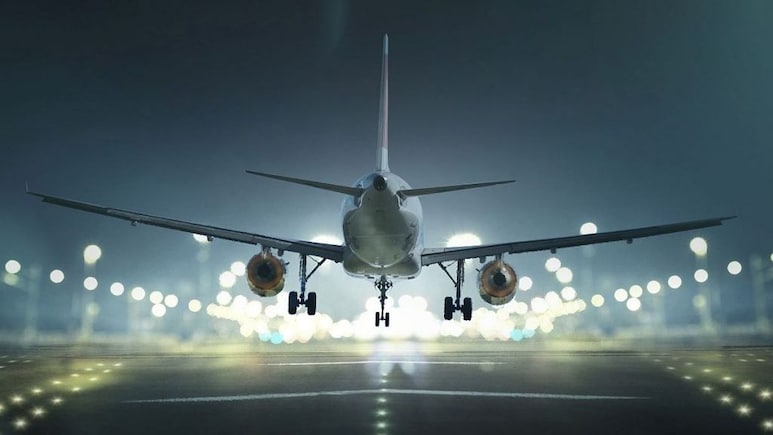
The Directorate General of Civil Aviation (DGCA) on Friday issued fresh guidelines for flight operations involving VIPs, and said that a twin-engine aircraft with a minimum of two crew and easy maintainability characteristics should be used.
The new guidelines have been issued nearly two months after the death of former Maharashtra Deputy Chief Minister Ajit Pawar in a plane crash at Baramati on January 28.
On February 24, the DGCA had announces eight new stringent safety mandates in view of increase in aviation accidents.
The guidelines, which replace the 1981 and 2014 safety circulars, state that it is mandatory to give pre-flight safety briefing to VIPs, and they should also be informed about aircraft capabilities.
The operator and flight crew shall carry out risk assessment before each flight in accordance with CAR Section 1 Series C Part I.
"The planning and conduct of the flight are professional responsibilities that must remain under the sound judgment of the flight crew and AMEs. They should be free from any external pressure or undue influence."
ALSO READ: DGCA Announces Eight New Stringent Safety Mandates Amid Rise In Aviation Accidents
The guideline says that crew and operators should ensure that the takeoff or descent path is free from obstacles and the airfield meets the performance criterion of operating aircraft.
"The flight crew shall ensure strict compliance with weather minima and proper weather briefing before commencement of flights as per existing regulations. Before commencement of flight, the Pilot in Command shall familiarize himself with the necessary meteorological information required for the intended flight."
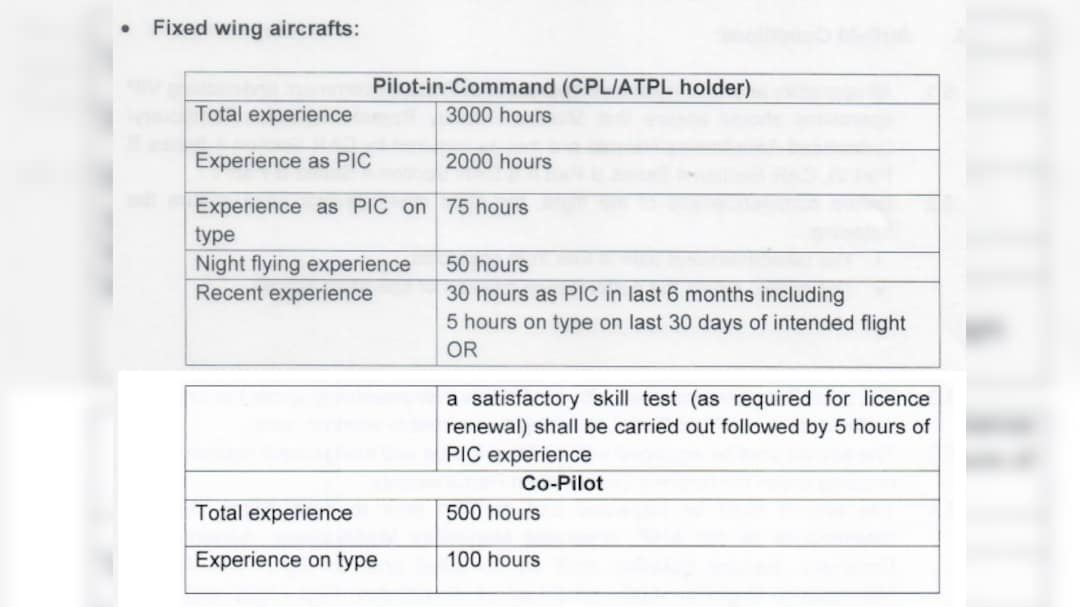
DGCA has also mndated that for fixed wing aircraft, the Pilot-in-Command must have 3,000 hours of experience, including 50 hours of night-time flying experience and 30 hours as PIC in the last six months.
The Co-pilot should have a total 500 hours of flying experience.
Whereas, for a helicopter, the Pilot-in-Command must have 2,000 hours of experience, including 10 hours of night-time flying experience.
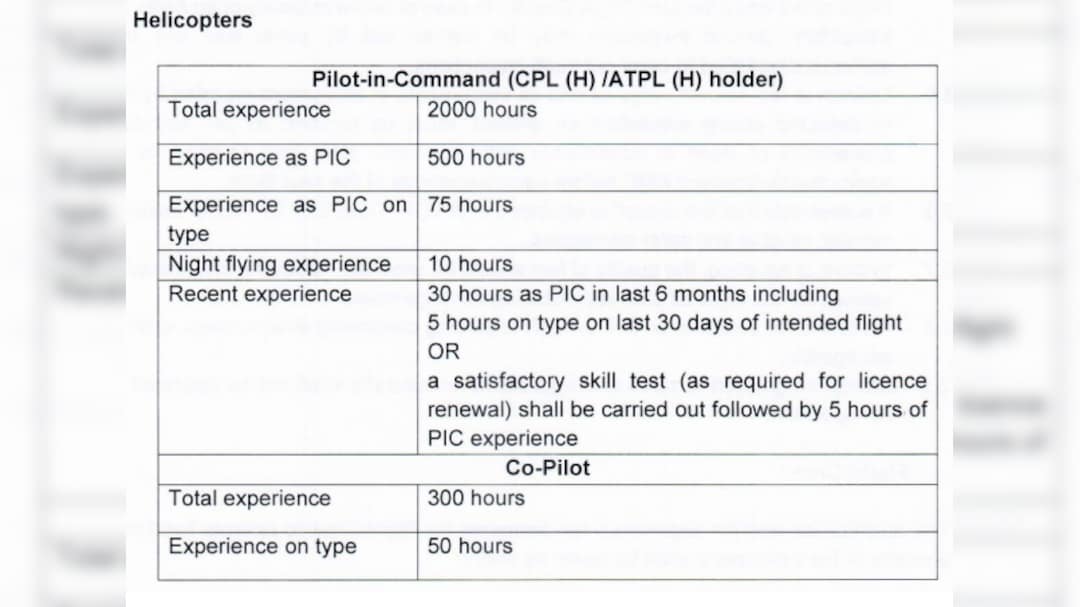
According to new rules, the flight crew shall either divert or carry out a precautionary landing in case of encountering bad weather during the flight.
"In case of flights over water-flooded areas and water bodies, the Pilot should ensure that an appropriate survival kit is available for each person on board and that, prior to commencement of such flight, the passengers are suitably briefed for proper use of the kits in the event of an emergency."
It has also been mandated that, prior to the flight, passengers should be briefed by the operating crew on safety aspects like fastening of seat belts, no smoking, evacuation procedures and 5 persons occupying seats near the Emergency exits or near the exit/entry doors, on operation of exits.
ALSO READ: Middle East Crisis: Pilots' Body ALPA India Seeks Centralised Risk Assessment For Flights, Crew
The aircraft must possess a Certificate of Airworthiness and a valid Airworthiness Review Certificate (ARC) and should be equipped with communication and navigational equipment and must be inspected and certified prior to such flight, say the new rules.
"Defects in the aircraft, engines and its instruments or equipment reported by PIC or detected during inspection on the ground, must be rectified as per approved procedures or dealt with in accordance with approved MEL and certified by an appropriately licensed AME before commencement of the next flight."
Guidelines for flying during Elections
- Operator/flight crew shall ensure that no unauthorized cash, arms, ammunitions, narcotics or illegal items are carried on board
- All regional offices in their respective jurisdiction where the elections are scheduled or underway shall conduct regular briefings with pilots, Aircraft Maintenance Engineer (AME).
Essential Business Intelligence, Continuous LIVE TV, Sharp Market Insights, Practical Personal Finance Advice and Latest Stories — On NDTV Profit.