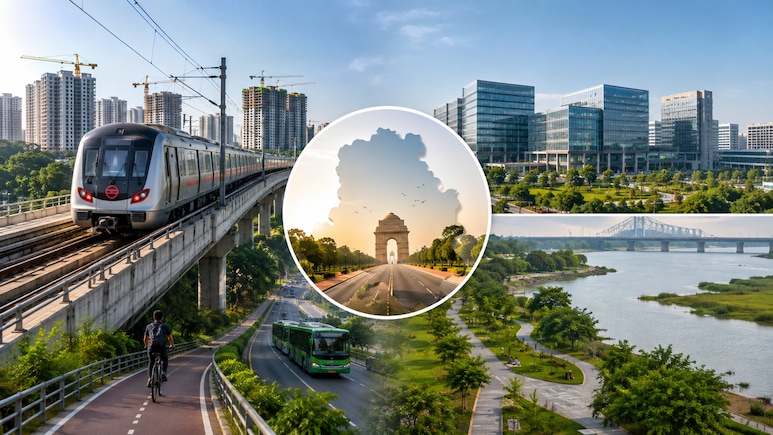
Delhi's long-term urban development is set for a major reset with the Master Plan for Delhi 2047 (MPD-2047), laying out a roadmap for housing, transport, infrastructure, economic growth and environmental sustainability.
The plan is designed to prepare the national capital for a projected population of around 32 million by 2047, while addressing growing demand for homes, mobility and civic infrastructure, according to NDTV.
If implemented as envisaged, MPD-2047 could reshape how Delhi grows over the next two decades, with greater emphasis on public transport, compact development, redevelopment of older areas and planned expansion in peripheral regions.
Also Read | Layoffs Are Rising In Tech, But These Skills Are Helping People Unlock Better Pay
ALSO READ | 40 Lakh Homes, Rental Units, And More: Delhi Master Plan 2047 Explained
Delhi To Need Nearly 4 Million More Homes
One of the biggest challenges addressed by MPD-2047 is Delhi's expected population growth. The plan estimates that the capital could require nearly 4 million additional housing units by 2047, taking into account population growth and changing household sizes.
Housing development is expected to come through a combination of redevelopment, greenfield projects, land pooling and transit-oriented development.
The plan also focuses on making better use of land that is already developed. Ageing residential buildings, underutilised plots and low-density areas could see redevelopment, subject to applicable planning and safety regulations, the NDTV report added.
It also supports the 'Jahan Jhuggi, Wahan Makaan' approach, which encourages the in-situ rehabilitation of slum residents, while unauthorised colonies could see planned improvements in roads, connectivity and civic infrastructure.
Metro, RRTS To Drive Future Growth
Public transport is at the heart of the proposed development strategy.
MPD-2047 gives a strong push to Transit-Oriented Development, promoting compact, mixed-use neighbourhoods around Metro and regional transit stations.
Delhi's existing Metro network of around 416 km could be expanded by another approximately 279 km, while a regional rapid transit network of around 383 km is envisaged to improve connectivity with centres including Ghaziabad, Meerut, Panipat, Karnal and Alwar.
The plan also prioritises buses, walking and cycling, with greater focus on last-mile connectivity and infrastructure for electric, hydrogen-powered and other low-emission vehicles.
New Growth And Economic Hubs
Land pooling and other planned-development models are expected to unlock new areas for housing, commercial activity and infrastructure.
The plan stresses that infrastructure should be developed alongside new growth areas, including roads, public transport, water supply, sewerage, drainage, electricity and digital connectivity.
MPD-2047 also envisages new commercial districts, industrial and logistics clusters and specialised economic zones to attract investment and generate employment.
Narela is set to receive a major push, including a proposed 138-hectare education hub for universities, research institutions, skill-development centres and startups.
Yamuna, Green Cover And Climate Resilience
Environmental sustainability is another major focus.
The plan seeks to create a more integrated green network by connecting parks, forests, biodiversity areas, green belts and ecological corridors. Delhi currently has around 22% green cover, which MPD-2047 aims to strengthen and improve.
The rejuvenation of the Yamuna floodplain, lakes, wetlands and drainage systems also forms part of the strategy. Greater tree-canopy cover, native vegetation and nature-based solutions are proposed to help reduce the urban heat-island effect and improve resilience to flooding and other climate-related challenges.
ALSO READ | DDA Residential Property Conversion Policy Under Review; Requests On Hold: Centre
AI, Heritage And The Bigger Picture
MPD-2047 also envisages the use of artificial intelligence, digital twins and data-driven systems to improve urban planning, development management and governance.
The plan also focuses on protecting Delhi's heritage through adaptive reuse of historic buildings, traditional markets and cultural circuits, while tourism and international-standard sports infrastructure are expected to support wider economic activity.
Ultimately, MPD-2047 goes beyond a traditional land-use framework, bringing together housing, transport, jobs, infrastructure, environmental protection and technology.
Its success, however, will depend on coordinated implementation by multiple agencies, including the DDA, Delhi government, MCD, NDMC, DMRC, NCRTC, Delhi Jal Board and DUSIB.
Essential Business Intelligence, Sharp Market Insights, Practical Personal Finance Advice, Daily Fuel, Gold and Silver Prices and Latest Stories — On NDTV Profit.