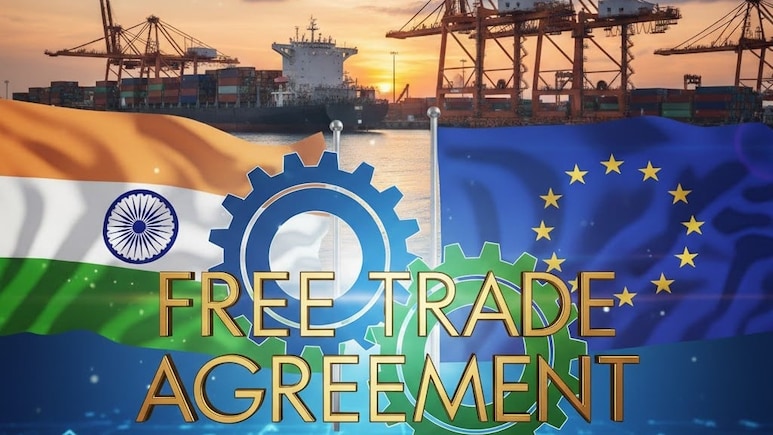
The European Union's Carbon Border Adjustment Mechanism (CBAM) will not see any exceptions despite the concluded India-EU Free Trade Agreement (FTA), but both sides have committed to technical discussions to find the best way forward, a senior German environment ministry official said.
Jochen Flasbarth, State Secretary in the German Federal Ministry for the Environment, Nature Conservation, Nuclear Safety and Consumer Protection, emphasised that the CBAM is not targeted against any specific country but serves as a necessary protective measure once carbon pricing is introduced domestically in the EU.
ALSO READ: Trouble Fermenting For Sula: FTA With EU Set To Shake Up India's Wine Market
Also Read | Layoffs Are Rising In Tech, But These Skills Are Helping People Unlock Better Pay
"CBAM is not against anyone. Once you introduce carbon pricing, you need to have some kind of protection," Flasbarth told PTI Videos on Wednesday during his ongoing visit to India, where he held discussions with officials from the Ministries of New and Renewable Energy, Power, and Environment, Forest and Climate Change.
"With the carbon pricing, we need to do something, and that is something we want to discuss. It is written in the free trade agreement that there will be technical discussions on how to do it in the best possible way. And of course, it's very clear we will not make exceptions for any other countries in the world. We would not follow the pressure of the US, for example, or others, so India can be sure there will be no exceptions," the secretary emphasised.
ALSO READ: $2 Trillion Opportunity: How FTA With EU Can Boost Indian Exports To Europe
The EU's CBAM, which entered its definitive financial phase in January 2026, imposes charges on embedded carbon emissions in imports of key sectors such as iron and steel, aluminium, and cement, among others. This has raised concerns in India, particularly for carbon-intensive exports like steel, which could face additional costs, potentially offsetting some tariff benefits from the FTA.
Flasbarth described the FTA as enormously important amid rising global trade barriers and a difficult geopolitical situation. He noted that while environment and climate issues are not the core of the agreement text, they remain central given the EU's commitment to climate neutrality.
"The Free Trade Agreement that was agreed...will have to be ratified soon. We also agreed to collaborate more in the field of carbon pricing and emission trading systems," Flasbarth said.
Flasbarth also stated that India and Germany will ratify a pact on critical minerals during the upcoming inter-governmental commission meeting.
"Critical minerals are extremely important for both countries. At the moment, both countries are dependent on one source, basically from China. And of course, it's in the interest of the two countries to get less dependent on one source," he said.
Sources indicate that the IGC between the two countries is likely to be held in June 2026.
(This story has not been edited by NDTV staff and is auto-generated from a syndicated feed.)
Essential Business Intelligence, Sharp Market Insights, Practical Personal Finance Advice, Daily Fuel, Gold and Silver Prices and Latest Stories — On NDTV Profit.