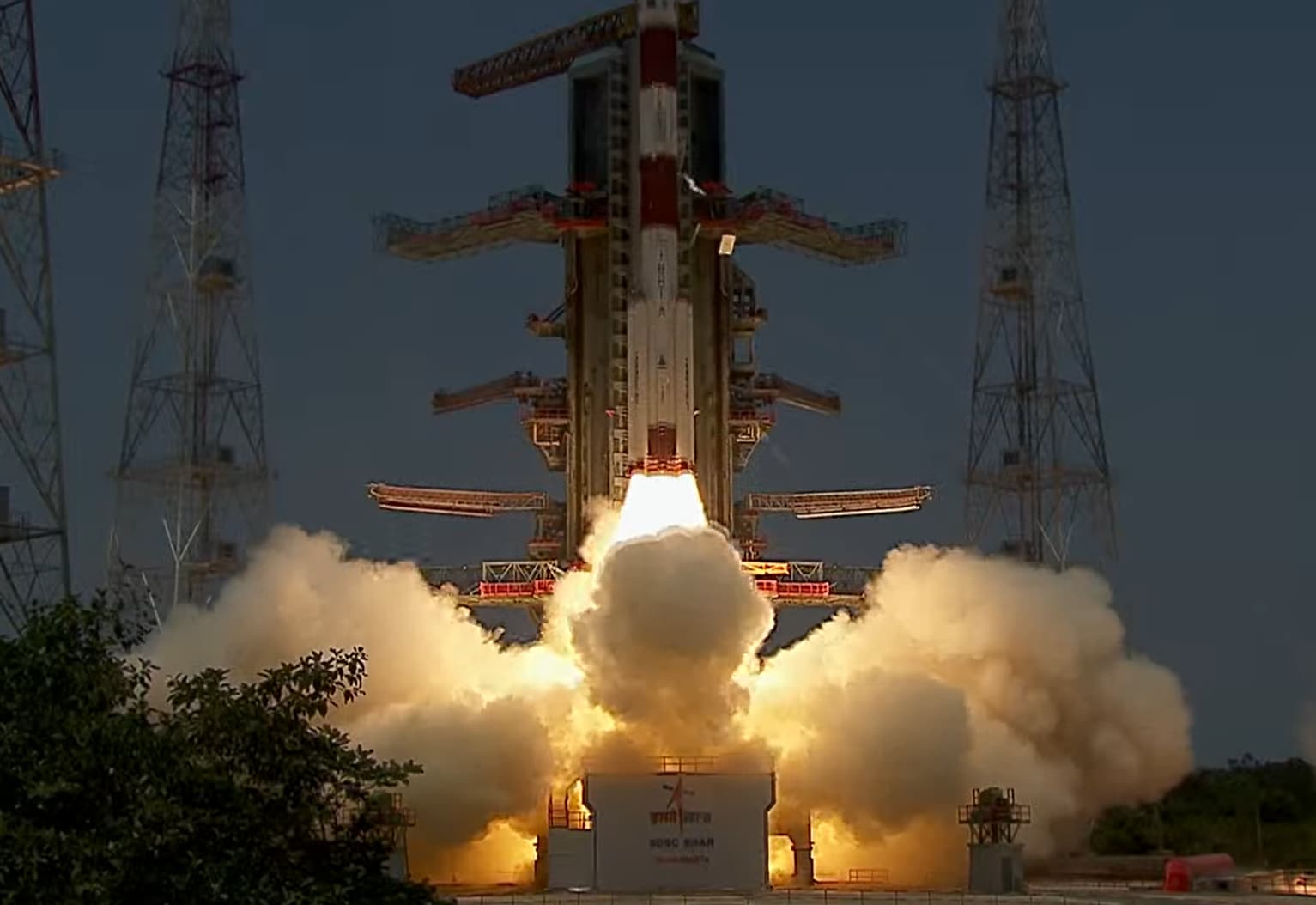
India's maiden solar mission Aditya L1 has been launched from Satish Dhawan Space Centre (SDSC) SHAR in Sriharikota, Andhra Pradesh on Saturday. The distance of 1.5 million km to L1 point will be covered in nearly four months (125 days).
The solar mission comes in less than a month since the successful soft landing of the Chandrayaan-3 lander and rover near the Moon's south pole, the first country to achieve the milestone.
PSLV-C57 launched the Aditya-L1 spacecraft in a highly eccentric Earth bound orbit. PSLV is considered as ISRO's workhorse when it comes to launching space missions.
Also Read | Layoffs Are Rising In Tech, But These Skills Are Helping People Unlock Better Pay
The spacecraft will perform orbital maneuvers by using its LAM to reach Sun-Earth Lagrange point L1.
View this post on InstagramAditya L1 will be placed in a halo orbit around the Lagrangian Point 1, which is 1.5 million km from the Earth in the direction of the Sun. It will revolve around the Sun with the same relative position and hence can see the Sun continuously.
For common understanding, L1 is a location in space where the gravitational forces of two celestial bodies, such as the Sun and Earth, are in equilibrium. This allows an object placed there to remain relatively stable with respect to both celestial bodies.
These points in space can be used by spacecraft to reduce fuel consumption needed to remain in position.
The Aditya L1 spacecraft carries seven payloads to observe the photosphere, chromosphere and the outermost layers of the Sun (the corona) using electromagnetic and particle and magnetic field detectors.
Using the special vantage point L1, four payloads will directly view the Sun and the remaining three payloads will carry out in-situ studies of particles and fields at the Lagrange point L1, thus providing important scientific studies of the propagatory effect of solar dynamics in the interplanetary medium.
The suits of Aditya L1 payloads are expected to provide most crucial information to understand the problem of coronal heating, coronal mass ejection, pre-flare and flare activities and their characteristics, dynamics of space weather, propagation of particle and fields etc.
Essential Business Intelligence, Sharp Market Insights, Practical Personal Finance Advice, Daily Fuel, Gold and Silver Prices and Latest Stories — On NDTV Profit.