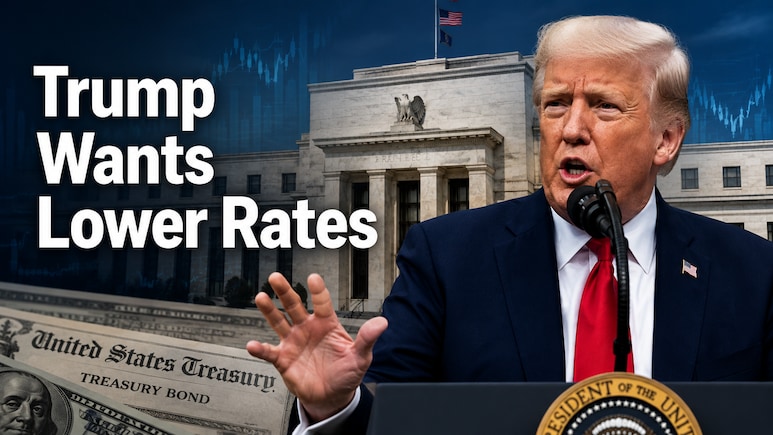
US President Donald Trump has renewed his criticism of the Federal Reserve, arguing that interest rates are too high and the country is paying too much to service its debt. As the US government is dealing with a rapidly rising interest bill, Trump pushes for lower interest rates; however, the Fed remains cautious because inflation is still above its 2% target.
According to the US Treasury, the US national debt stood at about $39.77 trillion through July 2026. Interest costs had reached $1.17 trillion in fiscal 2026 through July, accounting for around 19% of total federal spending.
This is why Trump's argument holds ground, as even a modest reduction in borrowing costs could eventually lower the government's interest burden as existing debt is refinanced.
Also Read | Layoffs Are Rising In Tech, But These Skills Are Helping People Unlock Better Pay
Why Trump Wants Lower Rates
The Federal Reserve currently keeps its federal funds target range at 3.50%-3.75%. The rate has been at this level since Dec. 2025, after the Fed cut rates several times from the 5.25%-5.50% range reached in 2023.
The US has therefore moved a long way from the near-zero interest-rate environment that existed before the tightening cycle began in March 2022. Rates were raised sharply to bring down inflation and remained at their peak for more than a year before the first cut in September 2024.
Trump's argument is that borrowing costs should fall further to support economic activity and reduce the cost of servicing government debt. The administration has also moved separately to support liquidity in longer-dated Treasury securities, with the Treasury announcing larger buyback operations from September.
Fed Faces A Different Problem
The Fed, however, has a different priority. Its longer-run median estimate for the federal funds rate is 3.1%, meaning the current midpoint of 3.625% is only about 53 basis points above that level.
But inflation remains the bigger obstacle to faster rate cuts. The Fed's July Monetary Policy Report said personal consumption expenditure inflation had reached 4.1% in the 12 months through May, well above its 2% target.
The July meeting minutes also showed that some policymakers believed rates should be increased if inflation pressures persist. Three officials dissented from the decision to hold rates, preferring a 25-basis-point increase.
That leaves Trump and the Fed looking at the same economy from very different angles: Trump sees expensive money and a $1.17 trillion interest bill, while the Fed sees inflation that is still too high to go for another rate cut.
Also Read: Will US Fed Increase Benchmark Interest Rate In Sept Policy? Here's What FOMC Minutes Reveal
Essential Business Intelligence, Sharp Market Insights, Practical Personal Finance Advice, Daily Fuel, Gold and Silver Prices and Latest Stories — On NDTV Profit.