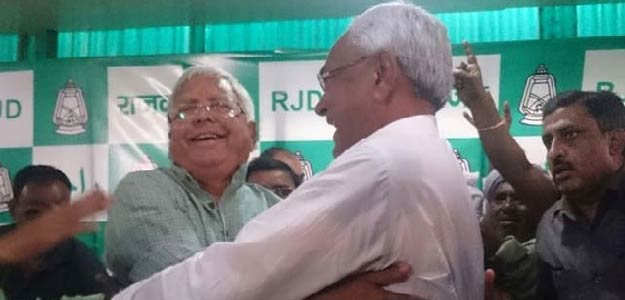
The BSE Sensex slumped as much as 600 points or 2.3 per cent on Monday following the BJP's massive defeat in Bihar assembly election in which the party managed to win just 58 seats. Nitish Kumar-led Grand Alliance won 178 of the 243 seats. Though markets made a smart recovery to end with just 0.5 per cent losses, the Bihar verdict will continue to weigh on sentiments, analysts say.
Here are 10 key takeaways that investors should know about Bihar election verdict
1) The victory of the Grand Alliance in Bihar is a reaffirmation of the trend that voters reward economic development, say analysts. "Under his watch, the 'Bihar miracle' has seen growth stepping up to an average of 9.5 per cent in FY06-15 from 5.3 per cent in FY95-05," said Indranil Sen Gupta of Bank of America Merrill Lynch.
2) The rout of the BJP is because of a series of "self-goals" that the alliance scored, says Jay Shankar of Religare. "The party's narrative shifted from development to controversial issues... Worst of all, the NDA's negative campaign against Nitish Kumar, a popular CM with virtually no anti-incumbency in the state, backfired," he added.
3) Most economists expect the government to keep pushing reforms such as the GST despite the setback in Bihar. "The show will go on hopefully. The result of the Bihar elections is not expected to have an immediate impact on the economic reforms agenda of the central government," said Sanjeev Prasad of Kotak Equities.
4) Foreign investors don't seem to be much perturbed by the big loss BJP suffered in Bihar. "The loss may complicate politics for the central government, but we don't expect major implications on the economic front," said global rating agency Fitch. The election results are not likely to impact decisions by foreign investors in other states, it added.
5) A victory in Bihar would have marginally improved the BJP's numbers in Rajya Sabha, even though the NDA would have remained far short of majority. Analysts say the BJP should accelerate its efforts to build consensus with opposition if it wants to progress on its legislative agenda. It should also speed up the pace of non-legislative reforms.
6) Since May 2014, when the BJP came to power at Centre, the party has won four states and lost in two. Till March 2017, there are no elections in any BJP-ruled states, which should hold the government in "good stead" to provide a push to the reform path which may now take a more nuanced course with greater political consensus, said Motilal Oswal.
7) The defeat in Bihar is unlikely to result in greater populism by the NDA government. The BJP refrained from sharp increases in minimum support prices or farm loan waiver packages despite its defeat in Delhi and a deficient monsoon, which is a testament to its commitment to good economics, said Nomura's Sonal Varma.
8) The BJP will now train its guns on 2017 UP polls, which account for a bulk of seats in the Rajya Sabha. In 2016, elections are due in Assam, Kerala, Tamil Nadu and West Bengal, but they do not matter much for the BJP as it does not have a significant presence in most of these states, said Bank of America.
9) The government is likely to focus on fighting the economic slowdown in rural India, where weak monsoon and falling wages have hit demand, analysts say. Higher minimum support prices and implementation of One Rank, One Pension and the 7th Pay Commission should lead to consumption recovery, they added.
10) Analysts expect PM Modi to undertake a Cabinet and bureaucratic reshuffle ahead of the winter session of Parliament. "Whilst the Cabinet reshuffle is likely to be aimed at replacing underperforming ministers, bureaucratic changes are likely to be geared towards introducing technocrats in economically important ministries," said Ambit Capital.
Essential Business Intelligence, Sharp Market Insights, Practical Personal Finance Advice, Daily Fuel, Gold and Silver Prices and Latest Stories — On NDTV Profit.