India's Retail Inflation Seen At A Five-Month High In September
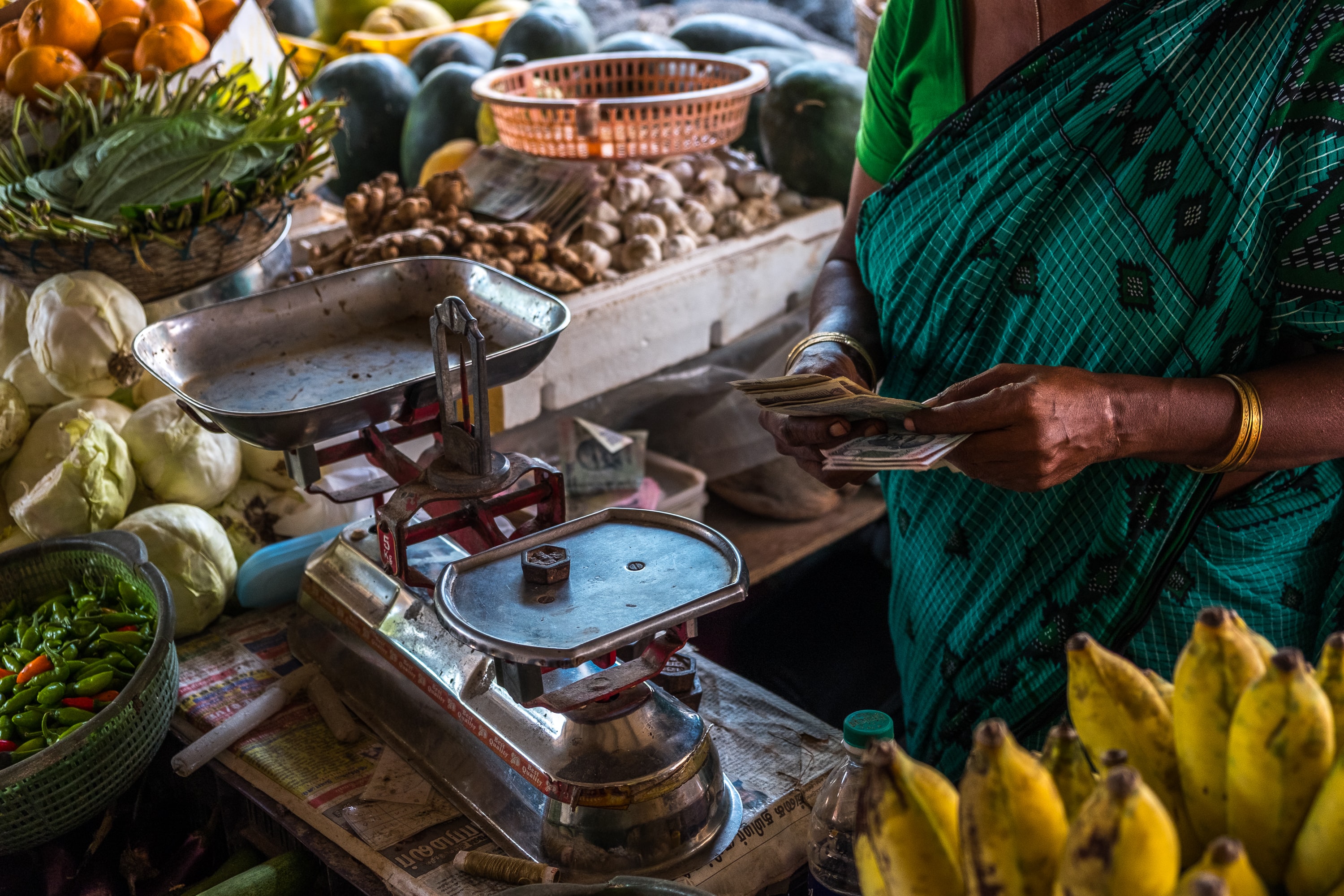
India's retail inflation is expected to spike in September led by a rise in food prices, along with sticky core inflation.
A Bloomberg poll of 32 economists' pegs September inflation to climb to a five-month high of 7.3%. While that's the median estimate, forecasts range between 6.9% and 7.5%.
This will be the third straight quarter of the retail inflation exceeding the central bank's target band of 4(+/-2)%. If the inflation target is breached for three quarters in a row, the Reserve Bank of India needs to explain to the government the failure to meet the target.
CPI data for September is set to be released on Oct. 12.
What's Driving The Price Rise?
Monthly average retail prices of rice, wheat and atta continued to rise sequentially, according to the data released by the Department Of Consumer Affairs.
Monthly average retail prices of tomatoes rose 22.7% to Rs 45.3 a kg in September. Edible oils saw a sequential decline in prices, across categories.
After the run-up in domestic wheat prices, rice and its derivatives are seeing a pick-up in price momentum owing to a decline in domestic sowing compared to last year and likely output, said a note by QuantEco Research. Late withdrawal of monsoon and intense rain spells in October 2022 seen in some states could have an adverse impact on price of perishables, especially vegetables.
CPI inflation is seen at 7.03% in September, largely unchanged from 6.99% in August. Food and beverage inflation is likely to rise to 7.93% from 7.50% in August, mainly due to higher prices of cereals, vegetables, pulses and milk products, Teresa John, economist at Nirmal Bang Institutional Equities, said in a note.
Vegetable prices, according to her, will likely rise, deviating from the seasonal decline, largely on account of a rise in prices of tomatoes, while inflation in oils and fats category will continue to ease on a decline in edible oil prices.
Inflation in services and other personal care and household goods may remain sticky despite gradual easing in input prices, John said, forecasting core CPI inflation—that excludes food and fuel—at 5.8% in September compared with 5.85% in August.
A sharp fall in cotton prices may likely lead to gradual easing in inflation in clothing and footwear, while fuel and light inflation is seen at 9.4% annually in September compared with 10.8% in August, supported by easing LPG prices, John said. A sharp rise in CNG and PNG (restricted largely to metros) in October, however, may push up sequential inflation in the fuel and light category at the margin in coming months.
Respite Ahead
“Beyond cereals, increase in food prices appear largely seasonal, as several commodities tend to rise before harvesting, hence, we expect these trends to reverse in the coming months barring any extreme weather events,” Barclays—that forecasts inflation to rise to 7.3% in September from 7% in August—said in a note.
“Further, we see a moderation in imported food price pressures, especially for cooking oil and feedstock, as a key driver of disinflation,” it said.
According to QuantEco Research, government action of a ban on export of broken rice and the imposition of a 20% export duty on non-basmati rice exports are likely to offer some reprieve.
But, onset of festive season demand, concentrated in October-November, along with some speculative trading could keep food price pressures intact, especially for wheat, along with the extension of the Pradhan Mantri Garib Kalyan Yojana by three months up to December, it said.
Inflation, QuantEco Research said, is likely to traverse a glide path lower with deceleration looking more pronounced in the second half of FY23, aided by softening in global commodity prices, especially crude oil, on-boarding of Kharif harvest along with the impact of government administrative measures and an adverse base.

-
Navigating Friction And Energy Realities: An Analysis Of Marco Rubio's October Visit To India

Occurring at a critical juncture marked by stalled trade negotiations and escalating geopolitical pressures over global energy supplies, the visit offers a profound window into modern US-India relations.
-
India Exports Capital. Why Not Export Trusteeship?
The big question, then, is whether India can build an institution that global borrowers, investors, banks, and lawyers can trust, even without an Indian connection.
-
France's Economy & Politics Are In Crisis | The Reason Why
Let's look at how the French economy and politics evolved under Nicolas Sarkozy, Franois Hollande and Emmanuel Macron.
-
You May Inherit The Business. You Must Earn Its Credibility.
Succession tests the founder's ability to share authority as much as it tests the next generation's readiness to assume it.
-
Signing Deals Is One Thing; Making Them Work Is Another | The Week In Whys
Sometimes, things don't turn out as planned. Indian companies have lost some bids to rivals, some projects won't produce until 2030.
-
FOMC Wall, PERM Suspension, Hospital Stocks | Talking Points This Week
A PERM suspension would directly affect green-card sponsorship rather than H-1B visas, so the near-term earnings impact could remain relatively limited. The key question is whether this marks a new phase in US scrutiny of Indian IT.
-
Everything, Everywhere, All At Once: Dalal Street's Week To Forget | Joining The Dots
Visa curbs, a Starlink spat and cancer drug caps: what connects this week's shocks for Indian markets
-
India Is Going Abroad For Critical Minerals. But It May Take Years To Pay Off | The Reason Why
Although India's steps are in the right direction, they remain modest compared with India's growing dependence.
-
When Everyone Has AI, What Gives You An Edge?
India's young workforce is entering an uncertain world of work where powerful AI tools are becoming widely accessible. The advantage will belong to those who combine deep expertise with digital fluency, and the distinctly human capabilities that technology cannot manufacture.
-
Wrong Labels, High Pesticide Residues Holding Back Agri Exports | The Reason Why
India needs stronger domestic food-safety and labelling standards, with best practices becoming part of everyday business for farmers, traders and food companies.










