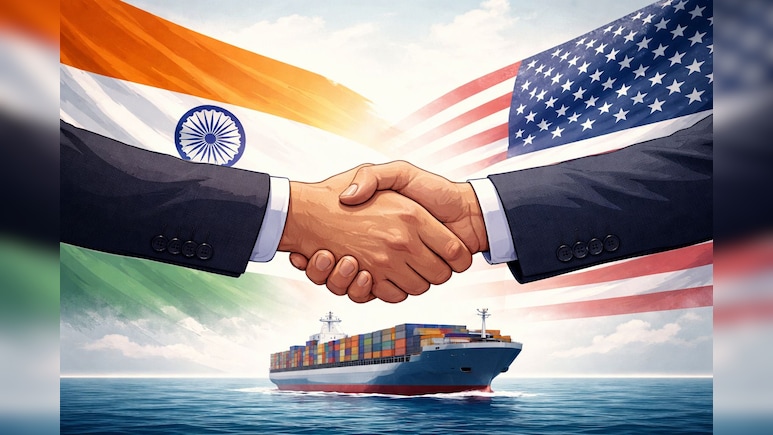
The India–US trade agreement has arrived at a moment of rare convergence — just after the Union Budget and days after India concluded a free trade pact with the European Union. Markets responded swiftly. Equity benchmarks rallied as investors took comfort from a reduction in trade uncertainty, improved export competitiveness, and the prospect of stronger capital inflows.
The immediate trigger was Washington's decision to cut reciprocal tariffs on Indian goods from 25% to 18% with immediate effect—a level markets see as workable rather than punitive. The move has improved India's relative position against regional peers and reinforced confidence that the deal is aimed at expanding trade volumes rather than merely resetting terms.
ALSO READ: India-US Trade Deal: Here's What Gets Cheaper In India
Also Read | Layoffs Are Rising In Tech, But These Skills Are Helping People Unlock Better Pay
The Scale Of The Relationship
The United States is already India's single largest export destination, accounting for 19.8% of India's exports in FY25, while contributing 6.3% of imports. Bilateral goods trade currently stands at around $191 billion, but both countries are now targeting a sharp expansion to $500 billion by 2030 — a more than two-and-a-half-fold increase that underscores the strategic ambition behind the agreement.
Trade data points to a steadily deepening relationship. India's exports to the US have risen from $51.6 billion in FY21 to $65.9 billion in FY25, while imports have grown from $28.9 billion to $39.4 billion over the same period. This consistent expansion has strengthened expectations that the latest deal could add momentum to India's external growth narrative.
ALSO READ: Two Weeks Two Mega Trade Deals: Comparison Of Trade Deals With US And EU
Sectoral Winners From 18% Tariff
India's top exports to the US include electrical machinery ($15.9 billion), pearls and gems ($10 billion) and pharmaceutical products ($9.8 billion). On the import side, mineral fuels and oils ($14.3 billion) and high-value machinery dominate.
With reciprocal tariffs now lowered to 18%, Indian exporters enjoy a relative edge over competitors such as Bangladesh and Vietnam, where comparable tariffs are closer to 20%.
Timing has amplified the deal's importance. With two major trade agreements concluded in less than 10 days, India has reinforced its position as a preferred partner in a fragmenting global trade landscape. For Washington, the agreement aligns with efforts to secure resilient supply chains. For New Delhi, it reflects a negotiating strategy built on market size, patience, and diversification rather than haste.
ALSO READ: Lower US Tariffs Could Lift India's Growth Outlook, Says CEA Nageswaran
What Still Needs Clarity
Yet, beneath the headline numbers, important exclusions remain.Steel, aluminium and copper exports could still face tariffs of up to 50%, as these fall under US Section 232 duties, which are typically excluded from FTA concessions. Select auto components may continue to attract tariffs of up to 25%, limiting near-term upside for parts manufacturers.
ALSO READ: 50% Cliff To 18% Relief — The Long Road To The Trade Pact
Where Zero Tariffs Continue
On the positive side, zero-tariff treatment is expected to continue for pharmaceuticals, aircraft and parts, smartphones, and select mechanical and electronic components, offering stability to sectors already embedded in global supply chains.
For now, markets are betting that the certainty provided by an 18% tariff framework, combined with a clear $500 billion trade ambition, will outweigh sectoral exclusions. Whether that optimism holds will depend on how quickly clarity emerges on sensitive sectors — and how effectively intent is translated into execution.
In a world grappling with trade fragmentation, the India–US deal signals a recalibration rather than a retreat from globalisation — with India increasingly shaping the terms of engagement.
Track every development in the India–US trade deal, live here.
Essential Business Intelligence, Sharp Market Insights, Practical Personal Finance Advice, Daily Fuel, Gold and Silver Prices and Latest Stories — On NDTV Profit.