Trump-Modi Meet: India, US Set $500 Billion Trade Target By 2030
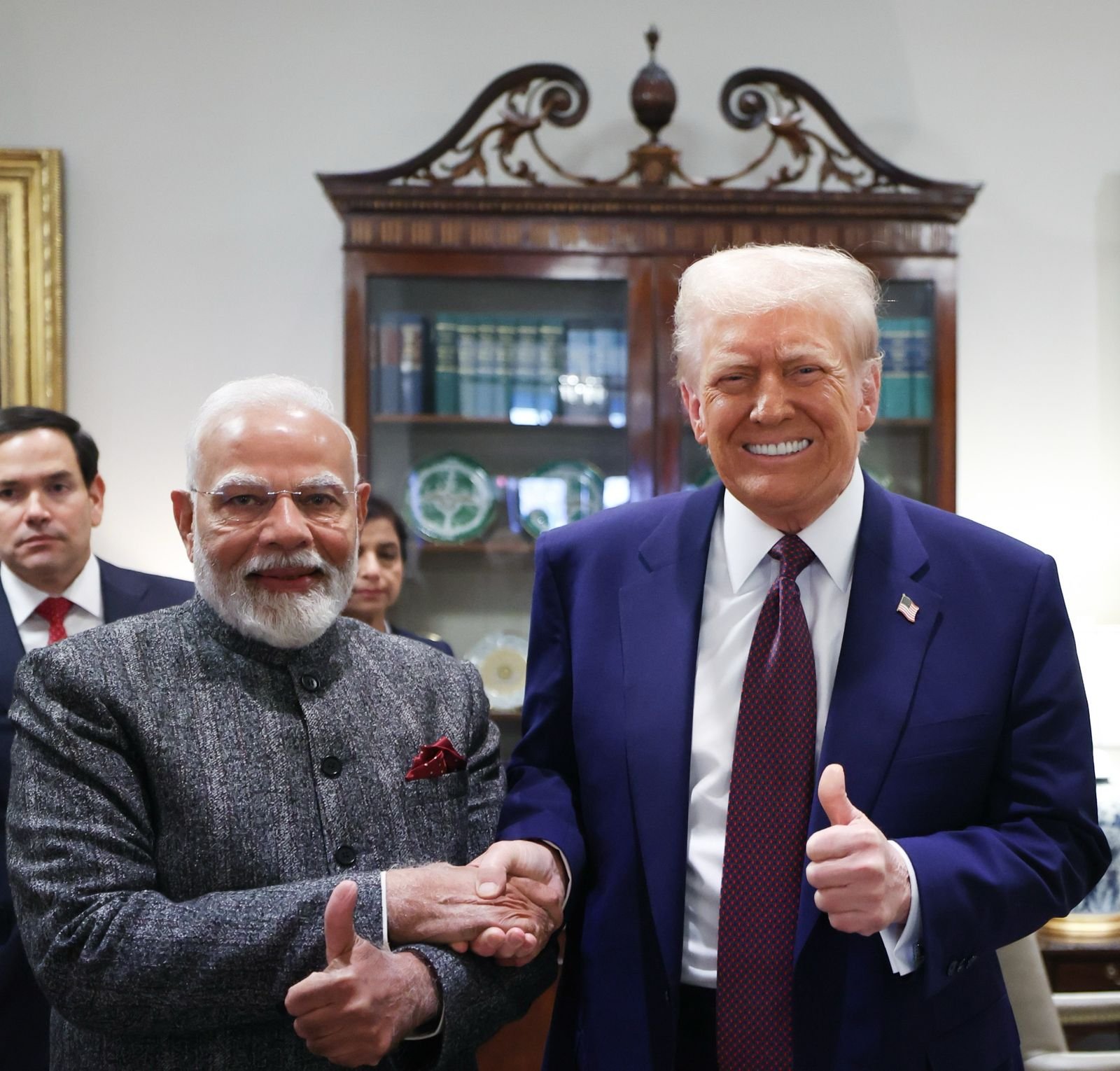
US President Donald Trump and Indian Prime Minister Narendra Modi, in a joint meeting on Thursday, announced a series of initiatives aimed at deepening the bilateral relationship between the two countries. The event emphasised the growing partnership, spanning economic, defence, and technological collaboration.
With economic collaborations taking the centre stage, both the leaders have decided to double the bilateral trade to $500 billion by 2030, with a focus on energy, defence, and technology cooperation. Modi also highlighted initiatives like the I-MEECH economic corridor, collaboration in space through ISRO and NASA, and strengthened supply chains for critical minerals.
Prime Minister Modi also announced plans to launch an Autonomous Systems Industry Alliance, with a framework for defence cooperation that will shape the coming decade.
Modi described the meeting as the beginning of a 'Mega' partnership, symbolising the integration of 'MAGA' (Make America Great Again) and 'MIGA' (Make India Great Again).
President Trump highlighted the announcement of a framework to bolster economic ties, underscoring the plan to increase US military sales to India by billions of dollars, including the prospect of providing India with the advanced F-35 stealth fighters.
Trump also spoke about plans to boost energy sales, including oil and gas. He said he wants India to buy more crude oil and natural gas from the US.
He emphasised the strategic importance of strengthening the Quad alliance, to maintain peace and prosperity in the Indo-Pacific region. Trump also lauded the approval of the extradition of one of the key perpetrators of the 26/11 Mumbai attacks, reaffirming the commitment to combat global terrorism.
The US president further addressed trade imbalances, mentioning India's high tariffs on American goods, which hindered trade, especially in sectors like automotive exports. He expressed hope that through discussions, both nations would work toward reducing the nearly $100 billion trade deficit, with potential for energy trade to bridge the gap.
Trump also acknowledged India's efforts in nuclear energy reform, alongside joint ventures in advanced technologies like AI, semiconductors, and biotech.
“India is also reforming its laws to welcome US nuclear technology, which is at the highest level, into the Indian market. This will bring safe, clean, and affordable electricity to millions of Indians,” said the US President.

-
Ten Things I Learnt This Samvat

Patience can be a trap. Cheap stocks can stay cheap. Leverage can wipe you out. What did Samvat 2082 teach us? Niraj Shah writes on 10 lessons from the year gone by.
-
Talking Points This Week: Tech Nerves, FII Buying, And A Faraway Banking Shock
The global markets are not shining this Diwali. The exception in the large markets is, India.
-
Midterm Rally Lasted A Day. The Hard Reality Of A Divided US May Last Two Years | Opinion
Between a contested AI boom, a debt ceiling that arrives in 2027 and a president with every incentive to act alone, the next two years may prove more volatile than the first day's rally suggests.
-
Blue Wave Will Derail the AI Trade but Won't Dismantle the AI Era | Unhedged Position
The Democrats' sweep of the US Congress will see politics collide with economic forces both over the long and short term.
-
It's Time To Take The GST Council's Bet On Trust Global
Payment records can prove India's services exports, and clear, proportionate rules can bring foreign digital sellers into the tax net.
-
Opinion | India at 38: From Innovation Overperformer to Innovation Powerhouse
India now has 453 VC-backed deep science startups, 18 of them late-stage, after 117 percent growth since 2020. Laurus Labs, at USD 9.3 billion, is the most valuable deep science company in any middle-income economy outside China.
-
Navigating Energy Crossroads: S Jaishankar's Call For Diversified Supply Chains At G20 Ministerial Meeting
As geopolitical fault lines continue to test maritime trade routes and commodity flows, Jaishankar's message remains pertinent: true economic resilience requires open markets, protected transit lines, and a genuine commitment to multilateral cooperation rather than coercion.
-
Indians Are Travelling, But Not Every Journey Is A Holiday | The Week In Whys
Pilgrims, patients and working women are the real travellers, and the system hasn't quite caught up with them.
-
Getting To Work Costs Women More | The Reason Why
It is not just about women paying more than men. It is about women paying much more in cities than in villages.









