Modi Trump Meet: New Trade Deal Discussed As US Eyes Defence, Energy Sales
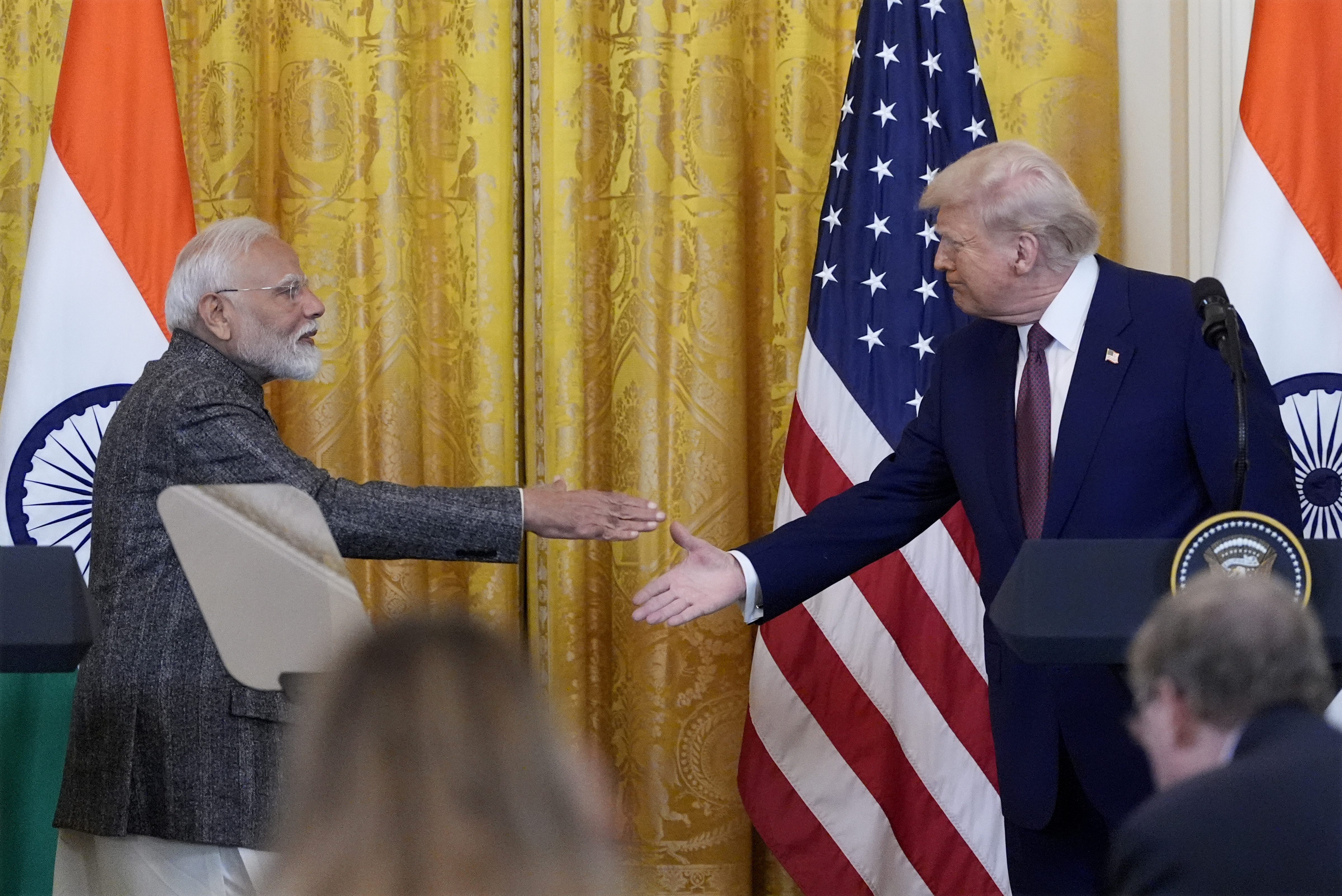
Prime Minister Narendra Modi on Friday said the US and India are working on a new trade agreement, that will increase Indian imports of American energy and promote technological cooperation.
"Our teams are working on a trade agreement that will increase our coal and gas trade with US, energy infrastructure, increasing small nuclear power plant infra and also improve joint production and joint transfer of technology," PM Modi said in a press conference alongside US President Trump.
The two leaders are working on a framework to strengthen both sides economically. Trump flagged the US' $100 billion trade deficit with India and talked to PM Modi on steps to reduce that.
"We want a level playing field and we can easily make up that deficit with the sale of oil and gas. India is reforming its laws to welcome US nuclear energy. Advanced technologies, AI to be developed jointly by India and US," Trump said.
He said PM Modi, as a symbol of good faith, recently announced the reductions to India's "unfair, very strong tariffs", that limit US access into the Indian markets.
"India imposes 30-40-60-70% tariffs on so many of the goods; as an example 70% tariffs on American cars, which makes it pretty much impossible to sell those cars," he said.
The US has also offered to sell the advanced F-35 stealth fighters to India. "The US-India compact will deepen every aspect of our partnership and our friendship. Starting this year, we will increase our military sales to India by many billions of dollars," Trump said.
India and the US have agreed to work together to help build "one of the greatest trade routes in history", wherein a network of ports, railways and undersea cables will link India, Israel, Italy and the US, Trump said.

-
Talking Points This Week: Tech Nerves, FII Buying, And A Faraway Banking Shock

The global markets are not shining this Diwali. The exception in the large markets is, India.
-
Midterm Rally Lasted A Day. The Hard Reality Of A Divided US May Last Two Years | Opinion
Between a contested AI boom, a debt ceiling that arrives in 2027 and a president with every incentive to act alone, the next two years may prove more volatile than the first day's rally suggests.
-
Blue Wave Will Derail the AI Trade but Won't Dismantle the AI Era | Unhedged Position
The Democrats' sweep of the US Congress will see politics collide with economic forces both over the long and short term.
-
It's Time To Take The GST Council's Bet On Trust Global
Payment records can prove India's services exports, and clear, proportionate rules can bring foreign digital sellers into the tax net.
-
Opinion | India at 38: From Innovation Overperformer to Innovation Powerhouse
India now has 453 VC-backed deep science startups, 18 of them late-stage, after 117 percent growth since 2020. Laurus Labs, at USD 9.3 billion, is the most valuable deep science company in any middle-income economy outside China.
-
Navigating Energy Crossroads: S Jaishankar's Call For Diversified Supply Chains At G20 Ministerial Meeting
As geopolitical fault lines continue to test maritime trade routes and commodity flows, Jaishankar's message remains pertinent: true economic resilience requires open markets, protected transit lines, and a genuine commitment to multilateral cooperation rather than coercion.
-
Indians Are Travelling, But Not Every Journey Is A Holiday | The Week In Whys
Pilgrims, patients and working women are the real travellers, and the system hasn't quite caught up with them.
-
Getting To Work Costs Women More | The Reason Why
It is not just about women paying more than men. It is about women paying much more in cities than in villages.
-
AI Bias In Investing Cannot Be Eliminated, But It Can Be Governed
Framing is a particularly important example as identical financial information presented in terms of gains rather than losses can lead an LLM to reach a different assessment.









