Navigating Energy Crossroads: S Jaishankar's Call For Diversified Supply Chains At G20 Ministerial Meeting
As geopolitical fault lines continue to test maritime trade routes and commodity flows, Jaishankar's message remains pertinent: true economic resilience requires open markets, protected transit lines, and a genuine commitment to multilateral cooperation rather than coercion.
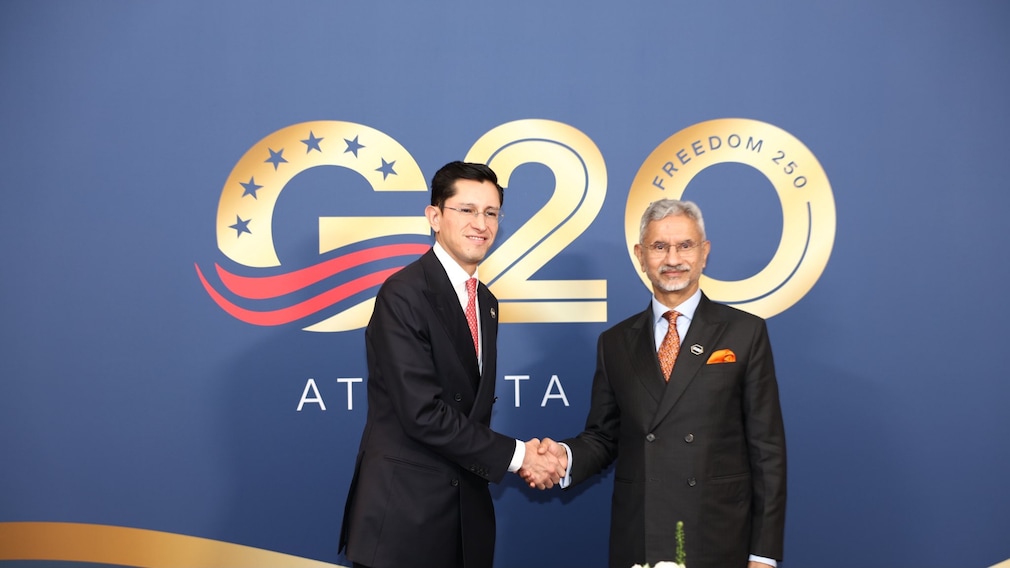
The contemporary global order faces a structural paradox: while interconnectedness defines modern commerce, geopolitical fragmentation increasingly weaponises those very connections. This tension formed the centerpiece of Indian External Affairs Minister S Jaishankar's address at the G20 Foreign Ministers' Meeting in Atlanta, United States, convened by US Secretary of State Marco Rubio on October 29-31, 2026.
Amid volatile markets, Middle Eastern conflicts, and transit chokepoints, Jaishankar articulated a clear vision for global energy security-one that challenges the politicisation of resources and champions diversified, predictable, and equitable supply chains. His address serves as both a critique of unilateral market distortions and a blueprint for global economic equity, particularly for low-income and developing nations.
The Diagnosis: An Artificial Crisis of Predictability
Jaishankar framed the global energy dilemma not strictly as a crisis of physical production, but as a crisis of unpredictability, disruption, and access. In his remarks at the G20 plenary, he underscored that deliberate interference-through unilateral sanctions, maritime chokepoints, and targeted disruptions of energy infrastructure-functions as a calculated strategy to hold global prices hostage.
For major emerging economies like India, which remains among the world's largest importers of oil, liquefied natural gas and fertilisers, these market distortions carry immediate domestic consequences. Jaishankar pointed out that continuous market manipulation displays little regard for the economic survival of low-income and developing nations. Furthermore, he criticized the habit of drawing convenient, selective distinctions between oil and gas, noting that selective carve-outs distort fair competition and stability.
Diversification and De-Risking as Strategic Imperatives
At the heart of Jaishankar's Atlanta address was a straightforward prescription: diversification and de-risking. As global trade routes face heightened risks-ranging from conflict around the Strait of Hormuz to systemic shocks-relying on concentrated, linear supply chains is no longer viable.
Jaishankar urged the G20 to work collectively toward the depoliticisation of energy markets, arguing that global commerce requires insulation from zero-sum geopolitical rivalries. For India, a country heavily reliant on crude oil, liquefied natural gas and fertiliser imports, energy security is directly tied to national development. In the short term, this means securing reliable, predictable liquid petroleum gas supplies for domestic clean cooking initiatives.
In the long term, it demands a robust framework for critical minerals, which are indispensable to the renewable energy transition. Highlighting India's National Mission on critical minerals-stretching from exploration to recycling-Jaishankar proposed a "G20 Critical Minerals Circularity Initiative" to prevent a new era of resource monopolisation.
The Broader Geopolitical Context
Jaishankar's intervention in Atlanta did not happen in a vacuum. It coincided with parallel deliberations, including a Quad Foreign Ministers' meeting on the sidelines and broader US-led foci on maritime security, sea lanes, and economic resilience. While Western powers often frame supply chain resilience through the lens of strategic competition, Jaishankar's stance injected the perspective of the Global South-insisting on the right to industrialise, resist predatory commercial practices, and prevent the weaponisation of trade.
Jaishankar pointedly noted that the deliberate weaponisation of energy trade and calculated attacks on infrastructure are being used to hold global energy prices hostage. In a globalised economy, these continuous distortions-manifesting as sanctions, geopolitical obstacles, and selective carve-outs between oil and gas-reverberate far beyond their intended targets. Jaishankar's sharp critique exposed the hypocrisy of wealthy nations drawing convenient distinctions in energy policies, which ultimately leave the Global South to bear the brunt of unaffordable costs and compromised access.
Conclusion
S Jaishankar's address at the Atlanta G20 ministerial serves as a wake-up call against the geoeconomic fragmentation of energy and resource flows. By tying market predictability directly to the welfare of developing populations, India positioned energy security not as a narrow national metric, but as a collective global public good.
As geopolitical fault lines continue to test maritime trade routes and commodity flows, Jaishankar's message remains pertinent: true economic resilience requires open markets, protected transit lines, and a genuine commitment to multilateral cooperation rather than coercion.
Ultimately, the Atlanta address reinforces India's role as a pragmatic, balancing power in an unsettled world. By engaging in extensive bilateral diplomacy on the margins of the G20-meeting with counterparts from Latin America, Europe, and East Asia to secure lithium, technology, and manufacturing partnerships-India is actively practicing the diversification it preaches.
Jaishankar's call to action is a reminder to the G20 that keeping energy markets open and predictable requires genuine multilateral leadership, wider access to green financing, and advanced collaboration in technologies like green hydrogen and small modular reactors. Only by de-politicising energy flows can the international community build a resilient economic architecture that protects the vulnerable and fuels global growth equitably.
Disclaimer: The views expressed in this article are solely those of the author and do not necessarily reflect the opinion of NDTV Profit or its affiliates. Readers are advised to conduct their own research or consult a qualified professional before making any investment or business decisions. NDTV Profit does not guarantee the accuracy, completeness, or reliability of the information presented in this article.
-
Signature Play: The Classic Cocktail Is Dead. Or Is It?

Classic cocktails are disappearing from India's cocktail menus. But they're still being ordered, taught to bartenders and borrowed from. So, who's really having the last drink?
-
A New Samvat Wishlist: Inclusive Prosperity And Human Development
India has strengthened its economic foundations through infrastructure, digital access and enterprise. Its next growth chapter must deepen productivity, create better livelihoods and widen participation in prosperity.
-
Love, Sex Aur Dhokha: The Audacious Plot To Spy On Jensen Huang
A Taipei dinner, a Singapore chip buyer and a suspected Chinese asset: inside the alleged spy operation that got close to NVIDIA's Jensen Huang.
-
Ten Things I Learnt This Samvat
Patience can be a trap. Cheap stocks can stay cheap. Leverage can wipe you out. What did Samvat 2082 teach us? Niraj Shah writes on 10 lessons from the year gone by.
-
Talking Points This Week: Tech Nerves, FII Buying, And A Faraway Banking Shock
The global markets are not shining this Diwali. The exception in the large markets is, India.
-
Midterm Rally Lasted A Day. The Hard Reality Of A Divided US May Last Two Years | Opinion
Between a contested AI boom, a debt ceiling that arrives in 2027 and a president with every incentive to act alone, the next two years may prove more volatile than the first day's rally suggests.
-
Blue Wave Will Derail the AI Trade but Won't Dismantle the AI Era | Unhedged Position
The Democrats' sweep of the US Congress will see politics collide with economic forces both over the long and short term.
-
It's Time To Take The GST Council's Bet On Trust Global
Payment records can prove India's services exports, and clear, proportionate rules can bring foreign digital sellers into the tax net.
-
Opinion | India at 38: From Innovation Overperformer to Innovation Powerhouse
India now has 453 VC-backed deep science startups, 18 of them late-stage, after 117 percent growth since 2020. Laurus Labs, at USD 9.3 billion, is the most valuable deep science company in any middle-income economy outside China.









