India-US Trade Deal Highlights: Protected Section 232 May See Some Relief From 50% Levies; Joint Statement In 2-3 Days
Commerce Minister Piyush Goyal has announced that both India and US will release a joint statement soon.

We Have A Deal!
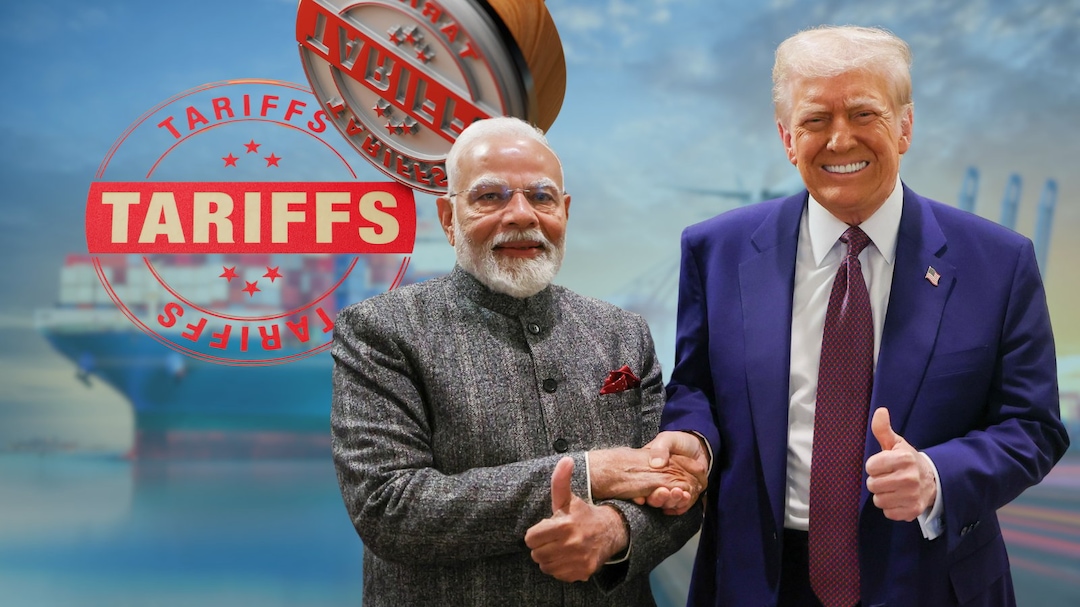
India and the United States have agreed to a trade agreement under which reciprocal tariffs on Indian goods will be slashed to 18% from 25% and the additional 25% duty linked to the purchases of Russian crude oil will be eliminated. The trade deal will be "effective immediately", President Donald Trump said, following a phone call with Prime Minister Narendra Modi late Monday, signaling immediate tariff relief for India.
Notably, the two sides have been locked in negotiations since early 2025, but the talks derailed after the US slapped tariffs as high as 50% on Indian imports in August. After a brief pause, the negotiations resumed in October, but the two countries could not reach the finish line.
The stock market joined the euphoria around better trade flows between the two large economies. Rupee appreciated against the dollar and government bond yields fell.
Industry and political leaders have welcomed the India-US trade deal which can deepen supply-chain integration, enable faster technology collaboration, and attract investment into advanced manufacturing.
India-US Trade Deal Live Updates: The Much-Awaited India-US Deal In Infographics
India and the United States have taken a decisive step toward reshaping their economic relationship, with Prime Minister Narendra Modi and President Donald Trump finalising a long-awaited trade agreement.
In this infographic-led explainer for NDTV Profit, we break down what changed, why it matters, and how the agreement could impact markets, companies, and consumers on both sides.
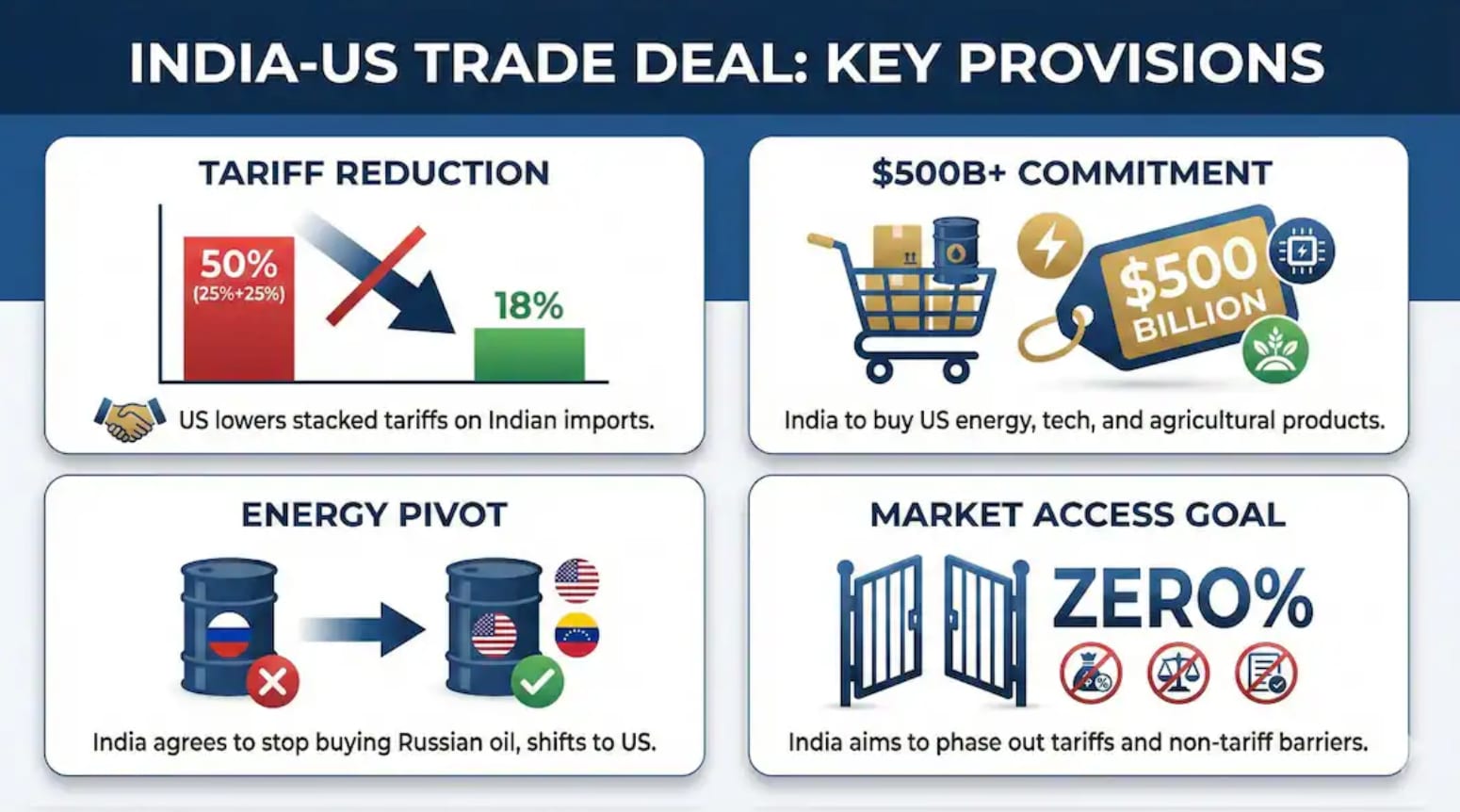
Photo Credit: NDTV Profit
India-US Trade Deal Live: This live blog has ended
Thanks for connecting. Stay tuned to NDTV Profit for all India-US Trade Deal updates!
India-US Trade Deal Live Updates: India To Import Goods Worth $500 Billion From US In Five Years
India-US Trade Deal Live Updates: India's agreement with the US to buy $500 billion-worth of goods over five years includes an existing pipeline of projects, as well as new areas of spending, such as data centers and energy. A joint statement on a US-India framework trade agreement will likely be published in the next 2-3 days, fleshing out more details of the deal announced by US President Donald Trump.
India-US Trade Deal Live Updates: Infosys, Wipro ADR To Be In Focus
New York-listed shares of leading Indian information technology giants Infosys Ltd. and Wipro Ltd. and even banks like HDFC Bank and ICICI Bank soared after the trade deal announcement on Monday. While Wipro ADR had risen 7%, Infosys ADR and HDFC ADR was up over 3%. ICICI Bank ADR on the other hand traded 4% higher.
India-US Trade Deal Live Updates: Landmark Pact Turn FPIs Into Net Buyers
Foreign Portfolio Investors turned net buyers of Indian equities on Tuesday, powered by the India-US trade deal. The overseas investors bought Rs 5,236 crore worth of stocks.
India-US Trade Deal Live Updates: India's Growth To Be 'Turbocharged', Says Deloitte India
"Opening its large consumer markets for the European and US companies will turbocharge India’s Growth story. Along with the announcements on the manufacturing sector in the Budget, this has the potential to increase productivity and per capita income and to also increase the standard of living and creating the niche position in the World Order which India truly deserves," said Anil Talreja, Partner, Deloitte India.
India-US Trade Deal Live Updates: Data Centers Purchases To Fetch $20 Billion
The $500 billion commitment includes all merchandise purchases like Boeing, Data centers, LPG, coking coal, gold. Of this, Data centers alone will fetch $20 Billion, sources told NDTV Profit.
India-US Trade Deal Live Updates: Auto Components Tariffs Still At 25%
Some auto components tariff which fall under the ambit of section 232 may still be levied at 25%, sources said.
India-US Trade Deal BREAKING: Goods Under Protected Section 232 May Receive Relief
The section 232 includes steel, Aluminium & Copper where duties remain 50% for national security reasons. However, Govt. sources have told NDTV Profit that some goods under the section may receive concessions.
India-US Trade Deal Live Updates: Zero Tariffs For Some Indian Goods
An understanding for agreement has been reached with the US, Government sources told NDTV Profit. The deal includes zero tariffs for some Indian goods too, sources added.
India-US Trade Deal Live Updates: $500 Billion Includes Merchandise Purchases Like Boeing, Coking Coal, Gold, Govt Sources Say
The $500 billion commitment includes all merchandise purchases including Boeing, Data center, LPG, coking coal, gold. An understanding for agreement has been reached with the US, Government sources told NDTV Profit. The deal includes zero tariffs for some Indian goods too, sources added.
India-US Trade Deal Live Updates: Joint Statement To Come In 2-3 Days, Sources Say
The joint statement regarding details of the trade deal announced by Commerce Minister Piyush Goyal will be issued by both India and United within two to three days, sources told NDTV Profit.
India-US Trade Deal Live Updates: Deal Aims At $500 Billion Volume In Five Years
Sources told NDTV Profit that the India-US trade deal aims at $500 billion trade volume in five years.
India-US Trade Deal Live Updates: Both Countries To Issue A Join Statement With Details Of Deal, Piyush Goyal Announces
Commerce Minister Piyush Goyal said that the India-US trade deal is in the final stages of detailing and will be notified by both the sides shortly. Both countries will give out details and understanding of the deal.
India-US Trade Deal Live Updates: US To Help India In Hi-Tech Sectors, Says Piyush Goyal
"The United States will help India in Hi-tech sectors under the trade deal", said Commerce Secretary Piyush Goyal.
He added that ties between the two economies will only strengthen.
India-US Trade Deal Live Updates: MSMEs, Textiles, Jewellery Sectors To Benefit, Says Goyal
"MSMEs, engineering goods, textile, leathers, jewellery sectors will be presented with many opportunities in this trade deal," said Commerce Minister Piyush Goyal.
India-US Trade Deal Live Updates: 'All Sensitive Sectors Protected', Says Piyush Goyal
"PM Modi has always protected interests of farmers, livestock holders, dairy farmers. Even in US trade deal, sensitive sectors like agriculture and dairy have been protected," Goyal said.
India-US Trade Deal Live Updates: Best Deal Among Competitors, Says Goyal
"India has got the best deal among competitors. Our teams have been negotiating with US officials for months. There were many issues, complexities that we had to work through to reach here," said Commerce Minister Goyal.
India-US Trade Deal Live Updates: Piyush Goyal Calls Deal A Gem In India's Crown
Commerce Minister Piyush Goyal said, "The trade deal is a gem in India's crown and speaks loudly for Narendra Modi's tenure as Prime Minister. It will open up opportunities for 140 crore Indians including the poor, farmers, fisherfolk, youth, and women."
India-US Trade Deal Live Updates: Trade Deficit Likely Outcome? Shankar Sharma Thinks So
Founder of GQuant Investech Shankar Sharma tweeted, "Just so that I don't misunderstand the trade deal: we have had exports of $ 86 BILLION to US, imports of around 45 billion . Surplus of ~40 billion dollars. Now, we will still export the same, but import $ 500 billion without duty, right? Even assuming this is over say, 5 years , we will export ~ 400 billion and import ~500 billion, resulting in a trade deficit of ~ 100 billion with Amreeka? What am I missing here?"
India-US Trade Deal Live Updates: Commerce Minister Piyush Goyal To Give Official Statement Soon
Commerce Minister Piyush Goyal will give on-camera statement on US Trade deal at Vanijya Bhawan at 5:15 p.m. today.
India-US Trade Deal Live Updates: Auto Sector To Be In Focus
In the two mega-deals in two deals sealed by India with EU and US, opening up of the auto sector is a common denominator.
Auto component makers with a strong presence in the US market are also expected to benefit. Lower tariffs can help sustain order inflows from global OEMs, improve margins, and strengthen India's position as a cost-efficient manufacturing hub.
Auto & Auto Ancillary Stocks with high US exposure:
- Sona BLW – 40%
- Ramkrishna Forging – 27%
- Bharat Forge – 25%
- Tata Motors – 23%
- Samvardhana Motherson – 18%
- Balkrishna Tyres – 18%
- Sanmar/ Sansera Engineering – 9%
- Apollo Tyres – 3%
India-US Trade Deal Live Updates: Jio BlackRock Says Focusing On Long-Term Growth
It has lifted a level of uncertainty. Positive impact on markets. Details of the deal are still awaited. We focus on long term growth for our clients as per their risk appetite. Events like US deal have the power to shift the asset allocation of clients.
India-US Trade Deal Live Updates: Rupee Outperforms Asian Currencies
The India-US trade deal boosted the legal tender to its best session since 2018 on Tuesday as foreign investors flocked into a market they cashed out over the past year amid trade frictions. The rupee strengthened 1.4% to close at 90.27 per dollar, according to Bloomberg data. Intraday, the local currency surged as much as 1.6% to 90.05, becoming the best performing unit in Asia.
Read more here: Rupee Logs Best Session In Eight Years After India-US Trade Deal Boost
India-US Trade Deal Live Updates: Benchmark Indices Clock Best Close Since May 2025
Nifty clocked its best performance since May 2025 as US-India trade deal fueled investor confidence. Nifty ended in green gaining over 2.5% in trade and closed over the 25,700 mark.
India-US Trade Deal Live Updates: Revenue Secy Says Deal Will Create Opportunities For Labour-Intensive Sectors
India-US trade deal will further expand and deepen trade between two of the largest economies of the World. It will create more opportunities for our labour-intensive and manufacturing sectors in the US market and give impetus to mutually-beneficial collaboration in high and advanced technology sectors,
~ Arvind Shrivastava, Secretary, Department of Revenue, Ministry of Finance, Government of India.
India-US Trade Deal Live Updates: 'We Are A Part Of This Grand Vision', Says Ambassador Of Italy To India, Antonio Enrico Bartoli
Ambassador of Italy to India, Antonio Enrico Bartoli says, "I think it's a very positive development. It lowers barriers and allows more and more trade and investments between partners. We are a part of this grand vision. We successfully concluded the negotiation with India, as EU. I think this will be a game-changer, both for India and for the EU. I think that it can also enhance the economic partnership between Italy and India. In our case, in the case of Europe, there was also a security and defence partnership and that is what we are talking about today, and also a mobility agreement that Italy and India have already agreed upon and signed. That is also an important part of our collaboration..."
India-US Trade Deal Live Updates: No Compromise On Protection Of Indian Farmers, Sources Tell NDTV
Government sources told NDTV that there will be absolutely no compromise on protecting the interests of Indian farmers, and that sensitive sectors such as dairy and agriculture will remain fully safeguarded under the new trade framework. They emphasised that India will continue to prioritise the needs of its people when making energy purchases, with market prices determining procurement decisions, while remaining committed to sourcing energy only from non‑sanctioned entities. The sources added that India–US bilateral trade is expected to grow fivefold over the next few years, moving toward the USD 500‑billion mark, and that the new trade agreement is poised to unlock significant economic value for both nations.
India-US Trade Deal Live Updates: Bharti Enterprises Founder Hails Trade Deal
“The India–US trade deal is a much awaited and a significant milestone for both the nations, unlocking immense opportunities for investments, growth. The flurry of FTA’s is an affirmation of India’s role at the centre of global frameworks, aimed at building resilient international trade patterns," says Bharti Enterprises founder Sunil Bharti Mittal,
India-US Trade Deal Live Updates: MCX Silver Futures Surge 14%, Gold Futures Reclaim Rs 1.53 Lakh
Gold and silver futures on the Multi Commodity Exchange (MCX) witnessed sharp buying interest on February 2, 2026, after India and the United States announced a major trade agreement that significantly reduces US tariffs on Indian exports. The development helped bullion prices recover strongly from last week's steep selloff, as investors reassessed risk sentiment.
MCX gold futures surged to reclaim levels above Rs 1.53 lakh per 10 grams, while MCX silver futures climbed close to the Rs 2.7 lakh per kg mark. On the day, gold futures were up more than 6%, while silver futures jumped over 14%, reflecting aggressive short-covering and fresh long positions.
India-US Trade Deal Live Updates: EAM Jaishankar To Meet US Secretary of State Rubio In Washington
"The Dealmaker in Chief has secured a trade deal with a fast-growing, top five global economy that's home to over one billion people. Another historic victory for American workers, farmers, and industries," says Kush Desai, White House Deputy Press Secretary.
Meanwhile, External Affairs Minister S. Jaishankar is set to meet U.S. Secretary of State Marco Rubio during his three‑day visit to Washington, where he will also take part in the first Critical Minerals Ministerial focused on enhancing global supply chains.
India-US Trade Deal Live Updates: India’s Ambassador to the United States, Vinay Mohan Kwatra's View
India’s Ambassador to the United States, Vinay Mohan Kwatra, welcomed the newly announced India–US trade agreement, saying it would unlock significant opportunities for both countries. He noted that the latest exchanges between U.S. President Donald Trump and Prime Minister Narendra Modi signal the beginning of a promising new stage in bilateral cooperation. In a post on X, Kwatra wrote that, "A big WIN for a consequential partnership under the leadership of Prime Minister Narendra Modi and President Donald Trump. India and USA announce trade deal creating vast new opportunities for the two economies and the people of our two great nations. Today's announcements herald an exciting new phase in our partnership."
India-US Trade Deal Live Updates: Commerce Minister Piyush Goyal To Make Statement On Deal In Parliament Today, Say NDTV Sources
Commerce Minister Piyush Goyal will make a statement on India-US Trade Deal in both Lok Sabha and Rajya Sabha. His statement is expected tentatively between 3 pm to 4 pm in Parliament today, according to NDTV sources.
India and the United States have agreed to a trade agreement under which reciprocal tariffs on Indian goods will be slashed to 18% from 25% and the additional 25% duty linked to the purchases of Russian crude oil will be eliminated.
India-US Trade Deal Live Updates: DFS Secretary M. Nagaraju's View
Department of Financial Services' Secretary M. Nagaraju, on the India-US deal, said that, "It's a good thing that has happened." He added that the long-awaited agreement "will help exporters."
India-US Trade Deal Live Updates: Ruckus Ensues In Parliament Over Lack Of Details
Ruckus ensued in Parliament over the lack of details around the India-US trade agreement announced last night.
Responding to Opposition MPs who raised their concerns in the Rajya Sabha, Union Minister JP Nadda said, “Late last night, the U.S. President posted on tariffs and described Prime Minister Modi as a true friend. Following this, the Prime Minister also responded on X, thanking the U.S. President and commenting on trade. The government will issue a suo motu statement on the trade deal and hold a detailed discussion on it. When the government is prepared to give a comprehensive explanation, the conduct of the Congress and the INDI alliance is unacceptable. What we are seeing is simply their frustration speaking."
This is after Congress MP KC Venugopal gave an adjournment motion notice in Lok Sabha, seeking a discussion on the India-US deal.
India-US Trade Deal Live Updates: Deal Also Envisages Technology Transfer In The Longer Run, Says Civil Aviation Minister Ram Mohan Naidu
"The US–India trade deal reflects strong leadership by Prime Minister Shri @narendramodi ji and President @realDonaldTrump, opening markets, strengthening supply chains, and creating new opportunities for businesses and workers in both countries. It is a win-win for the world’s two largest democracies. With the reduction in tariffs from 25% to 18%, many manufacturing sectors in India will be at an advantage. Make in India products in textiles, garments, auto parts, chemicals, seafood, and gems and jewellery will gain better competitiveness in US markets. The deal also envisages technology transfer in the longer run, which will give Indian manufacturers better opportunities to improve their capacity and product range.", says Union Civil Aviation Minister Ram Mohan Naidu Kinjarapu.
India-US Trade Deal Live Updates: DEA Secretary Anuradha Thakur's View
Department of Economic Affairs Secretary Anuradha Thakur says that they are waiting for the details of the US trade deal. "Let's see what impact it will have", she added, saying that the "deal is a result of constructive dialogue."
India-US Trade Deal Live Updates: Trump Official Claims Trade Deal Will Boost US Farm Exports to India
US Secretary of Agriculture Brooke Rollins said on Tuesday that the new India–U.S. trade agreement would expand opportunities for American agricultural exports, bringing economic gains to rural communities. In a post on X, she thanked President Donald Trump for “once again delivering for American farmers,” noting that the deal would open access to India’s vast consumer market, raise commodity prices, and bring more income into farming regions.
Rollins also highlighted that the US had a $1.3 billion agricultural trade deficit with India in 2024, and emphasized that India’s growing population represents a significant potential market for U.S. farm products.
India has not yet released the full terms of the agreement. According to USDA data, US agricultural exports to India totaled around $1.7 billion in 2025, supported mainly by shipments of tree nuts, cotton, and soybean oil.
India-US Trade Deal Live Updates: India's Seafood Exports To US Set To Rebound After Tariff Cut, Says SEAI
India's seafood exports to the United States are expected to recover, following months of declining shipments, after Washington agreed to cut tariffs to 18%, the Seafood Exporters Association of India (SEAI) said on Tuesday.
Fish exports to the US fell 15% by volume to 201,501 tonnes in the April-November period of the current fiscal year, while value declined 6.3% to $1.72 billion from $1.84 billion a year earlier, SEAI General Secretary K N Raghavan said, adding that he "expects that with tariffs coming down to 18%, we should get back to the previous levels."
India-US Trade Deal Live Updates: Trade Deal Has Created A Positive Environment, Says PM Modi
"The US trade deal has created a positive environment. People were criticizing, but we remained patient, and that patience has paid off. Now, manufacturing should increase, and quality products should be made in the country. All MPs should be present in the House and participate in the discussions," PM Modi said at the NDA parliamentary party meeting. He added, "I had said that the world order is changing. This is evident after COVID, and today the world order is shifting in India's favor."
Read more: India-US Trade Deal Shows Patience Paid Off, Says PM Modi
India-US Trade Deal Live Updates: 'Now Have Both The Father And Mother Of Trade Deals', Says Arvind Panagariya
"Bravo! Two of the world’s toughest negotiators come to an agreement. So, we have both the father and mother of all trade deals! Congratulations Prime Minister! India is unstoppable under your leadership!!", says Arvind Panagariya, Chairperson of the 16th Finance Commission.
India-US Trade Deal Live Updates: Madhusudan Kela's View
"Today is true Diwali from a market perspective. What I feel is there was some amount of feel‑good feeling that was lacking… markets have seen very, very meaningful corrections. This is a clear market which will now become buy on decline… Everyone’s portfolio had taken a beating in the last 15 months, and something like this is a feel‑good feeling," said Madhusudan Kela, Founder of MK Ventures.
India-US Trade Deal Live Updates: Vijay Kedia's Song Goes Viral
Against the backdrop of the historic trade deal between India and US, ace investor Vijay Kedia has sung a patriotic song lauding his country. The song is now viral on social media.
Ab ek secret tujhe , apun bhi batayega,
— Vijay Kedia (@VijayKedia1) February 3, 2026
India ko short kiya to, God bhi na bachayega.
India habeeb mera India naseeb hai.🇮🇳
Tu bada hi azeez hai , Tu bada hi ajeeb hai.
Jo bhi tujhko leke baitha, wo hi khushnaseeb hai. 🇮🇳#TradeDeal pic.twitter.com/cf3xgSKAso
India-US Trade Deal Live Updates: Two Mega Trade Deals Compared
The India-US trade deal comes days after India and the European Union announced their long-delayed deal. Under the new pact, India will reduce or remove tariffs on nearly 97% of EU exports. In return, the European Union will eliminate tariffs on 99.5% of Indian goods. This will give Indian exporters wider access to the EU market.
India-US Trade Deal Live Updates: Upside To GDP Forecast
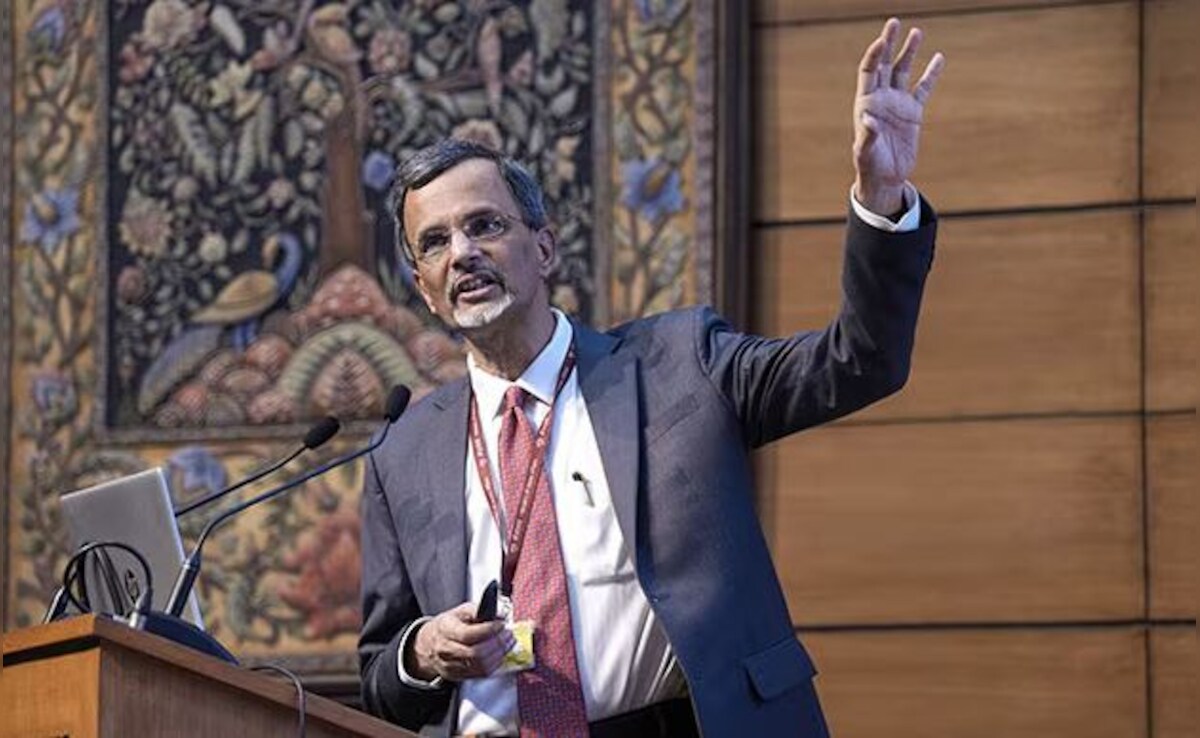
Chief Economic Advisor V Anantha Nageswaran said with the US trade deal, India FY27 growth could be seen closer to 7.4% due to the economic upside and boost to foreign capital flows.
Notably, the Economic Survey released last week pegged India's real GDP growth at 6.8%-7.2% for the 2026-27 fiscal year.
India-US Trade Deal Live Updates: All About Ambassador Sergio Gor Who Negotiated Tariff Truce
Sergio Gor, 38, became the US ambassador to India just a month ago. Even in such a short time, he has quickly emerged as a key figure in reshaping US - India relations under President Trump.
Speaking to NDTV, Gor said the deal was possible because of the strong friendship between the two nations. He said the US-India relationship has “limitless potential” and that the agreement opens a new chapter in ties between the two countries.
India-US Trade Deal Live Updates: No Relief For Steel And Aluminium
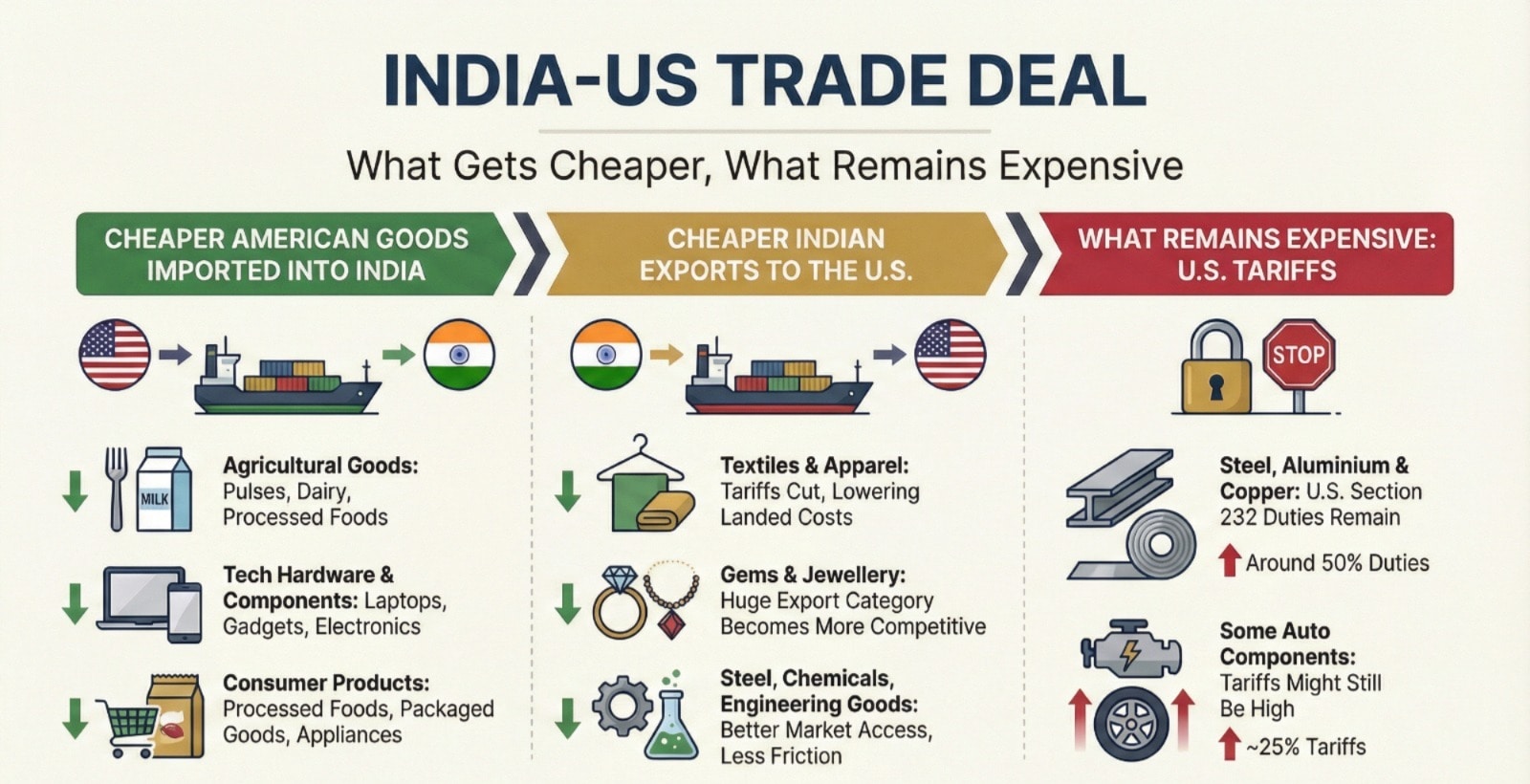
- Steel, aluminium, auto parts could still face steep 25-50% US tariffs
- Steel, aluminium, copper exports from India could still face 50% tariffs despite trade deal.
- These sectors have been slapped with Section 232 duties, which are not usually waived due to a Free Trade Agreement.
- Select auto components could continue facing 25% tariffs.
- Zero tariffs for pharmaceuticals, aircraft and parts, smartphones, certain mechanical, electronic components to continue.
India-US Trade Deal Live Updates: NDA Leaders Praise PM Modi
Leaders of the ruling National Democratic Alliance praised PM Narendra Modi for sealing to India-US trade deal that will slash tariffs on Indian goods from 50% to 18%.
The PM will address the NDA Parliamentary Party meeting in New Delhi on Tuesday morning. The Parliament's budget session is underway.
Prime Minister Narendra Modi says 'thank you' when congratulated on US trade deal
— NDTV (@ndtv) February 3, 2026
NDTV's @tejshreethought reports pic.twitter.com/h7C2QxqGX3
India-US Trade Deal Live Updates: Reinforce Confidence In Ties
"The reduction in the US reciprocal tariff on Indian goods to 18% is a positive step that improves export competitiveness and reinforces confidence in long-term bilateral economic ties. Equally important is the intent on both sides to progressively lower tariffs and non-tariff barriers, which can deepen supply-chain integration, enable faster technology collaboration, and attract investment into advanced manufacturing," said Sudarshan Venu, Chairman, TVS Motor Co.
"India has now secured several strategic trade deals with key economic partners around the world. In a challenging global environment, predictability and openness in trade help Indian industry scale, innovate and create jobs. We look forward to a stronger India–US partnership that accelerates growth, expands market access, and supports India’s ambition to be a globally competitive manufacturing and innovation hub.”
India-US Trade Deal Live Updates: Mahindra Group CEO Sees Improving Predictability Businesses
“The Mahindra Group welcomes the India–US trade deal, which marks a significant step forward in strengthening bilateral trade and investment ties. The immediate reduction in reciprocal tariffs on Indian exports from 50% to 18%, along with the commitment to progressively lower tariff and non-tariff barriers, will boost growth momentum and improve the predictability businesses need to invest with confidence," said Anish Shah, Group CEO & Managing Director, Mahindra Group on India-US trade deal.
India-US Trade Deal Live Updates: Adani Stocks Jump
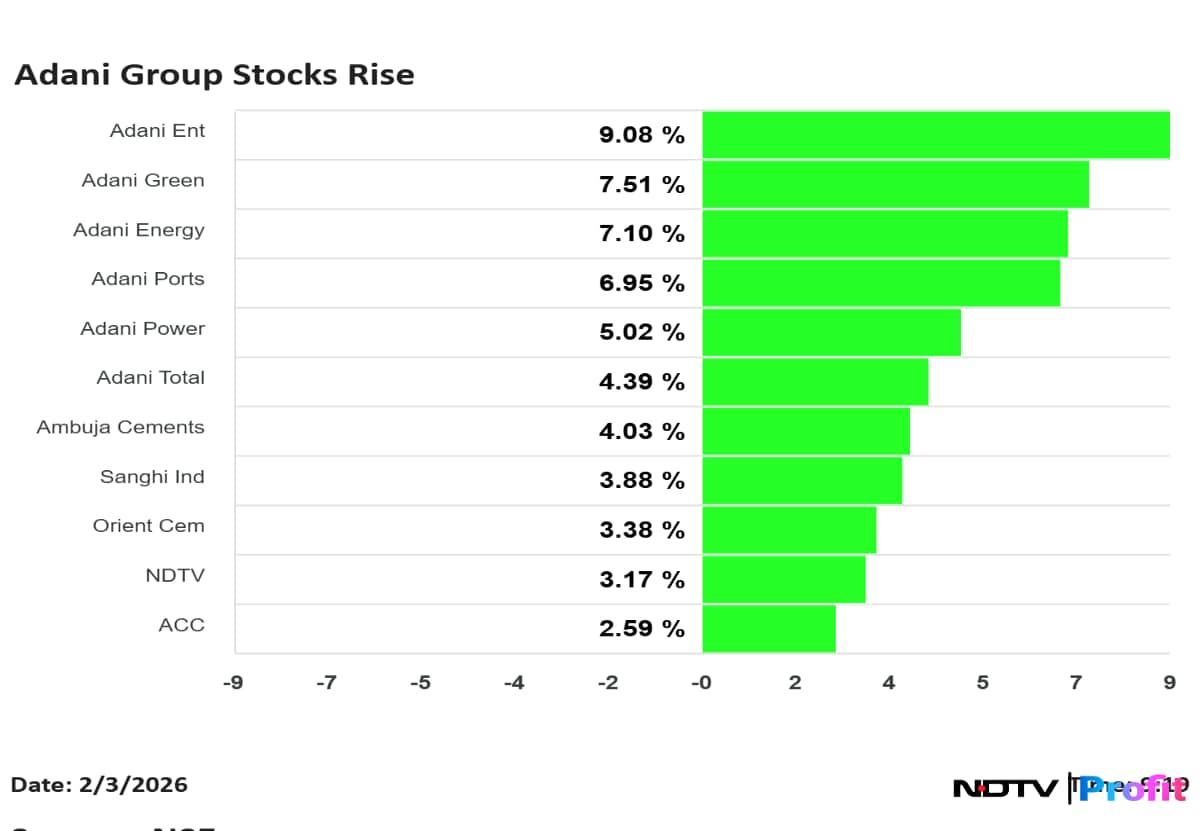
India-US Trade Deal Live Updates: Nifty, Sensex Jump
Indian equity indices surged during early trade. The Nifty gained as much as 5% to just a few dozen points short of an all time high. The BSE Sensex rose 2,319 points as of 9:20 am. It had risen as much as 4,200 points to 85,871.
Markets are tracking the trade deal between India and the United States that lowers reciprocal tariffs on Indian imports to 18% from 25%. The change takes effect immediately. India had earlier faced total tariffs of 50%, including a 25% penalty linked to buying Russian oil. The US Embassy confirmed the overall tariff rate is now 18%.
India-US Trade Deal Live Updates: 10-Year Bond Gains
The yield on the 10-year government bond fell 5 basis point at 6.71%
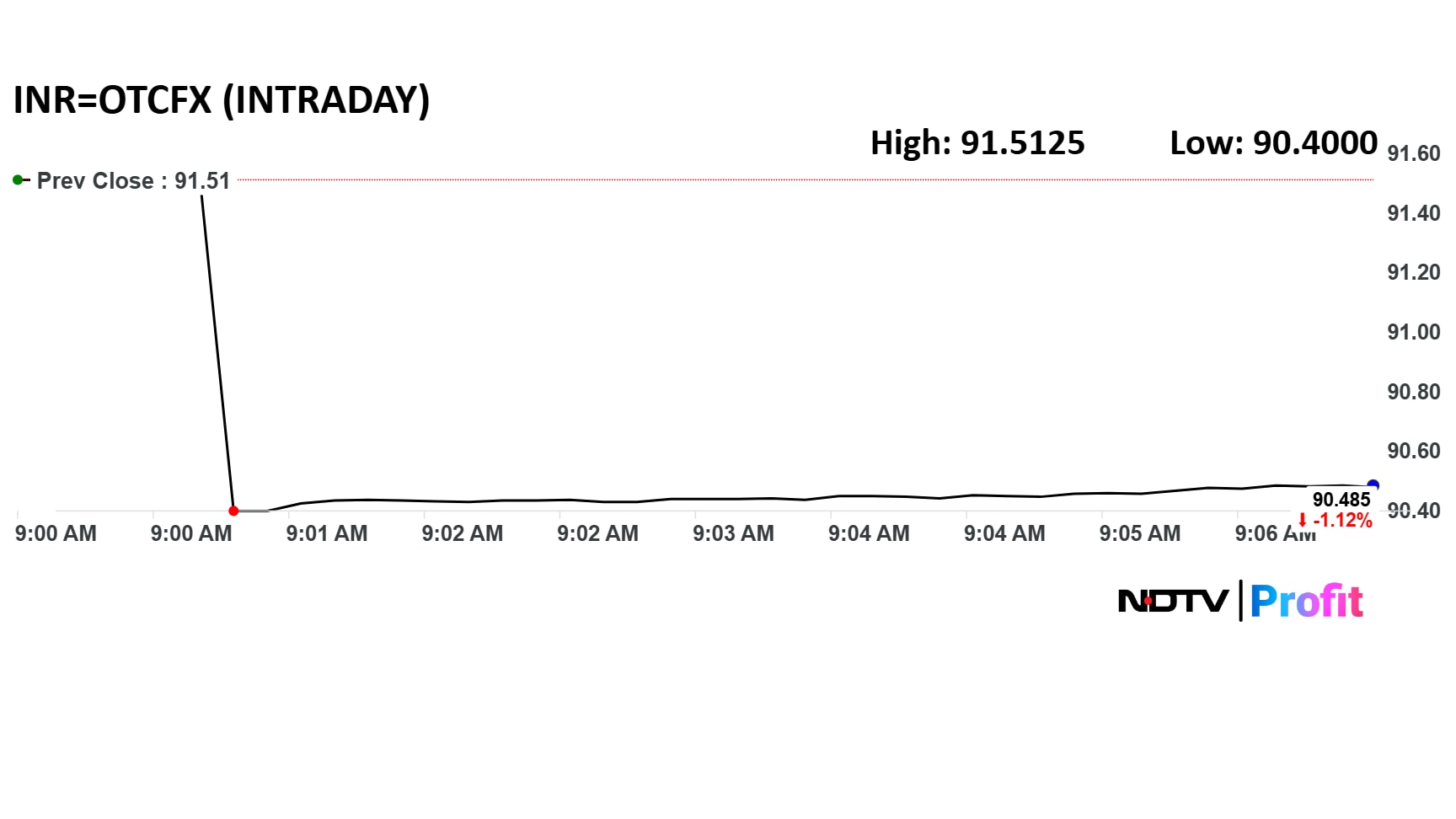
India-US Trade Deal Live Updates: Rupee Gains 1.2%
The rupee has surged as much as 1.2% against the US dollar after open today.
The USDINR went as high as 90.4, compared to Monday's close of 91.52.
India-US Trade Deal Live Updates: Auto To Textile — Here Are The Sectors Set To Benefit From Lower Tariffs
With the tariff burden now lower, companies with significant exposure to the US are expected to see relief in margins, improved competitiveness, and better order visibility. Among Indian exporters, sectors such as textiles, seafood, auto ancillaries, chemicals, and select consumer companies are likely to be the key beneficiaries.
After a spell of suffering, India's trade deal with US will bring long-sought relief to the textiles and apparel sector. The sector will be the highest beneficiary for the landmark pact as US accounts for nearly 28% of India's total textile exports, making it the single largest destination for Indian textile manufacturers. Additionally, more than half of India's textile and apparel imports are linked to US cotton, highlighting the deep trade integration between the two countries.
India-US Trade Deal Live Updates: What Get Cheaper, What Remains Expensive
India-US Trade Deal Live Updates: What Does It Mean For The Indian Stock Market?
Indian equity markets are expected to react quite positively as the deal completely eliminates key policy uncertainties.
Citi notes that the positive sentiment could trigger immediate foreign capital inflows, potentially turning India's Balance of Payments (BoP) position. The impact doesn't stop there. The trade deal may also go a long way in stabilising the rupee and easing pressure on domestic interest rates.
As noted by BofA, the effective tariffs will drop from approximately 35% to just 12-13%, thus providing a lifeline for labour-intensive sectors such as textiles, gems and jewellery and engineering goods, all of which have recently faced growth headwinds.
Welcome move for global trade! Congratulations! After today evening’s talks between the US President Mr @realDonaldTrump and the Indian Prime Minister Shri @narendramodi , tariffs on Indian goods coming down sharply from 50% to 18% with immediate effect. A big win for…
— Ashish Chauhan (@ashishchauhan) February 2, 2026
India-US Trade Deal Live Updates: Rupee In Focus
India-US trade deal: The rupee is set to rally sharply today and reduction on tariffs on Indian goods. Analysts at OCBC and Finrex Treasury Advisors see the currency rising about 1% on Tuesday, while Barclays predicts a “knee-jerk rally” of 1-2% after the trade deal, according to Bloomberg.
USD/INR fell 0.5% to 91.5163 on Monday.
Implied opening from forwards suggest spot may start trading around 90.14. The currency extended its gains in offshore markets after the US decision, with USD/INR 1-month non-deliverable forwards falling as much as 0.5%, extending a 1.3% overnight decline.
India-US Trade Deal Live Updates: Brokerages On Trade Deal
BofA on Trade Deal
- India to increase its imports from US in turn by $500 billion
- Effective tariffs may drop from ~35% to ~12-13%
- Could provide India with significant relief and a competitive rate across the region, with the Russian oil penalties being removed as well.
- India will be agreeing to stop purchasing Russian crude oil, purchase more crude oil from US and Venezuela.
- Provide significant relief to India’s export sector, especially labor intensive areas such as gems & jewelry, textiles, agricultural products and engineering goods.
- See growth upside risks to India’s FY27 GDP projections of 6.8%.
- Already see reasonable growth in high frequency indicators.
- Expect GDP growth to benefit further from this trade breakthrough.
- Believe RBI is now done cutting rates but will continue to manage its liquidity provisions carefully.
Citi on Trade Deal
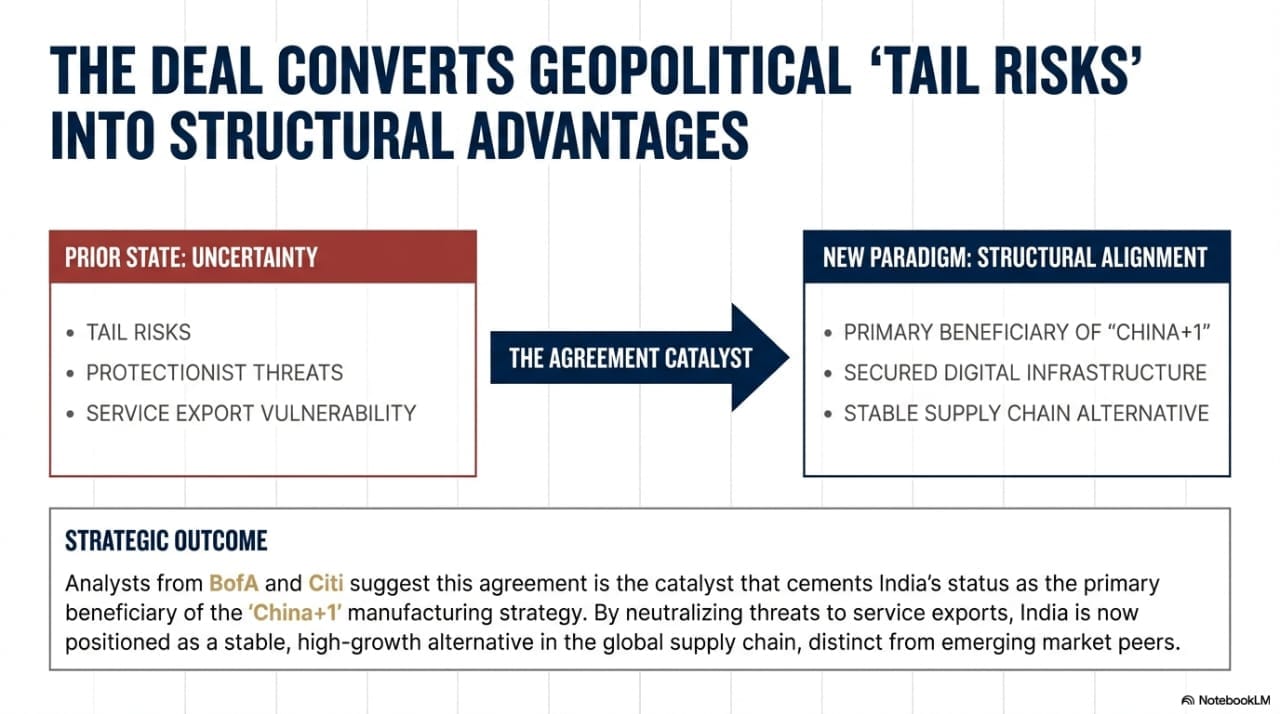
- Key tail risk of India’s geopolitical isolation about which investors were concerned has now been adequately addressed by the back-to-back deals with EU and US.
- Near-term growth risk from decline in labor intensive exports will now be substantially reduced as India’s tariff rates will be in line or lower than the peers in the region.
- Critical FDI (and to some extent FPI) theme of China 1 manufacturing in India might again become a dominant thesis.
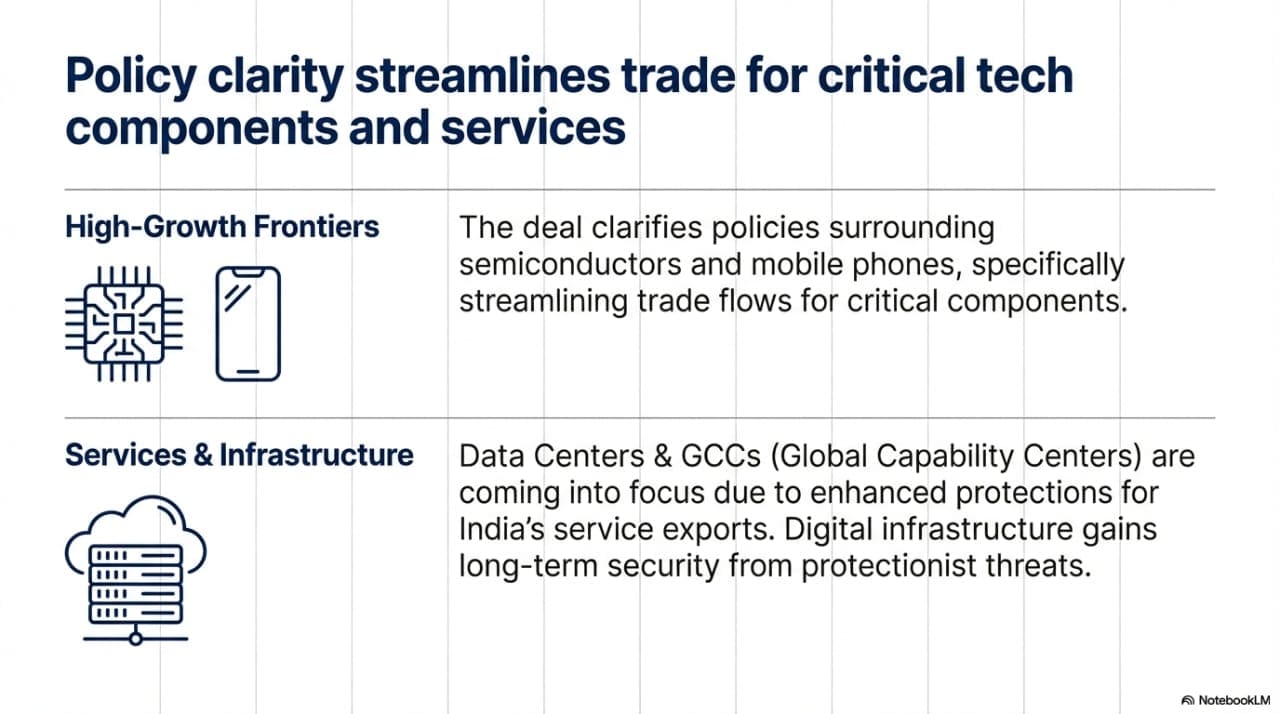
- Trade deal is likely to eliminate a critical uncertainty and make policies (data center, GCC, nuclear power, mobile phone, aircraft and semicon) more effective on the ground.
- Positive sentiment effect which can bring in foreign inflows immediately could make the BoP turn positive.
- This will ameliorate the short-term pressures on the currency and rates.
- It eliminates any risk of protectionist measures to be applied on India’s large service exports to US and the people movement.
- The rub on effect of this trade deal in boosting the equity markets could provide an important catalyst to urban consumption through the wealth effect channel.
- There could be less apprehensions in the market about India’s possible tilt towards China now.
India-US Trade Deal Live Updates: FPIs Expected To Return In Domestic Stocks
Indian equities appear poised to narrow their prolonged underperformance following a long-awaited trade agreement with the US, which has removed a major overhang on financial assets that had driven record foreign investor outflows.
Global investors have sold $3.2 billion worth of Indian equities so far this year, adding to a record $18.8 billion of outflows in 2024. After underperforming emerging-market peers by more than 30 percentage points, investor positioning weakened further in January, when India’s weight in the MSCI Emerging Markets Index slipped below South Korea’s for the first time since December 2021. This marks a sharp reversal from a period when India was challenging China for the top index position.
India’s valuation premium over the rest of Asia has also declined to its lowest level in nearly five years, as concerns over tariffs and a prolonged earnings slowdown weighed on market sentiment.
According to Jefferies Financial Group strategists, including Mahesh Nandurkar, the US trade agreement should help reverse negative foreign investor sentiment toward Indian assets. When combined with recent trade deals involving the EU, the UK, and other regions, the rupee could see a meaningful near-term boost, potentially acting as a catalyst for renewed foreign portfolio inflows.
Source: Bloomberg
India-US Trade Deal Live Updates: Market Dynamics
_03_February_26.jpeg)
_03_February_26.jpeg)
_03_February_26.jpeg)
_03_February_26.jpeg)
_03_February_26.jpeg)
_03_February_26.jpeg)
_03_February_26.jpeg)
India-US Trade Deal Live Updates: Editor's Take
INDIA-US DEAL: WORTH THE WAIT!
- India US trade deal has taken longer than expected but is on terms favourable.
- The drop in tariffs from 50% to 18% effectively puts India on better terms than Vietnam, Bangladesh, China.
- Back to back deals with the EU and US prove 'slow and steady wins the race'.
- Deal terms not a big negative as India has been cutting down import of Russian crude for a while.
- While deal inks an 18%,some calculations set effective tariff as low as 12%.
- Obvious benefit to textiles, leather, gems and other export oriented sectors.
- Need to see: What concessions have been made on agricultural imports if any.
- Need to see: If deal eases transfer of technology in key areas.
India-US Trade Deal Live Updates: American Trade Lobby Welcomes Agreement
US Chamber of Commerce President and CEO Suzanne P. Clark welcomed the India-US trade deal, saying the announcement will reduce tariffs and non-tariff barriers that will benefit American and Indian companies and workers in both great nations.
"We are optimistic that this is the first step toward a comprehensive trade agreement that will unlock even more private sector collaboration, and we look forward to reviewing the details of the deal," she aid.
India-US Trade Deal Live Updates: Economic Ties Set To Reach New Heights, Says Rajnath Singh
"A landmark moment for India-US relations as a historic trade deal has been finalised, bringing tariffs down to a significantly lower 18% and opening a new chapter of deeper and greater economic cooperation," said Defence Minister Rajnath Singh.
"I congratulate Prime Minister @narendramodi and US President @realDonaldTrump on reaching this decisive agreement, which will significantly strengthen our strategic partnership and deliver tangible benefits to both the countries and their people. With this agreement, India–US economic ties are set to reach new heights," he added.
India-US Trade Deal Live Updates: FM Sitharaman Posts On X
The India-US trade deal is a "good news for Made In India products" as they now face reduced tariff of 18%, said Finance Minister Nirmala Sitharaman on X. She noted that the
She thanked PM Modi and President Trump for their leadership. "People of our two large democracies stand to benefit."
Good news for #MadeInIndia products. They will now face reduced tariff of 18%.
— Nirmala Sitharaman (@nsitharaman) February 3, 2026
Thanking the leadership of PM @narendramodi and @POTUS for this development.
People of our two large democracies stand to benefit. #IndiaUSRelations
India-US Trade Deal Live Updates: Tariffs On India Lower Than Most Regional Peers
India has emerged with a clear tariff advantage over several competing export economies after New Delhi and Washington announced a trade deal on February 2, lowering tariffs on Indian goods to 18%. India now faces the lowest US tariffs among all emerging markets after South Korea. The move places India below or on par with most South and Southeast Asian peers, improving its relative cost competitiveness in key global markets.
Prime Minister Narendra Modi welcomed the announcement, calling it a boost for domestic manufacturing. "Delighted that Made in India products will now have a reduced tariff of 18%," Modi said in a post on social media platform X, thanking US President Donald Trump for the decision.
Lower Than Most Regional Peers
At 18%, India's tariff rate is now lower than several major export-oriented economies in Asia. Bangladesh, Sri Lanka, Taiwan and Vietnam face tariffs of 20%, while Indonesia, Malaysia, Thailand, the Philippines and Pakistan are levied 19%. Cambodia also faces a higher tariff burden at 19%.
Among South Asian economies, India's positioning is particularly significant. While Afghanistan faces a lower tariff of 15%, its limited manufacturing depth and small export base mean it is not a meaningful competitor. Pakistan, India's closest rival in textiles and select manufacturing segments, faces a marginally higher 19% tariff, putting Indian exporters at a relative advantage.
Essential Business Intelligence, Sharp Market Insights, Practical Personal Finance Advice, Daily Fuel, Gold and Silver Prices and Latest Stories — On NDTV Profit.