- India may face a widening edible oil deficit in 2027 due to El Nino's impact on imports
- Domestic edible oil production could drop by 5-10% in 2026-27 amid drought in key regions
- Oil palm yield losses have an 8-12 month lag, affecting supply primarily in 2026-27
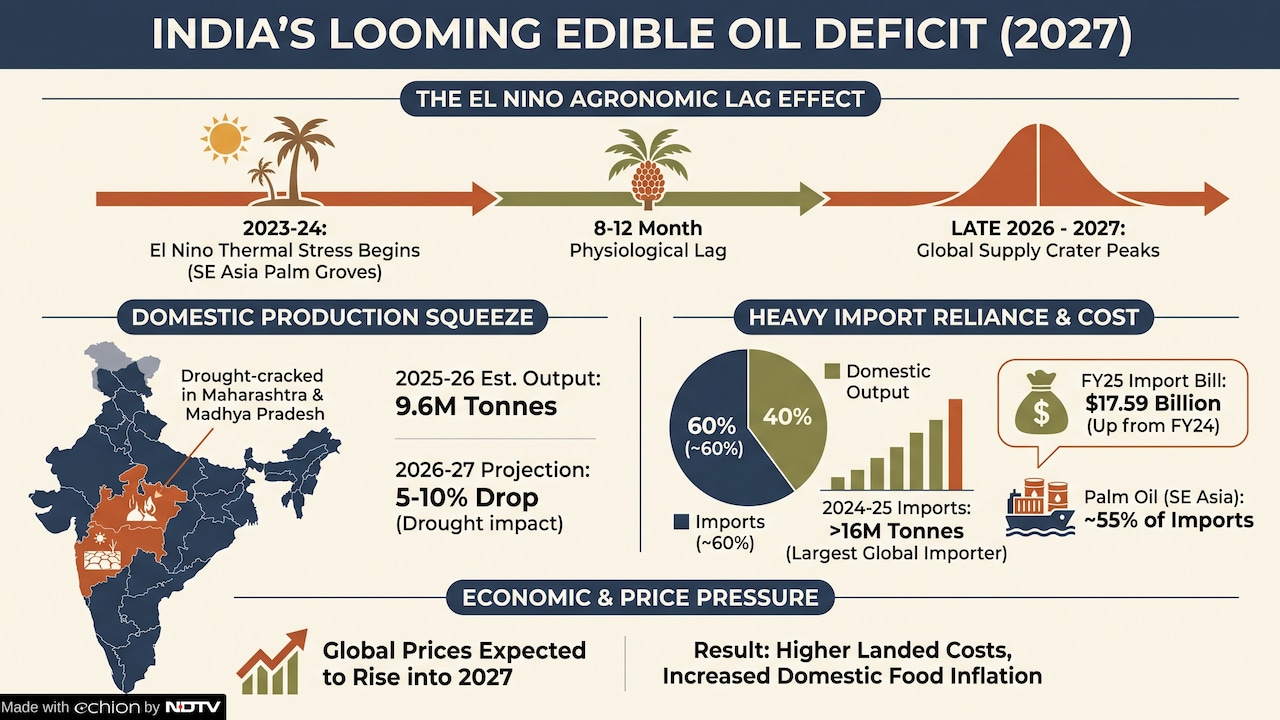
India could be facing a widening edible oil deficit in 2027, as the adverse effect of El Nino may hit the import pipeline. The country's domestic edible oil production, estimated by the Indian Vegetable Oil Producers' Association 9.6 million tonnes in the 2025-26 season, could edge lower, given that an erratic weather phenomenon is hurting both the key agricultural sowing season.
For the world's largest importer of edible oils, the macroeconomic balance is shifting unfavourably. Southeast Asian palm oil groves, which supply the bulk of India's daily cooking fat requirements, are bearing the brunt of sustained thermal stress. According to data tracked by the US National Oceanic and Atmospheric Administration's Climate Prediction Center, equatorial Pacific sea surface temperature anomalies peaked well above historical thresholds during the latest warming cycle, triggering weather anomalies that threaten multi-year agricultural cycles.
Speaking to NDTV Profit, SEBI-registered commodity market analyst Mukesh Tailor noted that while global headwinds are mounting, India retains proven institutional and trade cushions.
Also Read | Layoffs Are Rising In Tech, But These Skills Are Helping People Unlock Better Pay
"India relies on palm oil imports from various geographies, and not just Indonesia and Malaysia. Even in 2022, when Indonesia imposed an interim ban on exports, India was able to navigate through the crisis. The government is expected to similarly navigate the headwinds that El Nino may pose," Tailor told NDTV Profit.
On domestic crop dynamics, Tailor projected localized stress in key producing pockets but flagged offsetting factors in central India.
"There will be some 5-10% impact on edible oil production in 2026-27 season, as some of the high soyabean production areas of Maharashtra is facing a drought-like situation. However, there is relief as rainfall has been adequate in the Malwa belt of Madhya Pradesh, where soyabean is highly cultivated," Tailor added.
The Agronomic Lag Effect
The impact of an El Nino cycle on oil palm yields does not follow the immediate trajectory seen in annual row crops like wheat or soybeans. Oil palms respond to prolonged moisture stress and elevated vapor pressure deficits through a protracted biological defense mechanism, aborting emerging female inflorescences and terminating young fruit bunches.
According to research bulletins published by the Malaysian Palm Oil Board, this physiological disruption creates an eight to twelve-month lag before yield losses register in crude palm oil output. The dry conditions and severe moisture deficits recorded across major growing belts over the past year mean the resulting supply crater will only peak across global physical markets between late 2026 and 2027.
The reality of this impending squeeze was echoed heavily across the trading floor at the Globoil India 2026 conference in Mumbai last week. Addressing delegates on October 1, Thomas Mielke, Executive Director of Hamburg-based forecaster Oil World, warned that global vegetable oil prices will inevitably rise into 2027 on tighter supply.
ALSO READ: Super El Nino Intensifies: India Faces Higher Risk Of Heat, Dry Conditions, WMO Warns
"Global vegetable oil prices may rise in the coming months and into 2027 on tighter supply as disrupted Black Sea sunflower-oil shipments coincide with declining South American soyoil exports," Mielke stated, as quoted by Reuters.
India's Widening Structural Gap
This impending global production shortfall hits India at a vulnerable inflection point. According to data released by the Solvent Extractors' Association of India earlier this year, the country's annual edible oil consumption is pushing past 25 million tonnes. However, domestic production remains heavily constrained, and has struggled to exceed 10 million tonnes.
India's total imports topped 16 million tonnes in 2024-25, per official data. This made the country the biggest importer of edible oil, surging past the US and China.
This domestic output deficit forces New Delhi to rely on overseas purchases for approximately 60% of its total domestic consumption. The financial toll of this reliance is immense. According to trade flow figures from the Directorate General of Commercial Intelligence and Statistics, India's vegetable oil import bill rebounded to $17.59 billion in the 2024-25 fiscal year (FY25), up from $15.05 billion in FY24. Within this massive import basket, palm oil shipments from Indonesia and Malaysia consistently account for roughly 54 to 55% of the total volume.
Efforts to expand domestic oilseed acreage continue to run into structural bottlenecks. The Directorate of Economics and Statistics under the Ministry of Agriculture and Farmers Welfare notes that while domestic rapeseed and mustard sowing expanded significantly — crossing the 10-million-hectare mark during both the 2023-24 and 2024-25 Rabi crop seasons — erratic post-monsoon precipitation patterns and competition for land from staple cereals continue to cap the growth of indigenous soybean and groundnut production.
Imported Inflation And The 2027 Horizon
The convergence of biological supply lags, stagnant production profiles, and inelastic domestic demand threatens to spill directly into India's macroeconomic balance sheet. Because palm oil is the cheapest and most heavily consumed cooking fat in India, any offshore supply compression translates rapidly into higher landed prices at Indian ports, directly elevating food inflation within the Consumer Price Index.
The risk is magnified by currency dynamics and shifting price parities across competing edible oils. In an analytical note published for Fastmarkets Palm Oil Analytics, Senior Analyst Dr. Sathia Varqa pointed out that destination markets cannot simply trade around these structural shortfalls. Varqa observed that when crude palm oil loses its traditional price discount against substitute soft oils like soy and sunflower, price-sensitive destination buyers like India are forced into aggressive basket rebalancing, driving landed import parity costs higher.
For policymakers in New Delhi, the window to preempt this structural crunch is narrowing. The physiological latency of El Nino means the harvest shortfalls are already locked into the biological cycle of Southeast Asian plantations. While geographic diversification and regional supply buffers provide crucial near-term insulation, India faces an inescapable expansion in its cooking oil import bill heading into 2027 unless domestic oilseed productivity accelerates materially.
ALSO READ: El Nino Effect? Kashmir Valley Sizzles With Decades-High Day Temperatures
Essential Business Intelligence, Sharp Market Insights, Practical Personal Finance Advice, Daily Fuel, Gold and Silver Prices and Latest Stories — On NDTV Profit.