- China's 2025 GNI per capita is $14,230, just below the high-income threshold
- China aims to remain a "developing country" for financial and diplomatic benefits
- Urban-rural income disparity in China remains significant despite growth
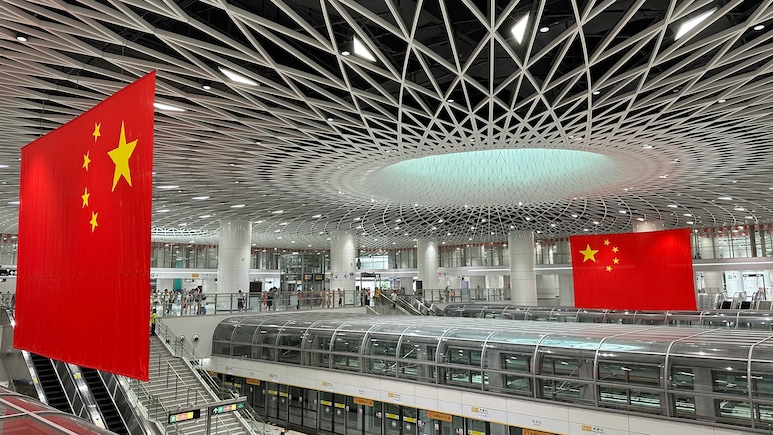
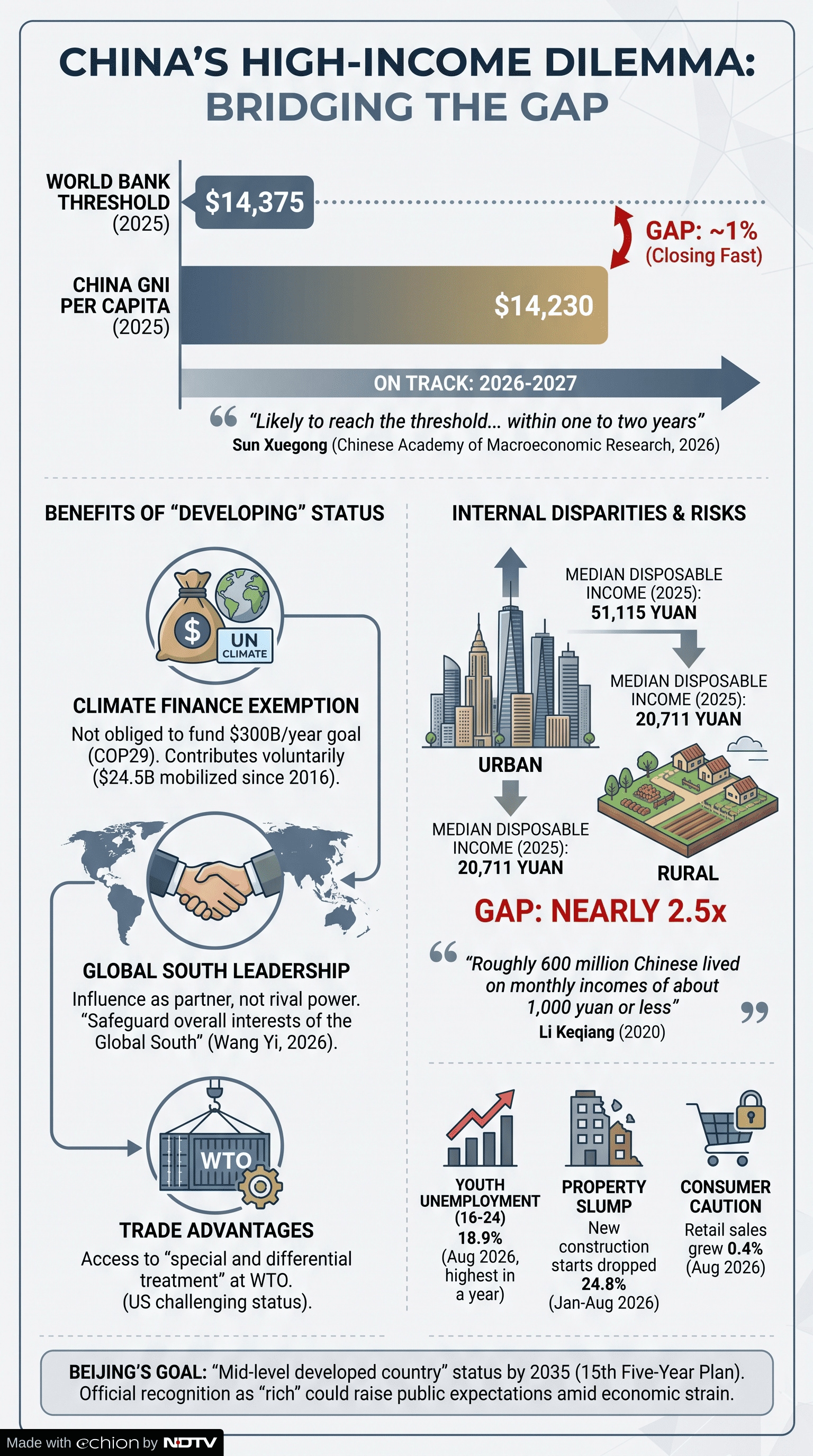
China is close to an economic milestone it has little interest in celebrating. In its latest annual review, the World Bank set the high-income threshold at a gross national income (GNI) per capita of more than $14,375, up from $13,935 a year earlier. China fell just short. Its Atlas-method GNI per capita for 2025 was $14,230, which keeps it in the upper-middle-income group for now. The gap is about 1%.
The gap has been closing fast. In the July 2025 review, China's 2024 GNI per capita was $13,660. China's GNI reached 139.4 trillion yuan ($19.2 trillion) in 2025. Using official data, state-run China Daily put per capita GNI at roughly $14,503 at current exchange rates.
Beijing's own advisers expect the line to be crossed soon. Speaking to China Daily in May 2026, Sun Xuegong of the Chinese Academy of Macroeconomic Research, which is affiliated with the National Development and Reform Commission, said China is “likely to reach the threshold of a high-income economy” within one to two years.
Also Read | Layoffs Are Rising In Tech, But These Skills Are Helping People Unlock Better Pay
Even so, officials keep insisting the label changes nothing.
‘The World's Largest Developing Country'
China's line has not changed. Foreign ministry spokesperson Guo Jiakun has described the country as “the world's largest developing country”, and the phrase appears regularly in official statements.
The phrase brings tangible benefits. The first is money. Under the UN climate principle of “common but differentiated responsibilities,” China is not obliged to contribute to the $300 billion-a-year climate finance goal agreed at COP29, which developed nations must fund by 2035. China contributes, but strictly on its own terms. At the COP29 climate summit in Baku in November 2024, Vice Premier Ding Xuexiang said China had provided and mobilised more than $24.5 billion in climate finance for developing countries since 2016, while stressing that “China's South-South cooperation is voluntary, contrasting with the mandatory obligations of developed nations.
The second is influence. Being “developing” lets Beijing present itself as leader of the Global South, a partner to countries in Africa, Asia and Latin America rather than a rival Western power. Foreign Minister Wang Yi said in his 2026 diplomatic agenda that China will “firmly safeguard the overall interests of the Global South”.
The third is trade. China's developing-country status at the WTO gives it access to “special and differential treatment”. Washington has long objected, with the US Congress passed the “Ending China's Developing Nation Status Act” in 2023, urging international bodies to reclassify China.
ALSO READ: IMF Raises India's FY27 GDP Growth Forecast To 7%, Cuts China's 2026 Outlook
Two Chinas
Beijing's position is not purely tactical. Shanghai and Shenzhen may rival Western cities, but income in rural areas is far lower.
In 2025, the median per capita disposable income of urban residents was 51,115 yuan, against 20,711 yuan for rural residents, a gap of nearly 2.5 times. National per capita disposable income was 43,377 yuan (about $6,192), a fraction of the GNI headline. In 2020, then-Premier Li Keqiang acknowledged that roughly 600 million Chinese lived on monthly incomes of about 1,000 yuan or less.
Some of Beijing's own economists make the same point. Zhang Bin of the Chinese Academy of Social Sciences told China Daily in May that crossing the line does not mark the end of development, noting China's per capita GNI remains far behind the more than $80,000 of leading advanced economies such as the US.
Domestic Risk
There is also a political cost at home. Official recognition as a rich nation would raise public expectations of better pensions, healthcare, wages and welfare at a time when the economy is under strain.
Youth unemployment for 16-24-year-olds rose to 18.9% in August 2026, the highest in a year. The property slump is getting worse, with real estate investment felling 19.9% year-on-year in January-August, and new construction starts dropped 24.8%. Consumers remain cautious, with retail sales growing just 0.4% in August, while the economy grew 4.7% in the first half.
That helps explain why Beijing's stated goal is more modest. The 15th Five-Year Plan (2026-30) reiterates the aim of reaching “mid-level developed country” status by 2035, nearly a decade after the World Bank is likely to call it high-income.
The World Bank's next review is due in July 2027, and at the current pace China could be reclassified then.
ALSO READ: RBI's Rupee Defence May Drain Banking Liquidity, Ease Currency Pressure
Essential Business Intelligence, Sharp Market Insights, Practical Personal Finance Advice, Daily Fuel, Gold and Silver Prices and Latest Stories — On NDTV Profit.