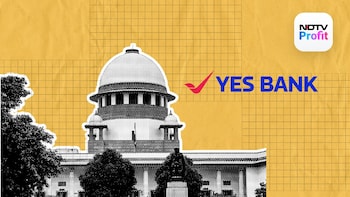
- The Supreme Court set aside Yes Bank's Rs 8,415 crore AT1 bond write-down decision
- The ruling upheld Bombay High Court's quashing of the bond write-down in January 2023
- Yes Bank shares fell 7.8% after the Supreme Court verdict on the bond write-down case
The Supreme Court on Thursday set aside the decision to write down Yes Bank's Additional Tier-1 bonds worth Rs 8,415 crore, handing relief to institutional and retail investors whose holdings were wiped out during the lender's rescue in March 2020.
The ruling comes nearly five months after the apex court reserved its order on May 20, following arguments from the Centre, the Reserve Bank of India, Yes Bank and bondholders.
A Bench led by Justices Dipankar Datta and Augustine George Masih upheld the Bombay High Court's January 2023 judgment that had quashed the write-down, and dismissed the appeals filed by Yes Bank, the RBI and the Centre.
Also Read | Layoffs Are Rising In Tech, But These Skills Are Helping People Unlock Better Pay
Following the court verdict, Yes Bank shares were hammered on the exchanges, falling as low as as 7.8% to Rs 19.55 apiece. This marked the stock's biggest intraday plunge since June last year.
The matter dates back to March 2020, when Yes Bank was facing a severe crisis marked by rising bad loans and falling depositor confidence. The RBI superseded its board and imposed a moratorium, after which the government approved a reconstruction scheme backed by capital infusion from an SBI-led consortium.
As part of the rescue, the bank's administrator wrote down AT1 bonds worth Rs 8,415 crore to zero. AT1 bonds are high-risk instruments designed to absorb losses when a bank's capital falls below specified thresholds.
The central question before the top court was whether the write-down was backed by the reconstruction scheme, or by the RBI master circular and the contractual terms governing the bonds.
ALSO READ: What Are AT1 Bonds At Centre Of Yes Bank's Plea Before Supreme Court
During the hearing, judges repeatedly asked when a bank is legally considered reconstructed, whether on the date the scheme is notified, or only after all its steps are complete. The court also examined whether the “non-viability” trigger for a write-down could arise independently, or had to be linked to a completed reconstruction under Section 45 of the Banking Regulation Act.
The Centre had argued that AT1 bonds are governed by RBI rules and bond contracts, not the reconstruction scheme, and that the RBI master circular provides a complete framework for the trigger, action and consequences of a write-down. The Solicitor General had also contended that writing down the bonds before the State Bank of India-led capital infusion could have jeopardised the rescue.
Bondholders, however, had countered that the final reconstruction scheme deliberately left out any provision for writing down or converting AT1 bonds, even though such provisions had been considered in the draft. They argued this preserved their rights, and that the administrator could not unilaterally write down the bonds after the scheme came into force.
The government had warned the court that nearly Rs 1 lakh crore of AT1 bonds are outstanding across banks, and that an adverse ruling could dent investor confidence in these instruments and complicate future bank rescues. Bondholders had pushed back, saying the case was limited to whether the law and due process were followed in this specific instance.
Notably, Yes Bank had said any financial liability arising from the court's final verdict would be recognised in the relevant future reporting period. The lender had also said it did not anticipate a material financial impact, maintaining the write-down complied with applicable contractual terms and regulatory guidelines.
ALSO READ: Yes Bank Q1 Results: Net Profit Jumps 34% Despite Provisions Rising; Asset Quality Remains Stable
Essential Business Intelligence, Sharp Market Insights, Practical Personal Finance Advice, Daily Fuel, Gold and Silver Prices and Latest Stories — On NDTV Profit.