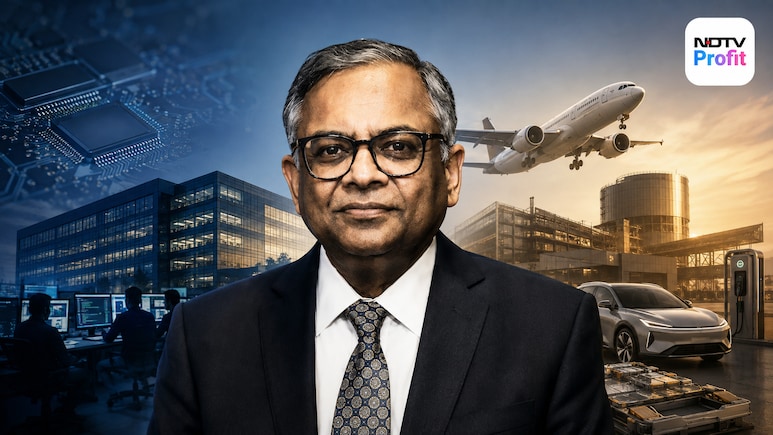
- Natarajan Chandrasekaran joined TCS in 1987 and became Tata Sons chairman in 2017
- He transformed TCS into a global tech firm and key profit driver for Tata Group
- As chairman, he led Tata into aviation, semiconductors, EVs, and digital businesses
Natarajan Chandrasekaran's rise inside the Tata Group is a study in continuity. He joined TCS in 1987 as a fresh engineer and never left the fold, rising through the ranks to become chairman of Tata Sons three decades later. Few executives anywhere have shaped both a company and its parent conglomerate quite so completely.
That three-decade run is now drawing to a close. Chandrasekaran stepped down as chairman of Tata Sons on Wednesday, days ahead of a contentious annual general meeting scheduled for August 18. His term as chairman was originally due to run until 20 February 2027, and he has asked the board to begin a succession process, having removed himself from consideration for reappointment.
The Climb: From Programmer To Chairman
Also Read | Layoffs Are Rising In Tech, But These Skills Are Helping People Unlock Better Pay
Chandra's Tata journey has unfolded in five distinct phases:
- 1987 onward: Joined TCS as an entry-level employee
- Before 2009: Served as chief operating officer and executive director at TCS
- 2009-2017: Led TCS as chief executive officer and managing director
- October 2016 onward: Inducted as director on the Tata Sons board
- February 2017 onward: Took over as chairman of Tata Sons and the wider Tata Group, formally assuming charge on 21 February 2017
That last appointment came at a turbulent moment for Tata, arriving soon after Cyrus Mistry's abrupt ousting. Chandra was the first non-Parsi and the first Tata Sons insider risen entirely from within a group company to lead the conglomerate.
TCS: The Engine He Built First
Long before he ran the Tata Group, Chandra built his reputation running its most valuable company. TCS remains the biggest profit generator in the Tata stable, a cash engine that has funded much of the group's newer bets and kept it anchored as a bellwether for India's IT sector.
Under his stewardship as CEO and MD, TCS pushed aggressively into North America and Europe, deepened ties with Fortune 500 clients, and moved from being a large Indian outsourcer to a genuinely global technology services firm. That transformation gave Chandra the credibility and the balance sheet he would later lean on as group chairman.
ALSO READ: Trent To Titan: Tata Stocks That Created The Most Wealth Under N Chandrasekaran
The Pivot: Taking Tata Into New-Age Businesses
If TCS was Chandra's apprenticeship, his chairmanship has been defined by pushing Tata into sectors the group had never touched. His biggest achievement, by most accounts, has been steering a 150-year-old conglomerate toward new-age businesses:
- Aviation, through Air India
- Semiconductors, a first for any Indian conglomerate at this scale
- Electronics manufacturing
- EV ecosystem, spanning vehicles, batteries and charging infrastructure
- Digital businesses under the Tata Neu umbrella
- AI and technology focus across group companies
Air India: The Boldest Bet
Chandra's most closely watched wager has been aviation. Tata Sons brought Air India back into the fold after the government divestment, ending a 69-year gap since the airline's nationalisation. That acquisition kicked off a consolidation drive still under way, bringing Air India, Vistara and AirAsia India under one roof. It is widely seen as the single biggest gamble of his tenure, a bet on turning a loss-making national carrier into a credible global airline.
ALSO READ: Rs 63,000 Crore Gone In One Hour As Tata Group Stocks Slide After N Chandrasekaran Steps Down
Semiconductors: The Strategic Shift
The other marquee move has been Tata's entry into chip manufacturing, a sharp departure from the group's traditional playbook. Alongside this, Chandra has pushed the build-out of electronics manufacturing capabilities, positioning Tata to ride India's semiconductor ambitions just as the country looks to build a domestic chip supply chain from scratch.
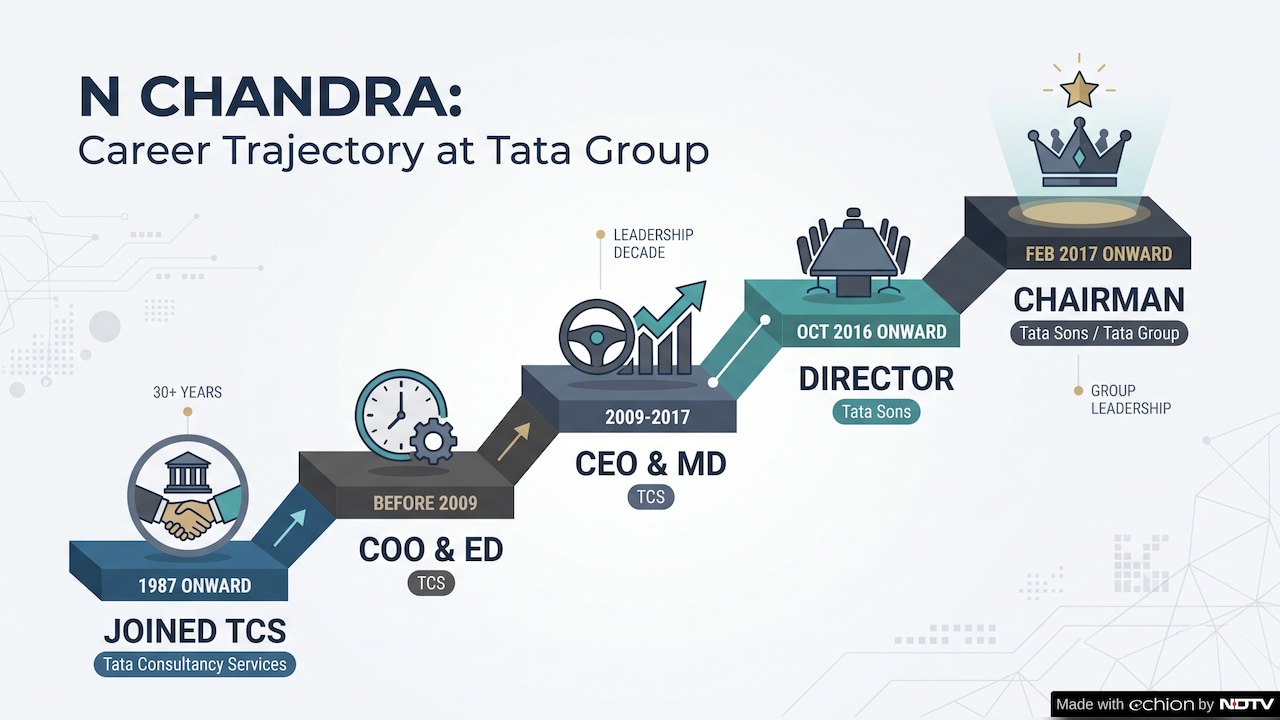
N Chandra's journey at Tata Sons
Photo Credit: NDTV Profit
The Through-Line
What connects the TCS years to the chairman years is a consistent instinct: back scale, back technology, and back long-gestation bets that only a group with Tata's balance sheet can afford to make. Nearly a decade into the chairmanship, that instinct reshaped what the Tata Group actually is, from a conglomerate built on steel, salt and software to one betting equally on chips, batteries and aircraft.
An Exit Clouded By A Board Split
Chandrasekaran's exit was not entirely of his own choosing. Tata Trusts had unanimously recommended a five-year extension of his term from February 2027, a recommendation the Tata Sons Nomination and Remuneration Committee and board had backed unanimously at a meeting on 12 September 2025. That resolution was then tabled before the Tata Sons board on 24 February 2026 to meet regulatory timelines, but did not go through because one board member withheld support. In the six months of deadlock that followed, no fresh decision was reached, and Chandrasekaran ultimately chose to step aside rather than let the matter spill into a shareholder vote at the AGM. The resignation comes almost exactly ten years after Cyrus Mistry's removal as Tata Sons chairman in 2016, the very episode that had first opened the door for Chandrasekaran.
With his departure, the Tata Group faces its first leadership transition in nearly a decade, one that will test whether the aviation, semiconductor and EV bets he championed can outlast the man who placed them.
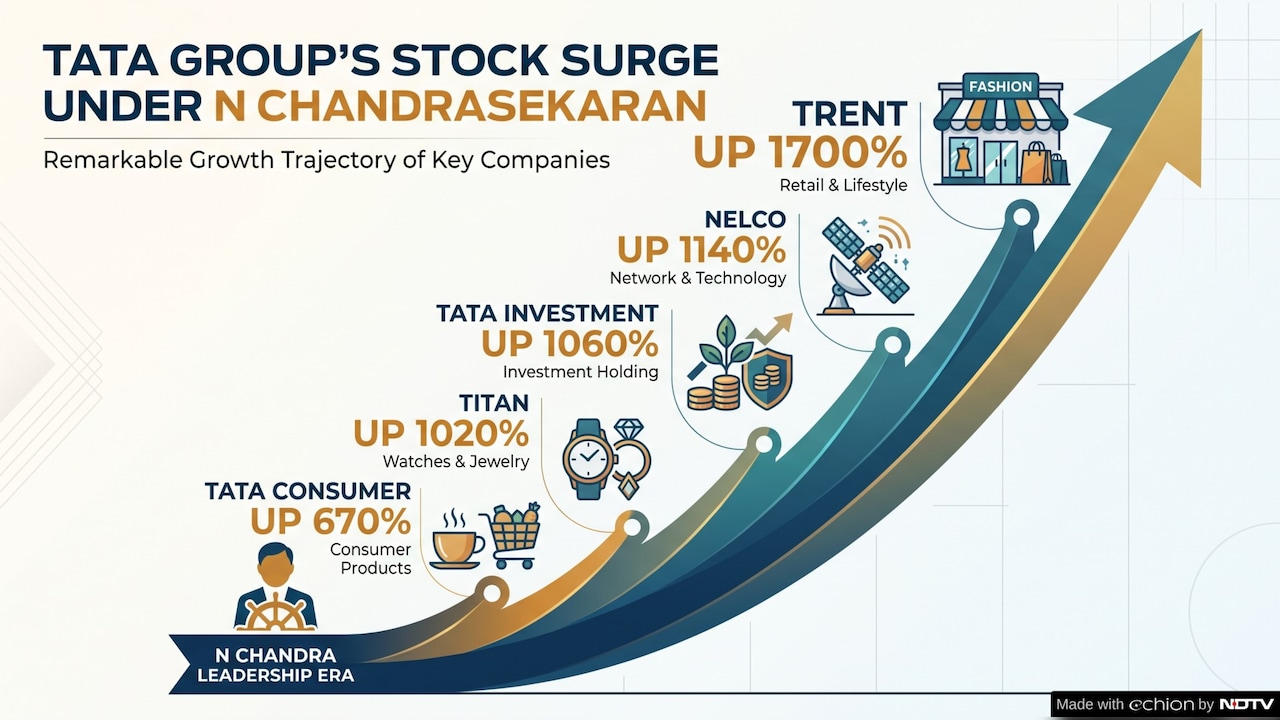
A look at the top stocks under N Chandra's leadership
Photo Credit: NDTV Profit
ALSO READ: N Chandra Steps Down As Tata Sons Chairman — Five Key Points From Letter To Board
Essential Business Intelligence, Sharp Market Insights, Practical Personal Finance Advice, Daily Fuel, Gold and Silver Prices and Latest Stories — On NDTV Profit.