Why Sales Fell? It’s More Than What Truckmakers Say
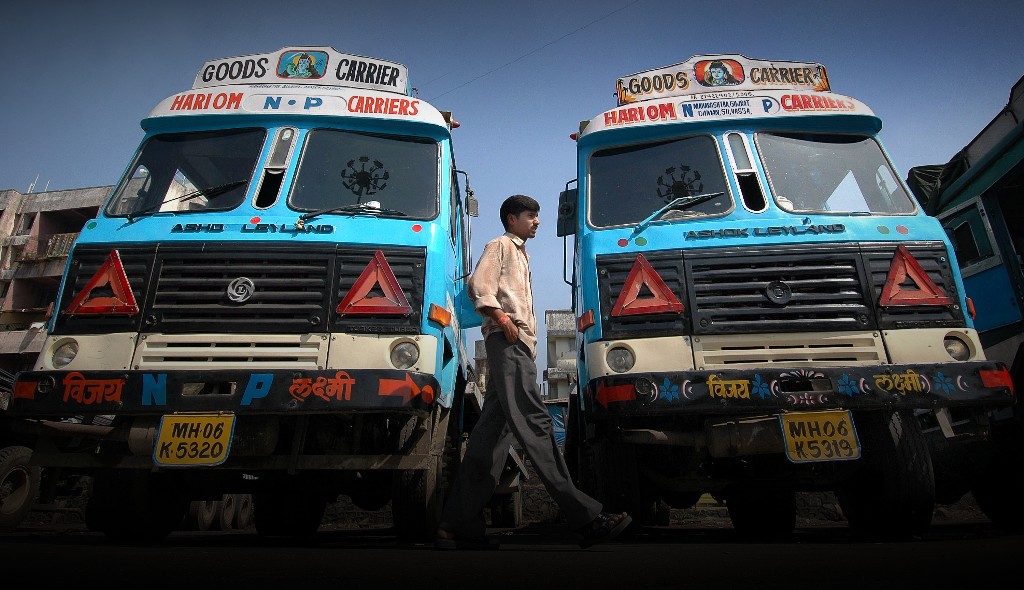
Truck and busmakers have attributed the decline in sales during April and May to the shortage of fuel injectors, a device that pumps diesel into cylinders of an auto engine.
There was a severe global supply constraint of fuel injection pumps complying with the new Bharat Stage-IV emission standards, market leader Tata Motors Ltd. said in a media statement. These issues are expected to be resolved shortly and full capacity will be available by July, said the company whose volumes fell 40 percent over a year ago to 6,522 units in May.
Brokerage HDFC Securities concurred. “Lower medium and heavy commercial vehicles volumes dragged overall CV volumes, owing to supply constraints of BS-IV engine components,” it said in a report.
Bosch, the largest supplier of such parts, declined to respond to an email seeking reasons for the shortfall, and the expected recovery period.

While April and May largely followed a pattern as sales of medium and heavy commercial vehicles continued to fall over a year ago, the reason cited this time is unique. Industry experts, however, said slower sales can't be blamed on fuel injectors alone.
The fall in CV sales during April-May seems to be due to two reasons: the pre-buying before BS-IV norms were enforced, and the uncertainty before GST (goods and services tax). Operators want to know the full impact of GST; there seems to be some uncertainty about how they will be impacted.Abdul Majeed, Partner (Assurance), PricewaterhouseCoopers India
The Supreme Court denied auto companies any relief and barred sale of older BS-III vehicles from April 1, making it mandatory for all vehicles sold after that to comply with the stricter emissions norm, which warranted price hikes.
Anticipating the price hike, several fleet operators advanced their purchases to February and March, pushing volumes higher during those months and at the same time building fleet capacities.
Pre-buying before implementation of BS-IV would have been a cause for the fall in sales during April-May, agreed Kumar Kandaswamy, senior director at Deloitte Touche Tohmatsu, adding that the shortfall in supply of parts can't be the only reason.
There was uncertainty in the run up to the GST in April and May, which is likely to continue through June. Medium and heavy commercial vehicles will be taxed at 28 percent under GST, marginally lower than the cumulative exiting rate of around 29 percent.
People would expect prices of commercial vehicles to go down post GST rollout and hence the wait.Kumar Kandaswamy, Senior Director, Deloitte Touche Tohmatsu
Also, GST is likely to do away with the state taxes levied at borders for transit of commercial vehicles. This would significantly reduce the time taken to pay such levies as they would be collected at one point under GST. This, Majeed said, would be another aspect fleet operators would want clarity on before making purchases, as the tonnage of vehicles might have to be altered to increase efficiency.
“The freight demand has also not gone up significantly over the recent past. Most operators seem to be utilising around 70 percent of their capacity,” Majeed said. “In such a situation, new purchases are not required, hence people seem to be holding off.”

-
Navigating Energy Crossroads: S Jaishankar's Call For Diversified Supply Chains At G20 Ministerial Meeting

As geopolitical fault lines continue to test maritime trade routes and commodity flows, Jaishankar's message remains pertinent: true economic resilience requires open markets, protected transit lines, and a genuine commitment to multilateral cooperation rather than coercion.
-
Indians Are Travelling, But Not Every Journey Is A Holiday | The Week In Whys
Pilgrims, patients and working women are the real travellers, and the system hasn't quite caught up with them.
-
Getting To Work Costs Women More | The Reason Why
It is not just about women paying more than men. It is about women paying much more in cities than in villages.
-
AI Bias In Investing Cannot Be Eliminated, But It Can Be Governed
Framing is a particularly important example as identical financial information presented in terms of gains rather than losses can lead an LLM to reach a different assessment.
-
Joining The Dots | Dark Skies, Steady Diya: Why Hope Holds This Diwali
With war, a weak rupee and foreign outflows weighing on sentiment, policymakers at the NDTV World Summit and market veterans at NDTV Profit Ignite: Diwali Edition offered the same advice: stay invested and filter out the noise.
-
The Curious Case of Equitas Small Finance Bank And A CEO Who Quit For Stock
PN Vasudevan believes persistent investor concerns over a perceived conflict of interest had become a governance overhang on Equitas Small Finance Bank's stock, even as the lender improved profitability and asset quality.
-
Talking Points This Week: AI Cash Burn, A Tiger Comeback And An India That Still Finds Its Own Path
India is not immune to higher oil or tighter global liquidity, yet its earnings base is broader, its domestic policy levers are still available.
-
Foreign Investors Own Half Of HDFC Bank and ICICI Bank. An LTCG Cut Could Matter Most Here
Foreign portfolio investors have US$115 billion parked in HDFC Bank, ICICI Bank. If the government cuts long-term capital gains tax, Jefferies says returning foreign money could land here first.
-
'Never Seen This Level Of Negativity': Sandeep Tandon Says The Next Rally May Be Closer Than You Think
Veteran investor Sandeep Tandon says foreign selling is easing, large-caps are due a comeback and mid-caps are crowded, while he turns positive on gold, power and pharma this Diwali.










