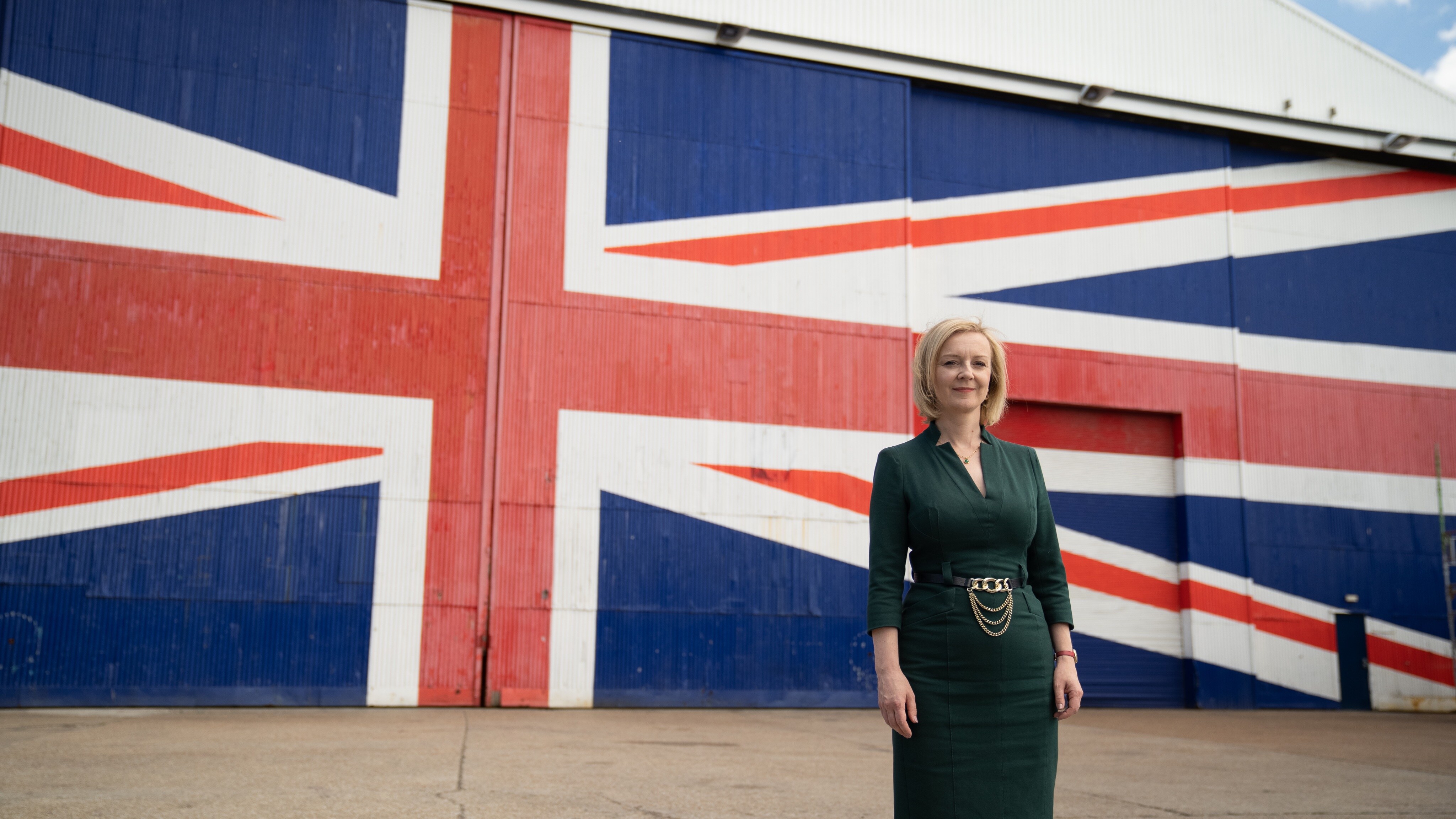
(Bloomberg Opinion) -- UK Prime Minister Liz Truss made “disruption” the theme of her conference speech on Wednesday. The first thing that needs to be disrupted is the party that made her leader.
Britain's Conservative Party is the most successful political party in the history of Western democracy. It won the most votes in 17 of the 26 general elections it fought in the 20th century, and, though it hit an electoral dry spot between 1997 and 2010, it arguably set the economic agenda of the Tony Blair and Gordon Brown administrations. Since the party's foundation in 1834, it has provided the surest path to Downing Street, with only four of the 22 men and women who have led the party failing to become prime minister.
Yet the Party that just held its annual conference in Birmingham is in turmoil, trailing Labour by 22 points, according to Politico's poll of polls, and Cabinet ministers are fighting like cats in a sack. Suella Braverman, the home secretary, has accused other prominent Tories of “mounting a coup.” Cabinet members have spoken out against Truss's plan to link the rise in benefits to wages rather than inflation. Paul Goodman, the editor of Conservative Home, a Tory web site, says that his party now faces a wipeout bigger than the one in 1997 when Tony Blair stormed to a 179-strong majority.
It's easy to blame all this on Truss. In a month at the helm, she has already made enough political mistakes to last a lifetime. She tried to push through a radical change in government policy with the slimmest of mandates. She failed to “roll the pitch” for her new agenda, instead relying on a policy of shock and awe. A great politician — a Lloyd George or a Bill Clinton — might have been able to pull off such a feat by sheer force of charisma or rhetorical genius. But Truss is singularly lacking in these political arts.
Yet the prime minister is only a symptom of Tory disarray, not a cause. The real question isn't why she has made so many mistakes, but why the party promoted her so far beyond her competence. There is growing talk of ditching Truss for another leader sooner rather than later. But replacing leader after leader in an ever-faster carousel will not save the party in the long term. It must be willing to make broader structural reforms.
For all its electoral successes since 2010, the Tories have been rotting from within.
The party today is a shadow of its former self. In the early 1950s, membership stood at 2.8 million and the party was deeply rooted in national life. Conservatism was a distinct philosophy with its reverence for traditional institutions, celebration of the ordinary pleasantries of life, and acceptance of the necessity of controlled change. Today membership stands at a mere 172,000.
Much of the party's thinking has been outsourced to think tanks that cluster around the Westminster village. These groups can electrify debate and destroy tired orthodoxies as they did under Margaret Thatcher (one of the most influential think tanks, the Centre for Policy Studies, was set up by Thatcher and Keith Joseph). But they are also dangerous allies, since they're in the business of pushing ideas as far as they can and tend to argue that more radicalism is the right solution.
The party has also got into the habit of waging war on all and sundry, particularly the establishment, as if compromise is a proof of weakness and belligerence evidence of virtue. This is partly a curse of Thatcherism, when belligerence did indeed bear fruit, but it is even more a consequence of Brexit. The “Leave” faction within the Conservative Party triumphed by waging relentless war first on “Remainers” within their own ranks and then on the pro-Remain establishment that, in their view, was bent on watering down Brexit. Brexiteers such as Braverman and her predecessor, Priti Patel, seemed to relish their unpopularity. Vice-signaling became to conservatives what virtue-signaling is to many liberals: a cheap way of stroking your ego.
This hollowing out has generated all sorts of problems for the party. The most obvious is that it's increasingly out of touch with much of the country, particularly the urban centers that generate much of the growth. The Tory coalition is dominated by elderly homeowners (the average member age is 58) who may embrace economic growth in theory but fiercely oppose its consequences if it means local disruption.
The party refuses to tackle public spending for the elderly such as state pensions that benefit from a triple lock. It seems to go out of its way to alienate young people: Look at the prominence in Tory circles of fogies such as Jacob Rees-Mogg (who talks about his nanny in a faux Edwardian accent) and John Redwood. The average age at which people first vote Tory has been increasing for decades, as property prices have risen and mortgages have grown more difficult to get.
The second problem is the party lurches from one policy to another. In fact, Conservatives are arguably no longer a party so much as a collection of warring interest groups with their own identities and think tanks. They've shifted wildly from David Cameron's virtue-signaling, to Theresa May's “the good that government can do,” to Boris Johnson's “get Brexit done” to Liz Truss's libertarianism. Truss adopted so many policies from the Institute of Economic Affairs, a libertarian think tank that even Mark Littlewood, the IEA's director and an old friend of Truss from Oxford, was a bit nonplussed. She's been forced to backtrack on the idea of cutting taxes for top earners, but she continues to demonize her opponents as the anti-growth coalition and talk about shrinking the state in the long-term.
The most important consequence of the hollowing out is a dire shortage of high-quality talent. A party of free enterprise will always have difficulty in attracting top-quality people when free enterprise itself offers higher salaries and more prestige. (One of the most striking things about Truss's speech at the party conference is that it didn't offer a word of praise for public service, which is supposedly at the heart of a politician's calling.) But the party has done its best to squander the limited resources that it has.
Brexit is the main culprit here. A generation of talented Remainers, notably Rory Stewart and David Gauke, were forced to abandon politics while pro-Brexit popinjays such as Braverman rose up the ranks. But time has also played a part. Each new prime minister dismissed anybody who stood in their way. Truss left Michael Gove, one of the party's most experienced and successful figures, on the backbenches while promoting MPs who had supported her leadership such as Kwasi Kwarteng.
The combination of a weak talent pool and rapid turnover means that the top of government is notably lacking in experience. There are no wise heads to tell the prime minister and the chancellor that you can't cut taxes while increasing spending without upsetting the market — and no trusted elders to calm the revolution currently brewing in the parliamentary party.
More From Bloomberg Opinion:
- Truss's Economic Plan Isn't the Disaster Everyone Says It Is: Tyler Cowen
- Why Investors Are Facing Even More Market Instability: Mohamed A. El-Erian
- The Bank of England Is Right to Snub Calls for Emergency Action: Mark Gilbert
This column does not necessarily reflect the opinion of the editorial board or Bloomberg LP and its owners.
Adrian Wooldridge is the global business columnist for Bloomberg Opinion. A former writer at the Economist, he is author, most recently, of “The Aristocracy of Talent: How Meritocracy Made the Modern World.”
More stories like this are available on bloomberg.com/opinion
©2022 Bloomberg L.P.
Essential Business Intelligence, Sharp Market Insights, Practical Personal Finance Advice, Daily Fuel, Gold and Silver Prices and Latest Stories — On NDTV Profit.