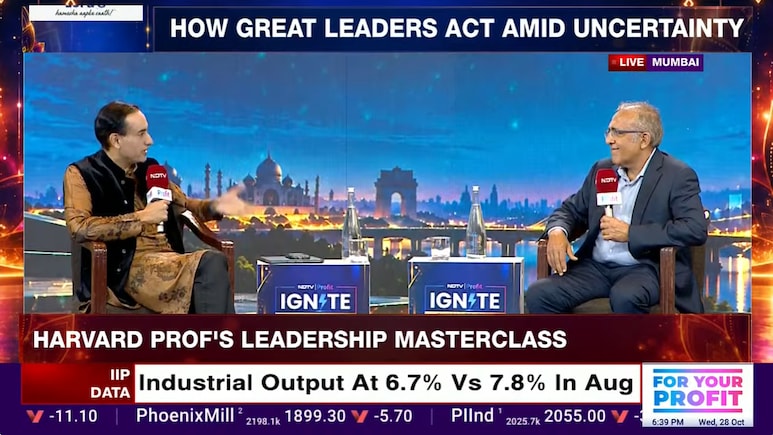
As artificial intelligence reshapes industries and challenges established business models, the ability of companies to confront uncertainty rather than retreat from it could determine who wins and who falls behind.
Ranjay Gulati, Paul R. Lawrence Professor of Business Administration at Harvard Business School, believes courage will become a critical differentiator as businesses navigate the AI transition. Speaking at NDTV Profit Ignite, Gulati argued that companies must move beyond defensive strategies and develop the confidence to experiment, adapt and challenge assumptions about their future.

-
 'Worst Is Behind': Quant MF Sees Market Bottom, Flags 'Extreme Euphoria' In Midcaps
-
 India's Mutual Fund Industry Could Become A $1 Trillion Opportunity, Say Fund Managers
-
 'Foreign Investors Are Baraatis': Raamdeo Agrawal's Take On LTCG Tax
-
 India Could Gain If AI Trade Unwinds, US Midterms May Hurt Markets: Ramesh Damani
-
 'Switch Off The Noise, Focus On Earnings': Raamdeo Agrawal's Advice To Investors
-
 Stay Invested Through Market Cycles: Raamdeo Agrawal at NDTV Profit Ignite
-
 Ramesh Damani Remains Bullish On India For Next 20-30 Years, Sees Bargains Amid Market Weakness
-
 CAS Came After A Long Consultation Process: SEBI Chairman Tuhin Kanta Pandey AT NDTV PROFIT IGNITE
-
 Aim To Cut FPI Onboarding Time From Mth To Five Days: SEBI Chairman Tuhin Kanta Pandey AT NDTV PROFI
-
 "I Am A Material Man In A Material World': Quantum Advisors' Ajit Dayal On NDTV Profit Ignite
“Courage is resourcing yourself to take action in the face of fear,” Gulati said, challenging the popular perception that courageous leaders are fearless.
Also Read | Layoffs Are Rising In Tech, But These Skills Are Helping People Unlock Better Pay
He said fear is a natural response to uncertainty, which has become a defining feature of today's business environment. Unlike risk, where outcomes and probabilities can be estimated, uncertainty involves situations in which the possible outcomes are not fully known.
Gulati warned that established companies risk falling behind when they use emerging technologies primarily to protect existing businesses instead of reimagining how they operate.
Traditional organisations often try to layer AI onto existing workflows, while newer, AI-native businesses can build their operations around the technology from the outset. This difference, he suggested, could create a widening divide between companies seeking to defend their market positions and those looking to redefine their industries.
“Market inflection points create winners and losers,” Gulati said, adding that courage could become the currency that separates them.
His research into corporate behaviour during recessions offers a glimpse of the challenge. Gulati said 91% of companies in the study focused primarily on cutting costs during downturns, while only 9% invested in growth alongside cost-cutting. Companies that continue investing strategically when others pull back can emerge stronger, he argued.
For Gulati, courage is not simply an individual leadership trait. It must also be built into an organisation's culture, purpose and decision-making processes.
Companies can encourage employees to speak up, create room for experimentation and accept failure as part of learning. Leaders must also give teams a clear sense of purpose, helping them understand why change matters beyond short-term financial targets.
Citing DBS Bank and Microsoft, Gulati highlighted how organisations can rethink their identities to pursue more ambitious goals. He also pointed to Lego's return to its founding idea of intelligent play as an example of how purpose can help companies make difficult strategic choices.
However, courage should not be confused with recklessness. Gulati advocated taking measured steps into unfamiliar territory through pilots, experimentation and learning rather than either rushing in blindly or doing nothing.
He also urged leaders to make their underlying assumptions about markets, technology and competition explicit. In the AI era, Gulati's message was clear: companies that acknowledge uncertainty, question established beliefs and act despite fear may be better positioned to seize opportunities than those that prioritise protecting the status quo.
Essential Business Intelligence, Sharp Market Insights, Practical Personal Finance Advice, Daily Fuel, Gold and Silver Prices and Latest Stories — On NDTV Profit.