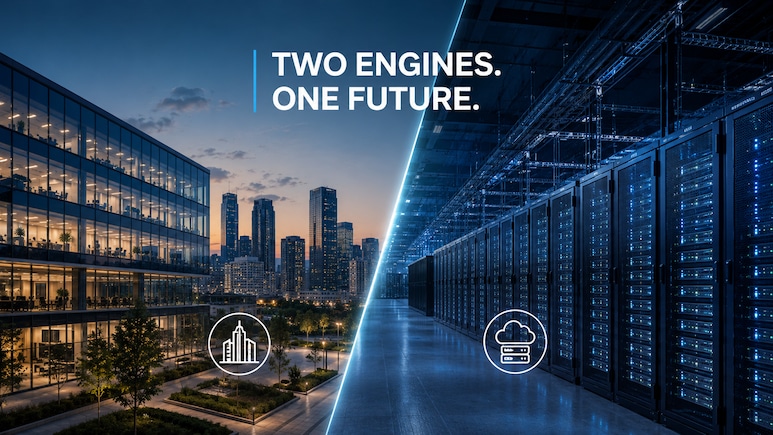
India's commercial real estate market is entering a new phase as artificial intelligence (AI) drives demand for data centres even as office leasing slows across the country's biggest markets.
Office space remains the larger and more established part of the market, but data centres are becoming the faster-growing segment. Office gross absorption across India's top seven cities fell 6% year-on-year to 19.4 million square feet in the June 2026 quarter, while net absorption fell 21% to 9.9 million square feet, according to Kotak Institutional Equities.
The slowdown reflects delayed tenant decisions, with the West Asia conflict making companies more cautious about committing to new space. But the underlying shift in commercial real estate is clearer in data centres, where rising AI workloads are creating demand for land, power, cooling and connectivity.
Also Read | Layoffs Are Rising In Tech, But These Skills Are Helping People Unlock Better Pay
Anarock Capital expects AI workloads to account for 70% of data centre demand by 2030. Shobhit Agarwal, CEO of Anarock Capital, said the sector could require more than 101 million square feet of data centre space by then.
"The projected 101 mn sq ft data centre footprint highlights the sheer physical scale of the real estate opportunity," Agarwal said.
The shift means commercial real estate is increasingly being shaped by two distinct demand cycles: established office markets supported by global capability centres (GCCs), and a data centre market entering a major investment and construction phase.
Office Slowdown
Office supply remained controlled during the June quarter, helping keep vacancy rates low despite weaker leasing.
Developers added 10.1 million square feet of new office space, down 3% from a year earlier. Vacancy across the top seven markets fell to 11.3% in June from 11.5% in March and 13.2% a year earlier.
Total office stock reached 757 million square feet, up 6% year-on-year.
GCCs remained the main source of demand. Chennai recorded three transactions totalling 2.1 million square feet, anchored by TCS and L&T Mindtree. Hyderabad recorded 1.9 million square feet across two deals, while Bengaluru and Pune each recorded 1.5 million square feet.
The listed landlords also continued to lease space, although quarterly volumes remained below their full-year totals.
Embassy REIT leased 1.3 million square feet during the quarter, compared with 6.4 million square feet in FY2026. Mindspace REIT leased 0.9 million square feet, against 7.1 million square feet for the full year. K-Raheja Corp's REIT leased 1.4 million square feet, compared with 3.5 million square feet in FY2026. Brookfield India leased 1.1 million square feet, against 4 million square feet in the previous year.
All four now have occupancy above 90% and are targeting 95% by the end of FY2027.
Rental Support
High occupancy leaves landlords with room to raise rents even as leasing activity slows.
DLF has 13 million square feet under construction, an increase of 26%. Embassy REIT has 6.2 million square feet under construction and another 2.6 million square feet of future development potential.
Mindspace REIT has 6.6 million square feet under construction and 3.5 million square feet of future development potential.
Contractual rent escalations and lease resets could support double-digit growth in REIT earnings, analysts said. Distribution yields of 5.5% to 7% for FY2027 are now fully priced, they said.
The combination of tight supply and high occupancy therefore gives established office landlords some protection despite the weaker quarterly absorption figures.
Data-Centre Boom
India's data centre footprint has expanded sharply, from 0.6 million square feet in 2007 to nearly 27 million square feet across 164 facilities in the first half of 2026, according to Anarock Capital.
Capacity has crossed 1.8 gigawatts, while the pipeline for the next four years could exceed 6.7 gigawatts.
"The pipeline over the next four years could exceed 6.7 gigawatts, close to a threefold jump," Agarwal said.
Anarock expects India's data centre footprint to exceed 101 million square feet by 2030, supported by more than $300 billion in investment commitments.
"Projected footprint doesn't represent just additional built-up space requirements. This is a specialised asset class at the intersection of real estate, technology and infrastructure," Agarwal said.
AI is central to that expansion. AI models require more computing power, storage and energy than conventional applications, Agarwal said. As adoption increases, data centres are moving from supporting digital activity to becoming critical economic infrastructure, he said.
Mumbai Leads
Mumbai-MMR is the largest data centre market in India, with 54 operational facilities and 812 MW of IT capacity, accounting for almost half of the national total.
Chennai follows with 25 facilities and 298 MW. Delhi-NCR and Bengaluru each have 18 facilities, with capacities of 179 MW and 137 MW, respectively. Hyderabad has 12 facilities with a combined capacity of 178 MW.
Land availability, power, connectivity, access to renewable energy and proximity to demand centres are driving the market.
CBRE expects India's data centre capacity to grow by about 30% in 2026, adding nearly 500 MW of new capacity. That follows 440 MW of new capacity in 2025, which was a record addition. Total capacity stood at about 1,700 MW at the end of 2025.
Investment commitments reached $56.4 billion, taking the cumulative total to $126 billion. CBRE expects commitments to rise another 45% in 2026 and cross $180 billion.
JLL had projected data centre capacity to rise 66% by 2026, including 604 MW of new supply. That would require 7.3 million square feet of built space and $3.8 billion of investment.
"Mumbai will keep its lead, with Chennai next in line for growth," JLL said.
Power Constraint
The expansion of data centres is also increasing the importance of power infrastructure.
India added a record 44.5 GW of renewable capacity in 2025, nearly twice the addition in the previous year. But power availability remains the main constraint on new data centre capacity.
Data centre infrastructure is also gaining access to longer-term financing. Loans are available at 9.5% to 10.5% for tenures of up to 12 years.
A proposed tax holiday through 2047 for eligible global cloud service providers could further improve India's competitiveness.
The result is a commercial real estate market with two different growth cycles. GCCs continue to support office leasing in cities such as Chennai, Hyderabad, Bengaluru and Pune. Those same companies, through their growing AI workloads, are also contributing to the demand that data centre operators are building against.
Office landlords are therefore monetising mature, high-occupancy portfolios, while data centre developers are entering an earlier and more capital-intensive construction cycle. The balance between the two could increasingly shape India's commercial real estate market as AI adoption grows.
Disclaimer: The views expressed in this article are solely those of the author and do not necessarily reflect the opinion of NDTV Profit or its affiliates. Readers are advised to conduct their own research or consult a qualified professional before making any investment or business decisions. NDTV Profit does not guarantee the accuracy, completeness, or reliability of the information presented in this article.
Essential Business Intelligence, Sharp Market Insights, Practical Personal Finance Advice, Daily Fuel, Gold and Silver Prices and Latest Stories — On NDTV Profit.