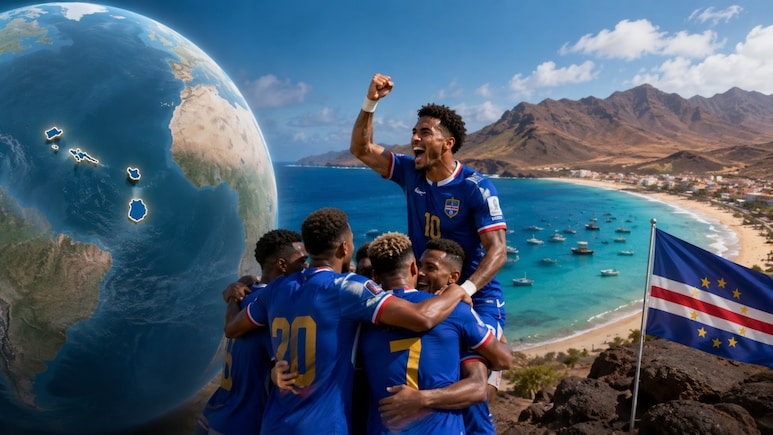
When FIFA expanded the World Cup from 32 to 48 teams, critics said the tournament would suffer, predicting weaker, lopsided games as smaller teams struggled against the big names.
Ten days in, Cape Verde has made a mockery of that argument.
The island nation first held Spain to a goalless draw, then traded blows with Uruguay in a thrilling 2-2 draw on Sunday, and now needs only a win over Saudi Arabia to reach the Round of 32 — forcing even the doubters to learn exactly where this country is.
Also Read | Layoffs Are Rising In Tech, But These Skills Are Helping People Unlock Better Pay
A Dot In The Atlantic
Cape Verde, officially known as "Cabo Verde" is an archipelago of ten volcanic islands roughly 600 to 850 kilometres off the coast of Senegal, in the central Atlantic Ocean, part of the Macaronesia ecoregion alongside the Azores, the Canary Islands and Madeira.
The islands were uninhabited until Portuguese navigators arrived in the 15th century, with the first permanent settlement founded at Ribeira Grande, now Cidade Velha, on Santiago island in 1462. With a population of around 5,30,000, it is one of the least populous countries in Africa, yet its diaspora in the United States, Portugal and Western Europe considerably outnumbers the people living on the islands today.
A History Forged In Slavery And Struggle
The islands' early prosperity came at a brutal cost: Cape Verde became a key staging post in the transatlantic slave trade, with Ribeira Grande growing into one of the wealthiest towns in the Portuguese empire by the 16th century.
As the slave trade ended in the 19th century, the economy collapsed and recurring droughts triggered famine and mass emigration, scattering Cape Verdeans across the Atlantic world.
Cape Verde finally won independence on July 5, 1975, becoming one of the few Portuguese African colonies to achieve it without armed conflict on its own soil.
Music, Language And A Culture Shaped By Departure
Portuguese is Cape Verde's official language, but daily life is carried in Kriolu, a Portuguese-based creole that varies from island to island.
The country's signature music, morna, carries a mournful quality similar to Portuguese fado, built around themes of longing and departure born from centuries of slavery and emigration. The genre's biggest icon, Cesária Évora, carried Cape Verdean sound to the world before her death in 2011, and morna was recognised by UNESCO as Intangible Cultural Heritage in 2019.
ALSO READ: Spain-Cabo Verde Draw Costs Bettor $1 Million In One Of World Cup's Biggest Wagers
An Archipelago Of Extremes
The ten islands split into two groups, Barlavento (windward) and Sotavento (leeward), and only a handful — Santiago, Santo Antão, São Nicolau, Fogo and Brava — support meaningful agriculture. Just 20 percent of the land is arable, droughts are routine, and Fogo is home to an active volcano that last erupted in 2014.
A Quiet Development Success
Cape Verde graduated from the United Nations' Least Developed Country category in 2007, one of the few nations to do so, on the back of investment in education, tourism and remittances rather than natural resources — a backdrop that makes its World Cup run feel consistent with the country's broader habit of overperforming its size.
From Colony To Stable Democracy
Since transitioning to multiparty democracy in 1991, Cape Verde has built a reputation as one of Africa's most consistent democratic success stories, with peaceful transfers of power between rival parties ever since.
Lacking natural resources, its economy runs mostly on services, with growing reliance on tourism and foreign investment, a fragility that makes its footballing breakthrough feel even more improbable — and its date with Saudi Arabia on June 27 all the more decisive.
Essential Business Intelligence, Sharp Market Insights, Practical Personal Finance Advice, Daily Fuel, Gold and Silver Prices and Latest Stories — On NDTV Profit.