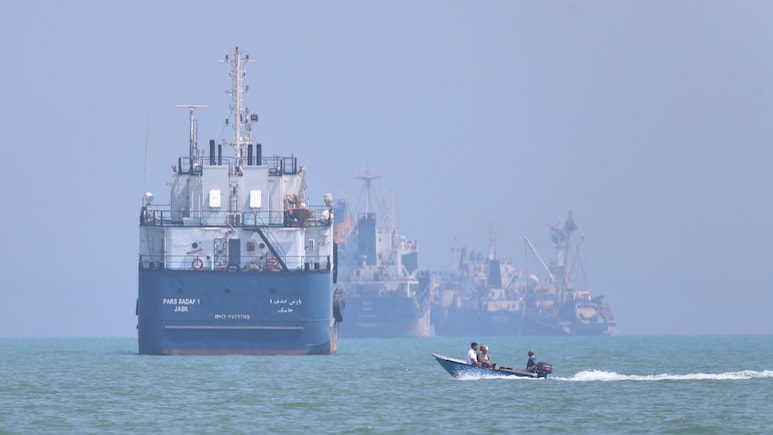
Using helicopters, aerial and underwater drones to direct convoys to waiting tankers, the US military has carried out numerous covert ship-to-ship oil transfers to maintain Gulf energy exports, according to reports.
According to shipping statistics and satellite photos examined by Reuters, the transfers began in early May and have involved at least 92 ships.
The operation near the Strait of Hormuz's edge uses a shuttling tactic that Iran uses to evade sanctions. There are two precise places where the oil transfers occur: one off the coast of Fujairah in the United Arab Emirates, and the other off the port of Sohar in Oman, the report added.
Also Read | Layoffs Are Rising In Tech, But These Skills Are Helping People Unlock Better Pay
Convoys depart 3,000–4,000 meters apart and sail in the dark, with transponders disabled and lights dimmed, to conduct these missions.
ALSO READ: 'Most Oppressed Team': Iran Coach After Team Told To Leave US Immediately After World Cup Match
As per satellite photos examined by Reuters, as recently as June 11, 17 pairs of ships were observed doing simultaneous oil transfers at the two locations.
The mission featured an Apache chopper that Iran had destroyed on June 9, which prompted retaliation bombings by the United States. On the day the Apache was shot down, Reuters used satellite imagery to count six pairs of tanker ships grouped in a limited area off the port of Sohar.
Reuters was unable to verify the Apache's involvement in the operation. A US defence official told Reuters that no Central Command forces are involved in an offshore ship-to-ship oil transfer operation. According to US officials, a drone boat saved both crew members.
The Persian Gulf Strait Authority, a new Iranian organisation created to oversee the Hormuz Strait, has set limits around the two locations where these transfers occur in the Gulf of Oman close to the Strait of Hormuz's exit. The Islamic Revolutionary Guard Corps may attack ships using drones and missiles if they disobey Iran's commands.
Throughout the duration of this US-led operation, Iran has repeatedly fired at the Fujairah port itself. The British maritime risk management organisation Vanguard reports that a tanker off the coast of Oman was hit by an "unknown projectile" this past weekend. According to a statement from Vanguard, the incident resulted in some cargo leaking, but no environmental damage, and the crew was safe. Whether the tanker was engaged in a ship-to-ship transfer was not made clear.
Approximately a fifth of the world's oil consumption typically goes through the Strait of Hormuz, which Iran essentially closed in response to the US-Israeli war. This led to the largest disruption in the world's energy supply in history and has caused global inflation.
Despite being dangerous and ineffective, the ship-to-ship transfers seem to be a part of the Trump administration's attempts to assist in restoring regular Gulf oil flows. Although specifics are yet unknown, US President Donald Trump stated that the Strait of Hormuz would reopen on Friday as part of a framework peace agreement with Iran that was unveiled this week.
ALSO READ: 'No Israel Without Me', Says Trump, Tells Netanyahu To Be 'Responsible With Lebanon'
Essential Business Intelligence, Sharp Market Insights, Practical Personal Finance Advice, Daily Fuel, Gold and Silver Prices and Latest Stories — On NDTV Profit.