Ukraine's Zelenskiy Backs Ceasefire On Energy In Friendly Trump Call
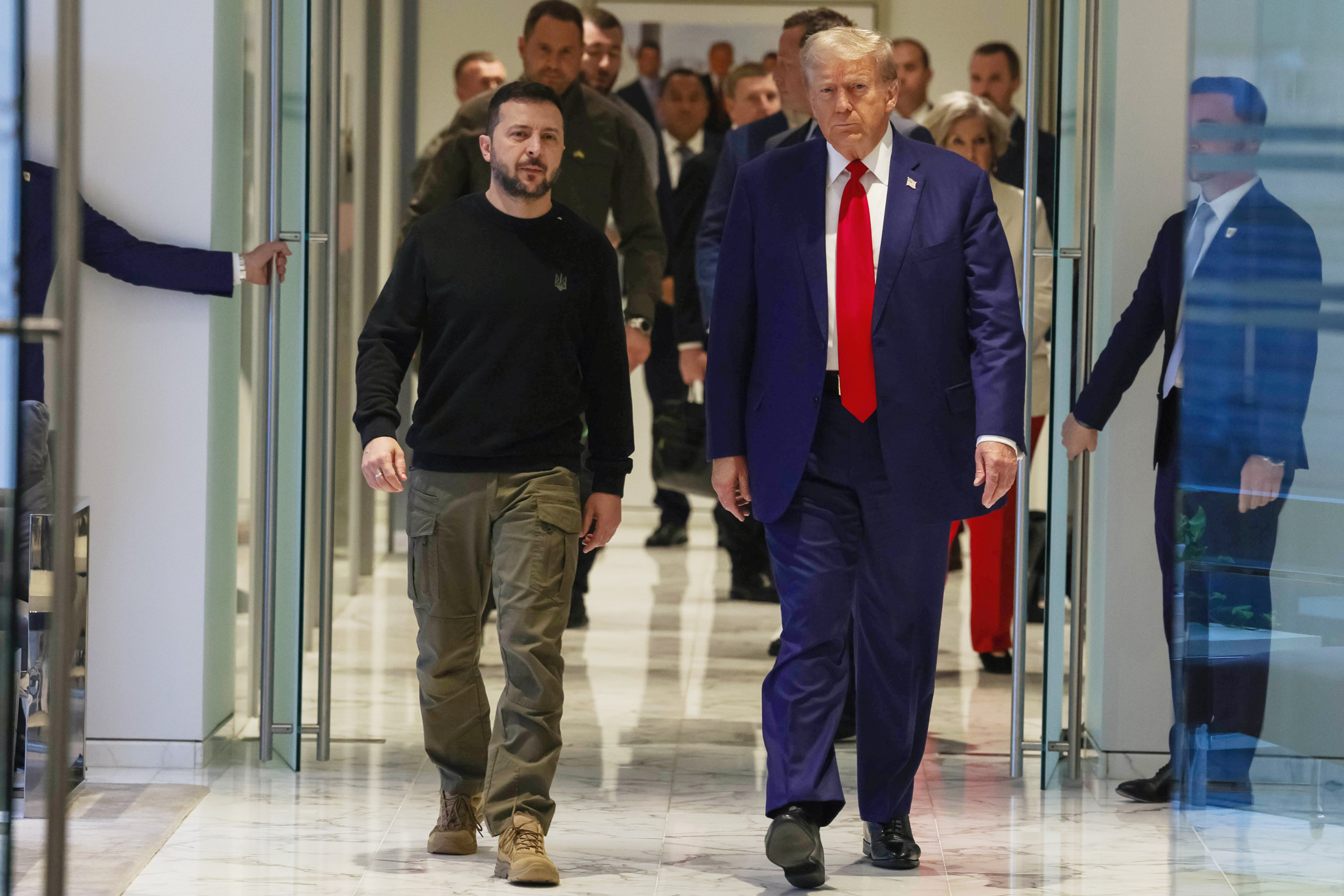
Ukrainian President Volodymyr Zelenskiy agreed to a proposal for a mutual halt to strikes on energy assets as an initial step in President Donald Trump's effort to end the war that began with Russia's full-scale invasion three years ago.
“One of the first steps toward fully ending the war could be ending strikes on energy and other civilian infrastructure,” Zelenskiy said in a statement on X after a call with Trump on Wednesday. “I supported this step, and Ukraine confirmed that we are ready to implement it.”
Trump, who had stormy exchanges earlier with Zelenskiy, described their call as “very good,” and top US officials called it “fantastic.” Trump, who at one point cut off weapons shipments and intelligence-sharing for Ukraine, promised fresh support, according to a statement on the call from Secretary of State Marco Rubio and National Security Advisor Mike Waltz.
Zelenskiy “asked for additional air defense systems to protect his civilians, particularly Patriot missile systems,” and “President Trump agreed to work with him to find what was available particularly in Europe,” they said.
The offers of support for Ukraine came a day after Trump had a friendly call with Russian President Vladimir Putin, who accepted the notion of a pause in attacks on energy facilities but gave no sign that he's dropped his insistence that Trump's proposed ceasefire be conditioned on a cutoff of weapons and intelligence aid to Ukraine and that Russia hold on to land it's seized in the war.
Trump even offered to help run Ukraine's electricity supply and nuclear power facilities, adding that “American ownership of those plants would be the best protection for that infrastructure,” according to Rubio and Waltz.
“President Trump shared details of his conversation with Putin and the key issues discussed,” Zelenskiy said. Rubio and Waltz said in their statement that “technical teams will meet in Saudi Arabia in the coming days to discuss broadening the ceasefire to the Black Sea on the way to a full ceasefire.”
Zelenskiy later told reporters on a conference call from Helsinki that he felt no pressure from Trump during their call and that no additional conditions were proposed for the partial ceasefire. He said US and Ukrainian teams will meet in Saudi Arabia March 22 to 24.
Eric Rubin, a former US ambassador to Bulgaria who's now a senior fellow at the Center for European Policy Analysis in Washington, said the Trump administration “is trying to say that Putin has agreed to Trump's proposal. But he has not. And it looks like he has no intention of agreeing to a simple ceasefire.” Rubin said Putin is “trying to use this process to negotiate” Russia's “actual, ultimate goals rather than agreeing to stop the fighting and stop the shelling.”
Trump and Zelenskiy held a disastrous meeting in the Oval Office in February, a public breach between the leaders that underscored their misalignment as Trump prioritizes a quick end to the fighting and restoring relations with Putin.
Putin's offer to stop attacks on energy infrastructure in Ukraine follows a painful series of strikes during the winter, which had already eased as the weather warms. Meanwhile, Ukraine has targeted Russian oil refineries to cut fuel supplies and revenues.
Russia has been occupying Ukraine's largest nuclear power plant in the southern region of Zaporizhzhia since early in the full-scale war.
Zelenskiy told reporters earlier Wednesday in Helsinki that mere promises from Putin to stop strikes on energy infrastructure wouldn't be enough for Ukraine to halt attacks on Russian oil assets. He said that overnight Moscow targeted energy and transport infrastructure as well as two hospitals. As he spoke Wednesday evening, the Ukrainian leader said, 107 Russian drones were in the sky over his country.
The Ukrainian leader also said before the Trump call that his country would never recognize areas currently occupied by Moscow's forces as Russian, signaling further friction ahead as both Trump and Putin have said some territory would be lost.
Trump's envoy, Steve Witkoff, said Wednesday in an interview with Bloomberg Television that he believed a full ceasefire between Russia and Ukraine can be reached “in a couple of weeks” and that a meeting between Trump and Putin is “likely to happen.”

-
Navigating Friction And Energy Realities: An Analysis Of Marco Rubio's October Visit To India

Occurring at a critical juncture marked by stalled trade negotiations and escalating geopolitical pressures over global energy supplies, the visit offers a profound window into modern US-India relations.
-
India Exports Capital. Why Not Export Trusteeship?
The big question, then, is whether India can build an institution that global borrowers, investors, banks, and lawyers can trust, even without an Indian connection.
-
France's Economy & Politics Are In Crisis | The Reason Why
Let's look at how the French economy and politics evolved under Nicolas Sarkozy, Franois Hollande and Emmanuel Macron.
-
You May Inherit The Business. You Must Earn Its Credibility.
Succession tests the founder's ability to share authority as much as it tests the next generation's readiness to assume it.
-
Signing Deals Is One Thing; Making Them Work Is Another | The Week In Whys
Sometimes, things don't turn out as planned. Indian companies have lost some bids to rivals, some projects won't produce until 2030.
-
FOMC Wall, PERM Suspension, Hospital Stocks | Talking Points This Week
A PERM suspension would directly affect green-card sponsorship rather than H-1B visas, so the near-term earnings impact could remain relatively limited. The key question is whether this marks a new phase in US scrutiny of Indian IT.
-
Everything, Everywhere, All At Once: Dalal Street's Week To Forget | Joining The Dots
Visa curbs, a Starlink spat and cancer drug caps: what connects this week's shocks for Indian markets
-
India Is Going Abroad For Critical Minerals. But It May Take Years To Pay Off | The Reason Why
Although India's steps are in the right direction, they remain modest compared with India's growing dependence.
-
When Everyone Has AI, What Gives You An Edge?
India's young workforce is entering an uncertain world of work where powerful AI tools are becoming widely accessible. The advantage will belong to those who combine deep expertise with digital fluency, and the distinctly human capabilities that technology cannot manufacture.
-
Wrong Labels, High Pesticide Residues Holding Back Agri Exports | The Reason Why
India needs stronger domestic food-safety and labelling standards, with best practices becoming part of everyday business for farmers, traders and food companies.