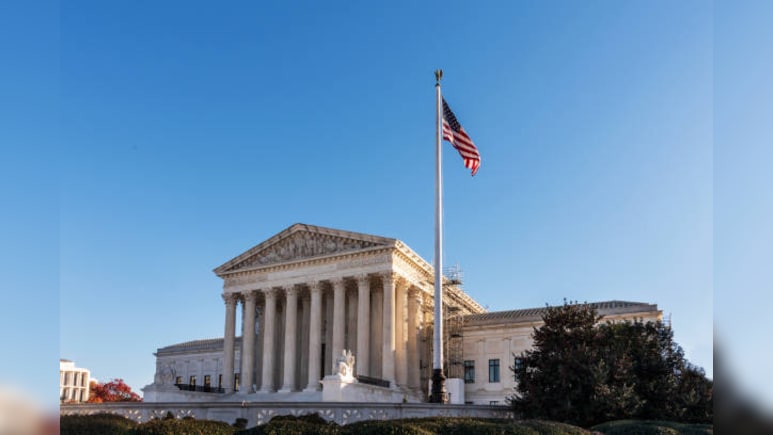
The United States Supreme Court on Monday rejected President Donald Trump's controversial plan to change how mail ballots are sent to voters across the country, a setback to an effort that would have given the US Postal Service (USPS) a greater role in determining whether certain election ballots could be delivered.
The ruling allows states to continue using their existing mail ballot procedures for now, even as voting for the November elections has already begun in some states.
ALSO READ: Supreme Court Lets Trump Keep Building White House Ballroom
Also Read | Layoffs Are Rising In Tech, But These Skills Are Helping People Unlock Better Pay
What Was Trump's Mail Ballot Plan?
The dispute stemmed from an executive order issued by President Donald Trump and subsequent USPS rules aimed at changing how states prepare and send mail-in ballots. Under the proposed plan, states would have been required to provide lists containing the names and addresses of voters who were due to receive mail ballots, while ballot envelopes would have had to meet specified federal design requirements, including the use of particular barcodes, Associated Press (AP) reported.
The USPS would then have used the information provided by the states to create state-specific lists of intended mail ballot recipients. The Postal Service said in its rule that it would not determine voter eligibility, maintain voter rolls or count ballots.
What Would The USPS Have Been Allowed To Do?
The proposed system would have given USPS a greater role in determining whether ballots met the new federal mailing requirements before they entered the delivery system, Reuters reported.
Under the rule, USPS could have also refused to deliver ballots that did not comply with the prescribed requirements, including requirements relating to voter information and ballot envelope design.
States would have also been required to obtain USPS approval for ballot envelop designs under the contested rules, while voter information would have been submitted through a federal online portal.
According to the reporting on the legal challenges of the proposed plan, it would have practically created a new federal checkpoint in the mail ballot process at a time when election administration is largely handled by individual states.
Why Did The States Challenge The Rules?
States and voting rights groups argued that the new requirements exceeded USPS' authority and interfered with the states' constitutional role in administering elections. Opponent also warned that the changes could result in valid ballots being rejected or delayed because election officials had very little time to redesign their systems and comply with the new requirements, AP reported.
The timing became particularly important because mail voting was already underway in states including Alabama, North Carolina and Wisconsin. Election officials argued that implementing a new system only weeks before the midterms could create mistakes, delays and confusion for voters and administrators.
What Did The Supreme Court Decide?
The Supreme Court left in place a lower court injunction preventing USPS from enforcing the disputed restrictions for the 2026 midterm elections. In one of the most significant cases to appear on the court's quick-turn docket in years, a majority of the justices blocked the procedure that would have given the US Postal Service the unprecedented power to withhold potentially millions of mail ballots. Even some GOP election officials cautioned that the proposal could lead to chaos and mass disenfranchisement, CNN reported.
The court said that the administration “is unlikely to succeed on the merits of its challenge” but offered little explanation in its three-sentence, unsigned order.
What Happens To Mail Voting Now?
For the 2026 midterms, states can continue mailing ballots under the existing procedures rather than adopting the Trump administration's proposed USPS requirements. The ruling therefore prevents USPS from imposing the new envelope, voter list and delivery requirements while the current election cycle is underway.
The decision does not necessarily settle every underlying legal question surrounding the federal government's authority over mail voting, particularly because Justice Brett Kavanaugh indicated that the administration could have merit in a future proceeding.
Why Is The Ruling Significant?
The ruling is significant because mail voting is used by a substantial share of American voters, with the AP reporting that nearly one-third of the country votes by mail. The ruling also represents a setback for Trump's broader effort to tighten federal oversight of mail voting ahead of the midterm elections.
At the same time, the decision leaves open a broader debate over how much authority the federal government and the USPS have to regulate the mechanics of state-run elections.
ALSO READ: Trump Admin Refunds $100 Billion In 'Liberation Day' Tariffs After Supreme Court Ruling
Essential Business Intelligence, Sharp Market Insights, Practical Personal Finance Advice, Daily Fuel, Gold and Silver Prices and Latest Stories — On NDTV Profit.