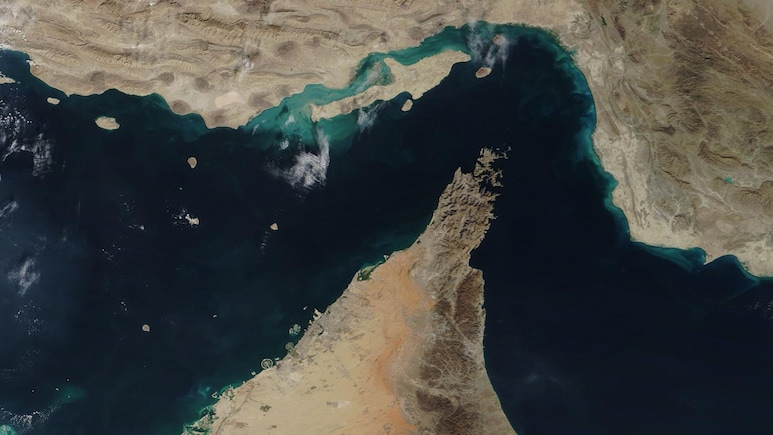
Iran's recent warning that submarine cables in the Strait of Hormuz are a vulnerable pressure point has sharpened concerns over the security of critical digital infrastructure amid the ongoing conflict, according to Reuters.
The narrow waterway, long seen as a chokepoint for global oil flows, is equally crucial for the world's data economy.
Fibre-optic cables running along the seabed carry, nearly 99% of global internet traffic, according to the International Telecommunication Union. These links connect India and Southeast Asia to Europe via Gulf nations and Egypt, supporting everything from cloud computing to financial transactions.
"Damaged cables mean the internet slowing down or outages, e-commerce disruptions, delayed financial transactions … and economic fallout from all of these disruptions," geopolitical and energy analyst Masha Kotkin said.
ALSO READ: Iran Pleading To Open Hormuz, Saying 'We're In State Of Collapse', Claims Donald Trump
Reuters reported that key systems in the region include the Asia-Africa-Europe 1 (AAE-1), the FALCON network, and the Gulf Bridge International Cable System, which together link multiple Gulf states, South Asia, and Europe. These networks underpin the digital ambitions of countries like the UAE and Saudi Arabia, which are investing heavily in artificial intelligence and data infrastructure.
While fears of deliberate sabotage persist, experts note that most cable faults, around 70–80%, are caused by accidental human activity such as fishing and ship anchors, according to the International Cable Protection Committee.
Natural hazards like earthquakes and undersea currents also pose risks. The conflict heightens the likelihood of accidental damage.
"In a situation of active military operations, the risk of unintentional damage increases, and the longer this conflict lasts, the higher the likelihood,” Kotkin added, referencing a 2024 Red Sea incident where a drifting vessel severed cables with its anchor.
Repairing damaged cables in a conflict zone presents its own challenges. Beyond technical fixes, operators must navigate security risks, insurance constraints, and permits to access territorial waters—often the biggest bottleneck, said TeleGeography's Alan Mauldin.
ALSO READ: Iran Offers To Reopen Hormuz — But Only If US Ends War And Blockade
Even if disruptions occur, alternatives remain limited. Land-based routes can provide partial relief, but satellite systems lack the capacity and cost efficiency to replace subsea networks. Low-Earth-orbit solutions like Starlink are “a boutique solution” and not yet scalable for mass demand, Kotkin noted.
For now, subsea cables in Hormuz remain intact, but as the conflict drags on, the risks to this hidden backbone of the global economy are rising.
Essential Business Intelligence, Continuous LIVE TV, Sharp Market Insights, Practical Personal Finance Advice and Latest Stories — On NDTV Profit.