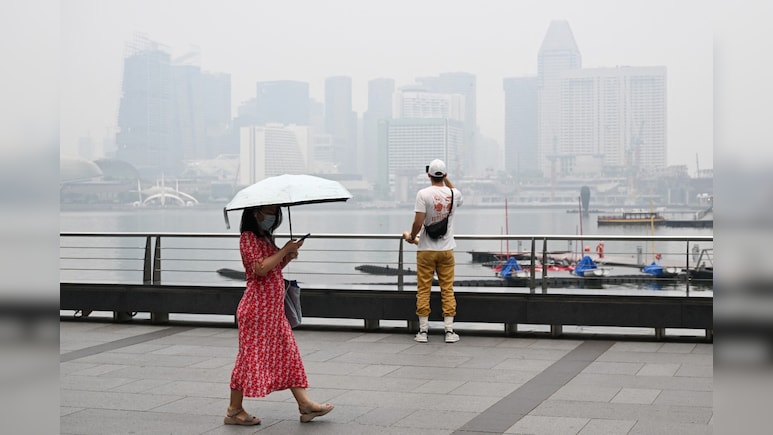
A Singapore gauge of air quality worsened to the highest category in parts of the city-state on Wednesday, as swathes of Southeast Asia choked on haze from wildfires raging in Indonesia.
The 1-hour reading of the average concentration of fine particulate matter reached 288 in the west of Singapore in the afternoon, National Environment Agency data show. Levels of 251 and above are considered “very high,” the top of its four-category system. The reading stood at 269 as of 7 p.m. local time, with the city-state's four other regions in the “elevated” and “high” categories.
Much of the smog stems from smoke drifting from neighboring Indonesia, which is suffering through its worst wildfire season in years. Prolonged dryness, exacerbated by a powerful El Niño, has created conditions for land-clearing fires to burn out of control and emit noxious fumes, fueling health and diplomatic concerns across the region.
Also Read | Layoffs Are Rising In Tech, But These Skills Are Helping People Unlock Better Pay
Singapore, Kuala Lumpur and the Indonesian city of Medan in Sumatra were the three most-polluted cities in the world as of Wednesday evening, according to data compiled by IQAir.
Pollution has also been high in parts of Malaysia, with schools in cities including Johor and Melaka closed on Wednesday. Prime Minister Anwar Ibrahim contacted Indonesian President Prabowo Subianto last week about efforts to tackle the smog, and the country's foreign minister said Malaysia will seek more effective regional mechanisms to address transboundary haze.
Singapore's Ministry of Education judges school closures based on another air-quality measure, the 24-hour Pollution Standards Index. If the PSI forecast for the next day is in the highest category — “hazardous” — school closures will be considered.
PSI readings in all five regions were in the “unhealthy” range, the third level in the government's five-step scale. Some sports facilities in the west of the city-state were closed on Wednesday.
Some lawmakers canceled house visits in their constituencies as the pollution worsened, while the government is distributing N95 masks to eligible Singaporeans and opened haze shelters at some community spaces. The city-state's haze task force is working with retailers to replenish supplies of the masks and ensure they remain available to the public, the National Environment Agency said, adding that retailers and the government have sufficient stocks.
Aerial firefighting efforts in Indonesia have recently been hampered by poor visibility. However, the country is repurposing a weather-modification technique pioneered in the 1940s in its latest effort to fight the pollution. Aircraft will disperse pellets of dry ice above South Sumatra province in an experimental approach that authorities hope will reduce the hazardous smoke.
The number of hotspots in Indonesia have exceeded 7,500 this month, the most in October since 2015, according to the Indonesian Forestry Ministry's fire-monitoring platform SiPongi. A hotspot is defined as a location where satellites detect an elevated surface temperature, indicating a potential fire.
Dry conditions are expected to persist over much of southern Southeast Asia in the coming days, aside from Peninsular Malaysia and northern and central parts of Sumatra and Borneo, according to the NEA's website.
Indonesia has forecast its rainy season will be shorter and later than usual this year, starting in November or December.
(This story has not been edited by NDTV staff and is auto-generated from a syndicated feed.)
Essential Business Intelligence, Sharp Market Insights, Practical Personal Finance Advice, Daily Fuel, Gold and Silver Prices and Latest Stories — On NDTV Profit.