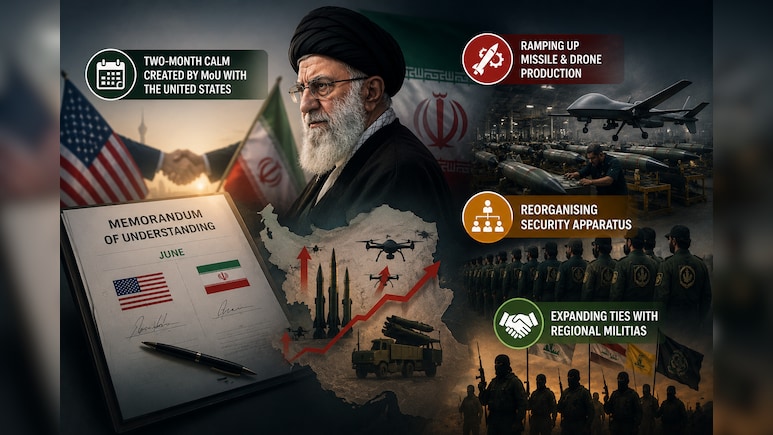
Iran's hard-line leadership used the two-month calm created by a memorandum of understanding signed with the United States in June to secretly prepare for a wider war, ramping up missile and drone production, reorganising its security apparatus and expanding ties with regional militias.
According to the Wall Street Journal that cited Iranian and Arab officials, Iran's leaders viewed the June 17 pact, signed by US President Donald Trump in Versailles, promising sanctions relief, unfrozen funds and a $300 billion reconstruction package in exchange for reopening the Strait of Hormuz, as a temporary reprieve rather than a genuine off-ramp.
They reportedly used the period to strengthen the Islamic Revolutionary Guard Corps' control over the regular army and elevate battle-hardened commanders to key posts.
Also Read | Layoffs Are Rising In Tech, But These Skills Are Helping People Unlock Better Pay
Intercepted communications reviewed by the newspaper showed the Revolutionary Guard sending advisers to Iraq, Yemen and Lebanon to coordinate a stepped-up regional confrontation, supplying Houthi militants with target lists for Saudi ports and energy infrastructure.
The fighting subsequently spread to the Red Sea and Strait of Hormuz, with Iran striking vessels from the UAE and Saudi Arabia and firing ballistic missiles at American forces in Jordan.
The report noted that Supreme Leader Mojtaba Khamenei has since overseen a sweeping reshuffle of seven senior security posts, including elevating Mohsen Rezaei to head Iran's Supreme National Security Council and formally confirming Ahmad Vahidi as Revolutionary Guard commander-in-chief with a mandate for "offensive operations against the enemy."
ALSO READ: Iran's $30,000 US Soldier Reward: What Army Chief Amir Hatami Said
Tehran-based defence analyst Mohammad Hassan Sangtarash was quoted as saying that Iran's actions reflected a belief that "the main war has not yet begun," with strategy increasingly built around limited, incremental strikes designed to weaken adversaries ahead of a larger confrontation.
The Revolutionary Guard has also reportedly drawn up further escalation options, including sabotaging Gulf internet cables and fomenting unrest in Shia-majority states such as Kuwait and Bahrain, after Kuwaiti forces intercepted Guard personnel attempting to land on a Kuwaiti island in May.
Despite the setbacks inflicted by earlier US and Israeli strikes, officials cited in the report said the Revolutionary Guard remains undeterred, with its grip on Hormuz having strengthened Iran's regional leverage even as sanctions continue to squeeze its economy.
ALSO READ: Beyond Sanctions: Inside Scott Bessent's Playbook For Iran's "Unprecedented" Economic Isolation
Essential Business Intelligence, Sharp Market Insights, Practical Personal Finance Advice, Daily Fuel, Gold and Silver Prices and Latest Stories — On NDTV Profit.