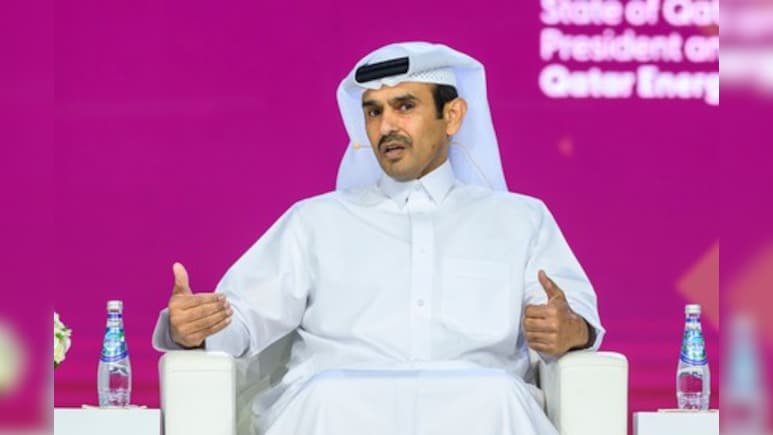
Qatar's energy minister and QatarEnergy CEO Saad Sherida Al-Kaabi has rejected US Treasury Secretary Scott Bessent's assessment that the Strait of Hormuz could become effectively irrelevant within two years as Gulf countries develop alternative oil export routes.
Speaking at the Qatar Economic Forum in New York on Sunday, Al-Kaabi said that Bessent's assessment was "completely wrong" and argued that the strategic waterway would remain important because it carries a wide range of maritime trade beyond oil and gas. Qatar's commerce and industry Minister Sheikh Faisal Al-Thani backed that argument, stating that roughly 90% of global shipping takes place by sea and describing the issue as one of diversification rather than completely replacing maritime routes.
ALSO READ: 'Catastrophic For Entire World': Qatar's Urgent Warning On Potential Bab al-Mandab Closure
Also Read | Layoffs Are Rising In Tech, But These Skills Are Helping People Unlock Better Pay
Al-Kaabi was responding to comments made by Bessent on the sidelines of a G20 meeting on September 1 stating that the Strait could become "a worthless piece of water" within two years as Gulf countries develop pipelines that bypass it. Al-Kaabi said Qatar is not currently planning to construct new pipelines to bypass the Strait of Hormuz.
According to Bloomberg's report, Al-Kaabi said that Qatar had decided not to pursue such pipelines, with the decision being based on commercial and technical considerations. Qatar therefore continues to rely on the Strait for its LNG exports.
This is particularly significant for Qatar because its major LNG infrastructure is located inside the Persian Gulf, meaning its seaborne LNG exports normally have to pass through Hormuz. Analysts have also noted that, unlike crude oil, LNG has far fewer practical pipeline alternatives for reaching international markets.
Bessent's argument centres on the development and expansion of overland pipelines and alternative export infrastructure that would allow Gulf producers to move more oil without sending it through Hormuz. Reuters reported earlier this month that projects involving Saudi Arabia, the UAE and Iraq could eventually increase the amount of oil capable of reaching markets without passing through Hormuz. However, those alternatives face construction, security and geopolitical challenges.
The comments come as the Strait of Hormuz remains severely disrupted amid the ongoing conflict involving Iran, with vessel traffic through the waterway falling sharply from normal levels. Reuters reported on Monday that only 12 commodity vessels crossed the Strait over the preceding weekend, compared with around 125 vessels a day before the conflict.
Qatar's LNG Exports Hit
The disruption has had a direct impact on Qatar's energy sector, with Al-Kaabi saying that QatarEnergy is currently producing only a "very minute" volume of liquified natural gas (LNG). The company is also facing difficulties bringing critical equipment into Qatar, raising the possibility that some of its expansion projects could be delayed.
Several LNG trains under QatarEnergy's North Field East expansion are scheduled to begin operations in 2027, while the North Field South expansion is expected to start production in 2028, according to Al-Kaabi's comments cited by Reuters.
Al-Kaabi has warned that a prolonged disruption to Hormuz could affect the timing of additional LNG production trains because equipment required for the projects depends on access through the waterway.
Why Is Hormuz Critical For Qatar?
Qatar is particularly exposed to disruptions in the Strait because its major LNG export infrastructure is located on the Gulf coast and its seaborne LNG shipments rely on passage through Hormuz. The Straits Times reported that Qatar currently has no alternative shipping route capable of bypassing the Strait of Hormuz for its main LNG exports.
Al-Kaabi said that Qatar is instead looking to expand its role as a global LNG trader, including through LNG operations outside the Persian Gulf. The country's Golden Pass LNG facility in the United States is part of that broader diversification strategy.
Gulf States Explore Alternative Routes
While Qatar has ruled out new bypass pipelines for now, other Gulf producers have been exploring ways to reduce their dependence on Hormuz. Reuters reported in July that Saudi Arabia was considering expanding its East-West crude pipeline capacity by up to 2 million barrels per day, potentially allowing more oil to reach the Red Sea without crossing Hormuz. Saudi Arabia's existing East-West pipeline can transport up to 7 million barrels of crude per day to the Red Sea port of Yanbu.
The United Arab Emirates also has an existing pipeline system that allows crude to reach the port of Fujairah outside the Strait of Hormuz. However, the alternatives primarily address crude oil transportation and do not provide an equivalent overland route for LNG exports.
Pipelines Cannot Completely Replace Hormuz
The International Energy Agency (IEA) has estimated that Saudi Arabia and UAE are currently the only Gulf producers with operational crude oil pipelines capable of rerouting significant volumes around Hormuz. It estimated available alternative capacity at roughly 3.5-5.5 million barrels per day, while warning that the logistics needed to reroute much larger volumes have not been tested.
The Strait normally handles a much larger volume of energy shipments. An analysis published by The National said that more than 20% of global energy trade passed through Hormuz before the current conflict, and that existing and proposed pipelines fall well short of replacing the waterway's overall capacity.
Damage To Qatar's Energy Infrastructure
Qatar's Ras Laffan Industrial Complex, one of the world's major LNG facilities, has also been affected by the conflict. The Straits Times, citing Al-Kaabi, reported that an attack damaged approximately 17% of the facility. Al-Kaabi said that the undamaged parts of Ras Laffan could resume operations within a couple of weeks once the Strait reopens, while the damaged portion would require much longer to repair.
Despite the disruption, Al-Kaabi said that Qatar's LNG expansion remains on course for initial production from North Field East in the first half of 2027, although prolonged disruption could affect subsequent trains.
The dispute over Hormuz therefore centres on whether alternative pipelines can reduce the waterway's importance rather than whether they can completely replace it, with Bessent pointing to future bypass infrastructure while Qatar argues that the Strait's wider role in global maritime trade and its importance to LNG exports cannot be eliminated.
ALSO READ: Qatar Exports First LNG Shipment Through Hormuz In Weeks
Essential Business Intelligence, Sharp Market Insights, Practical Personal Finance Advice, Daily Fuel, Gold and Silver Prices and Latest Stories — On NDTV Profit.