Harvard, Penn Heads Walk Back Genocide Answers After Backlash
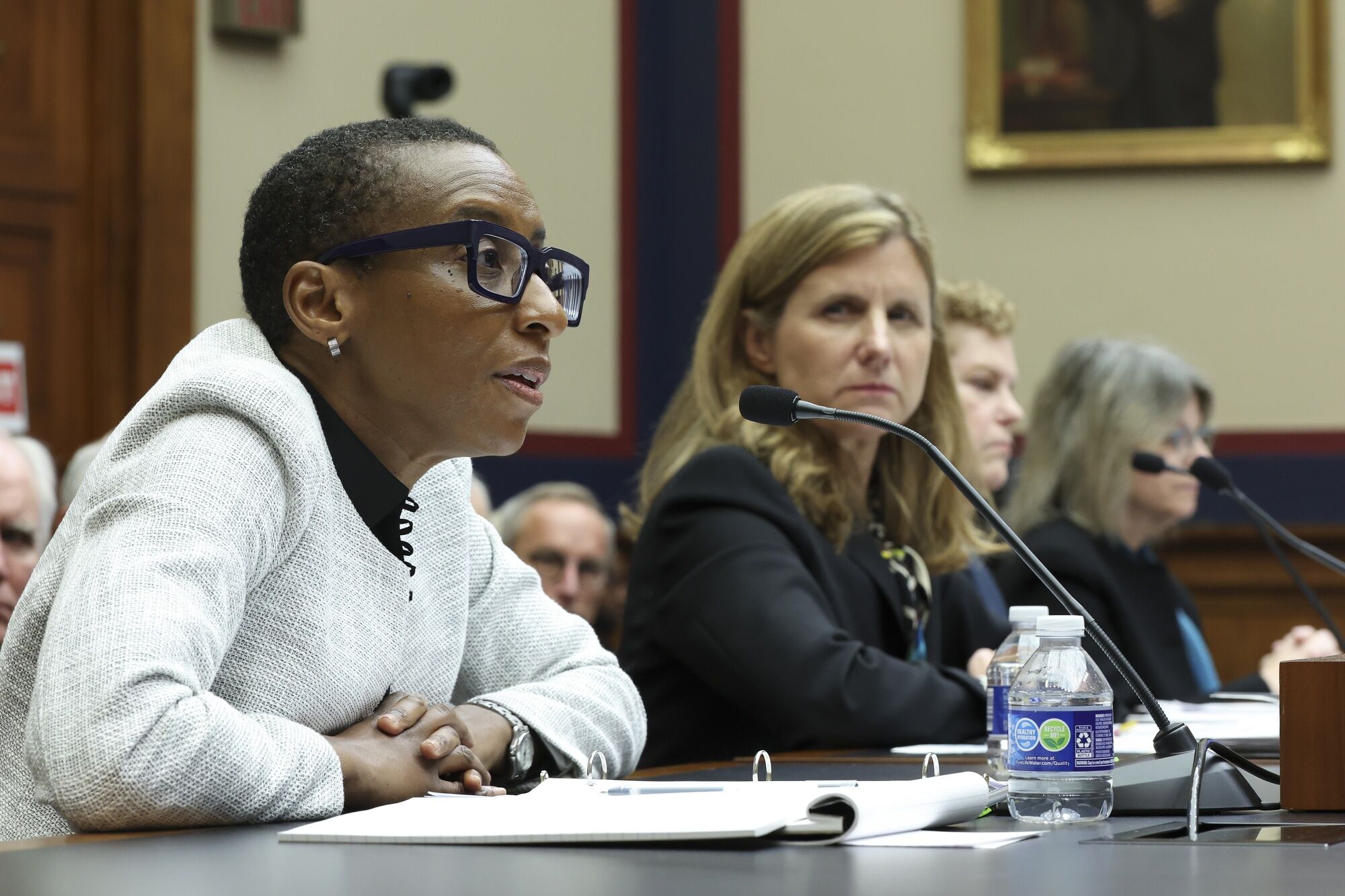
(Bloomberg) -- The presidents of Harvard University and the University of Pennsylvania were forced to issue statements clarifying their responses to a US congressional hearing on antisemitism after a barrage of criticism from business leaders and politicians that shows few signs of abating.
Harvard's Claudine Gay and Penn's Liz Magill were lambasted for refusing to say at the Dec. 5 hearing that calling for the genocide of Jews is against school policy, instead offering narrow legal responses.
Magill said late Wednesday in a video message that such language would amount to “harassment or intimidation,” while Gay said on social media that Harvard won't condone violent speech against Jewish students.
The presidents backtracked in the face of widespread denunciations of their performances at the hearing which also included Massachusetts Institute of Technology President Sally Kornbluth.
Pfizer Inc. Chief Executive Officer Albert Bourla, whose grandparents, aunt and uncle perished in the Holocaust, described the hearing as “one of the most despicable moments in the history of US academia.”
Investor Bill Ackman said “they must all resign in disgrace” while Pennsylvania Governor Josh Shapiro slammed Magill's initial response as shameful and unacceptable.
They even drew a rebuke from the White House.
“It's unbelievable that this needs to be said: Calls for genocide are monstrous and antithetical to everything we represent as a country,” stated Andrew Bates, a White House spokesman. “Any statements that advocate for the systematic murder of Jews are dangerous and revolting – and we should all stand firmly against them, on the side of human dignity and the most basic values that unite us as Americans.”
The hearing led by US House Education and the Workforce Committee Chair Virginia Foxx, a North Carolina Republican, was held after weeks of protests on campuses that have stirred controversy over the limits of free speech and what constitutes antisemitism.
Foxx said she wanted to know why college administrators “largely stood by, allowing horrific rhetoric to fester and grow” after the Oct. 7 attack on Israel by Hamas, which is designated a terrorist group by the US and European Union. Students and faculty continue to protest Israel's response, which has killed more than 16,000 Palestinians, according to the health ministry in Hamas-controlled Gaza.
Stefanik Exchange
The most explosive exchange of the hearing occurred when Representative Elise Stefanik, a New York Republican and Harvard graduate, questioned the university presidents on whether “calling for the genocide of Jews” violates their code of conduct or constitutes bullying or harassment.
Magill responded that “it is a context-dependent decision” that could be considered harassment “if the speech becomes conduct.” Gay also said it depended on the context, such as being “targeted at an individual.” Kornbluth said it would be “investigated as harassment if pervasive and severe.”
Throughout the hearing, the presidents stressed the importance of maintaining freedom of speech on campuses while providing a safe environment for students, and the difficulty in balancing the two. Gay said she couldn't discuss ongoing disciplinary proceedings.
“I've sought to confront hate while preserving free expression,” Gay told lawmakers. “This is difficult work. I know I have not always gotten it right.”
As criticism mounted after the hearing, Gay posted a statement Wednesday on X, the platform formerly known as Twitter, saying any calls for violence or genocide against Jews or any religious or ethnic group “are vile.” She also said “those who threaten our Jewish students will be held to account.”
Magill said in her video statement that during the testimony, she should have been focused on the “irrefutable fact”' that such a call is “some of the most terrible violence human beings can perpetrate.”
“In my view, it would be harassment or intimidation,” Magill said in the video.
Some saw legal strategy in Gay's testimony because of a complaint opened by the US Education Department. Harvard's effort to shield itself from litigation led to Gay “grotesquely claiming that calls for genocide are acceptable on campus,” said Rebecca Brooks, director of advocacy for the Harvard Jewish Alumni Association.
“Harvard is retroactively inventing an interpretation of its own guidelines to pretend that it has complied with its policies and hasn't shirked its most basic duties to protect students on campus,” said Brooks.
Two Massachusetts Congressmen, both Democrats and Harvard alumni, condemned their alma mater in a joint statement on X.
“Harvard ranks last out of 248 universities for support of free speech,” wrote Seth Moulton and Jake Auchincloss. “But when it comes to denouncing antisemitism, suddenly the university has anxieties about the First Amendment. It rings hollow.”
--With assistance from Justin Sink.
More stories like this are available on bloomberg.com
©2023 Bloomberg L.P.

-
The Curious Case of Equitas Small Finance Bank And A CEO Who Quit For Stock

PN Vasudevan believes persistent investor concerns over a perceived conflict of interest had become a governance overhang on Equitas Small Finance Bank's stock, even as the lender improved profitability and asset quality.
-
Talking Points This Week: AI Cash Burn, A Tiger Comeback And An India That Still Finds Its Own Path
India is not immune to higher oil or tighter global liquidity, yet its earnings base is broader, its domestic policy levers are still available.
-
Foreign Investors Own Half Of HDFC Bank and ICICI Bank. An LTCG Cut Could Matter Most Here
Foreign portfolio investors have US$115 billion parked in HDFC Bank, ICICI Bank. If the government cuts long-term capital gains tax, Jefferies says returning foreign money could land here first.
-
'Never Seen This Level Of Negativity': Sandeep Tandon Says The Next Rally May Be Closer Than You Think
Veteran investor Sandeep Tandon says foreign selling is easing, large-caps are due a comeback and mid-caps are crowded, while he turns positive on gold, power and pharma this Diwali.
-
Indians Stay With Family, Not In Hotels | The Reason Why
India still lacks enough clean, reliable and affordable hotels for budget-conscious travellers.
-
The Economic Imperative: Analysing The Material Driving Force Behind India-Canada Strategic Reset
This economic complementarity is further reinforced by deep institutional investment ties and talent mobility, which form the bedrock of the bilateral framework.
-
Medicine Pricing: Where Must Profit Stop?
India must confront excessive margins, hidden incentives and regulatory gaps that threaten the integrity of medicine.
-
Why Amazon And Flipkart Are Struggling To Beat Meesho In India's Smaller Cities
With 274 million users and lowest-cost logistics, Meesho is defending its value commerce crown against giants like Amazon and Flipkart.
-
High US Salaries, No Green Card Certainty: The Financial Calculation Facing Indian H-1B Families
The suspension of PERM processing at eight technology employers does not cancel existing H-1B visas. What it does is force a question many Indian families have been avoiding: is the US salary worth tying your career and family plans to one employer?
-
Swiggy vs Eternal: Food Delivery's Two Rivals Are No Longer In The Same Race
Eternal is building a private AI assistant, dark.ai. Swiggy is still working out how to make Instamart pay, with an operating loss of Rs 895 crore in the July-September quarter while Blinkit stayed profitable.










