
For decades, globalisation promised a world where trade created mutual dependence and economic stability. But according to business strategist and author Professor Ram Charan, the balance of industrial power has quietly shifted in ways that could reshape the global economy. In his latest book China's 90% Model: China Has America by the Throat, Charan argues that China has systematically built overwhelming manufacturing capacity across critical industries-giving it a level of economic leverage that few countries can match.
"China controls about 80-90% of the world's supply of rare earth materials," Charan said in a conversation with NDTV. "If they stop supplying them, many industries-from automobiles to electronics-could stop altogether."
Rare earths are essential inputs used in everything from electric vehicles and semiconductors to defence technologies and renewable energy systems. Their supply chain dominance, Charan argues, illustrates how China has positioned itself at the heart of global industrial production.
The '90% Model'
At the centre of Charan's thesis is what he calls the "90% model"-a strategy where China builds manufacturing capacity in selected sectors to meet roughly 90% of global demand. Once that scale is achieved, the economics shift dramatically.
"When you produce at that scale, your marginal cost becomes very low," Charan explained. "You can sell at marginal cost-or even below-making it impossible for competitors in other countries to match your prices."
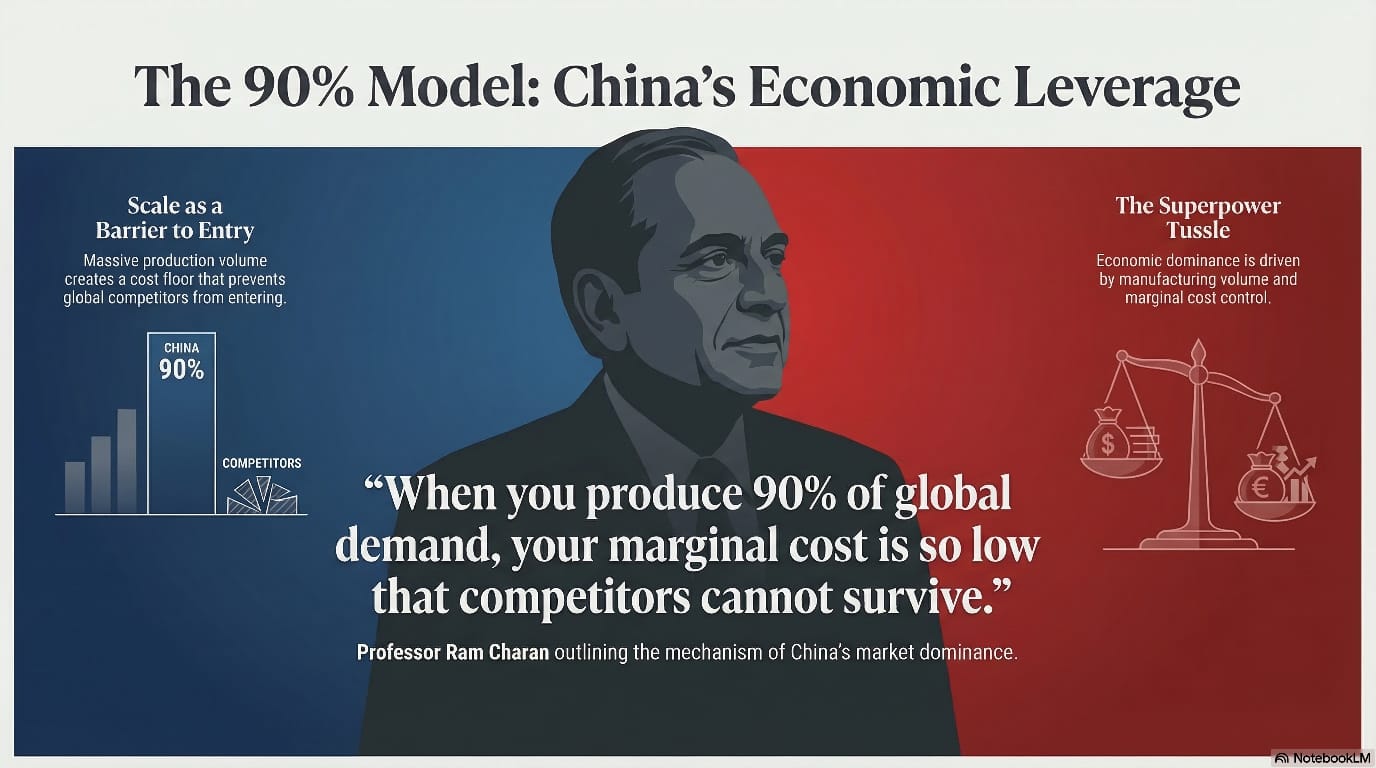
This dynamic, he argues, has already played out across several industries. The United States once had a significant presence in sectors such as solar manufacturing, but much of that capacity has shifted to China over the past decade. The strategy also feeds into China's growing financial power. By exporting large volumes of goods globally, the country has accumulated massive foreign exchange reserves and persistent trade surpluses.
According to Charan, China generates around $1.2 trillion in annual trade surplus, while its total reserves are estimated at about $7.4 trillion, giving it significant economic firepower.
Why Tariffs Alone May Not Work
The debate around China's industrial dominance has intensified in recent years, particularly in the United States, where policymakers have increasingly turned to tariffs and trade restrictions. Charan, however, believes tariffs alone will not solve the problem.
"The idea of tariffs is to bring trading partners to the negotiating table," he said. "But rebuilding manufacturing requires something much bigger." Instead, he argues that a coalition of major industrial economies-including the United States, Japan, South Korea, Germany and Israel-must coordinate efforts to rebuild manufacturing at scale.
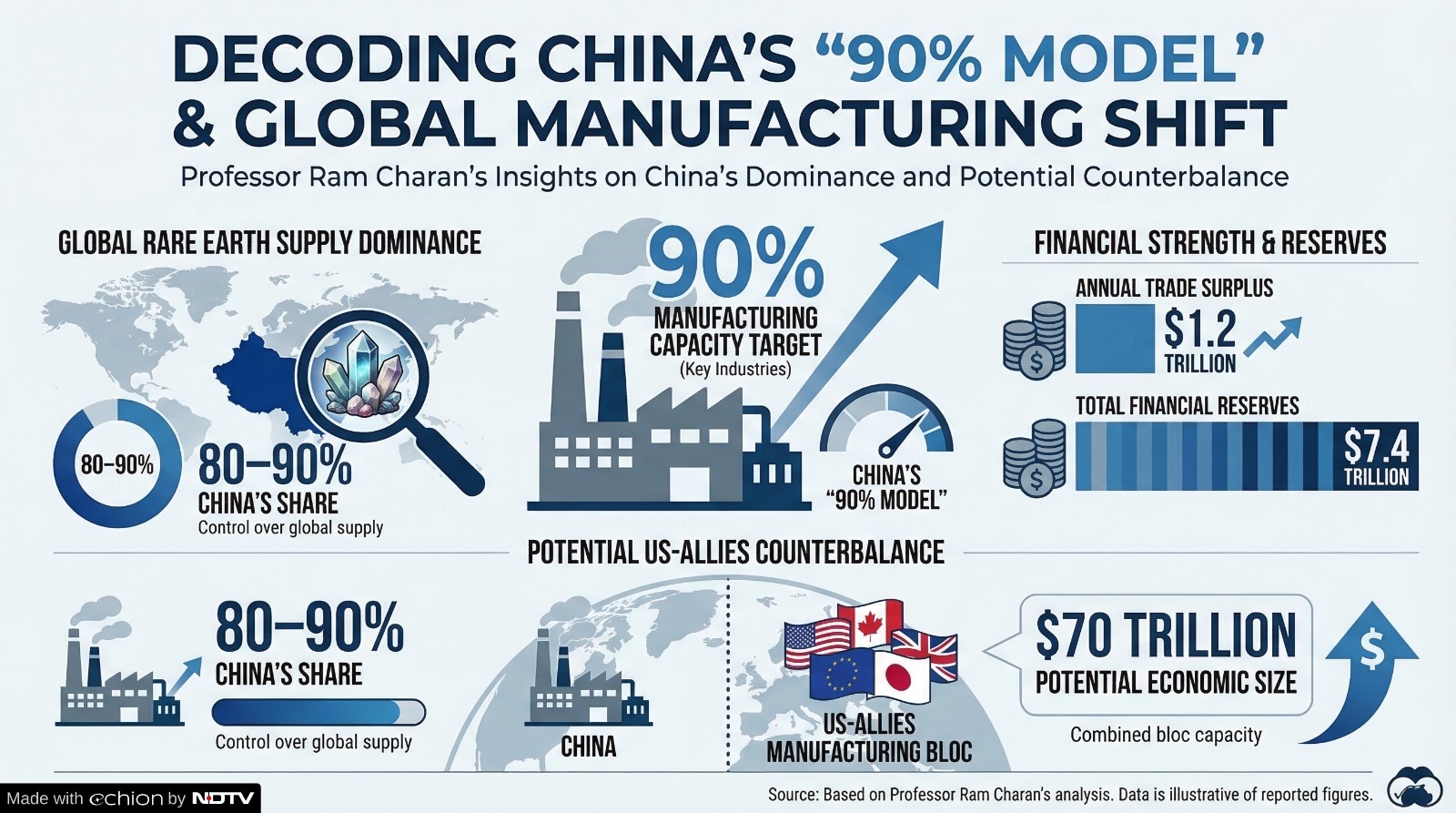
Together, these economies represent a combined economic base of roughly $70 trillion, which Charan believes could rival China's manufacturing power if they act collectively. But achieving such coordination remains difficult. European economies, for instance, have deep trade relationships with China and may be cautious about adopting a confrontational stance.
Some sectors-such as rare earth magnets, lithium batteries, telecom infrastructure and solar panels-are already heavily dominated by Chinese manufacturers, he said.
Industries like aerospace, advanced materials, agricultural machinery, robotics, maritime equipment, autonomous driving technology and high-end medical devices could become the next major battlegrounds. "These sectors are not just commercial," Charan noted. "Many of them are also critical for military and strategic capabilities."
India's Opportunity, And Challenge
For India, the shifting global supply chain landscape presents both risks and opportunities. Charan pointed out that India's imports from China have continued to grow even amid geopolitical tensions. But he believes India could strengthen its industrial base by scaling up domestic manufacturing and supporting mid-sized companies.
One key step, he suggested, would be focusing on expanding mid-sized manufacturing firms-companies that already have operational capacity but need support to scale. "If India can build and scale 500 mid-sized manufacturing companies, it can create a powerful job engine and strengthen its industrial competitiveness," he said.
ALSO READ: Despite PLI Push, India Sources Over 70% Key Pharma Inputs From China: Govt Disclosure
Essential Business Intelligence, Continuous LIVE TV, Sharp Market Insights, Practical Personal Finance Advice and Latest Stories — On NDTV Profit.