When Anthropic wanted help deciding what makes an AI "good", it looked beyond engineers and ethicists to a Vedanta monk from New York.
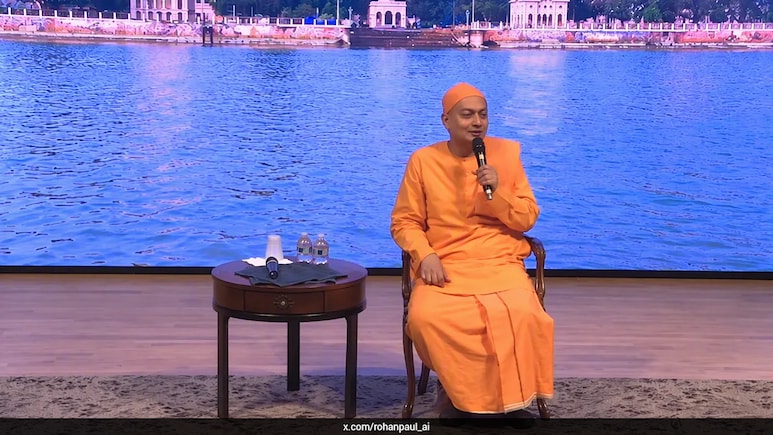
Swami Sarvapriyananda, head of the Vedanta Society of New York and a monk of the Ramakrishna Order, says the company flew him to its San Francisco headquarters to help shape how its Claude models think about right and wrong.
How The Story Surfaced
Sarvapriyananda described the visit in June at a talk at the Unity of Dallas. The clip spread widely on X this week after a New York Times report, published on September 29, said Anthropic had been quietly hosting religious thinkers for months.
Also Read | Layoffs Are Rising In Tech, But These Skills Are Helping People Unlock Better Pay
So this is the part I did not expect.
— Rohan Paul (@rohanpaul_ai) October 1, 2026
Anthropic called Swami Sarvapriyananda, a Vedanta monk and flew him to the San Francisco head-office.
> Closed door meeting with NDA signed.
> theologians and mental health people in the same sitting, all of it aimed at training Claude.
>… https://t.co/pP2vo08DHU pic.twitter.com/prW0Kva67X
According to his account, Anthropic first approached him for an online interview, then invited him to San Francisco and arranged his travel and stay. There he met theologians from different faiths, counsellors and mental health professionals.
He said participants were shown some of the company's latest work, and that he could not share details because he had signed a non-disclosure agreement. He added that he spent "hours and hours" speaking with one of the company's founders.
A Wider Effort
The NYT reported that dozens of scholars, including Catholic, Jewish, Sikh and evangelical thinkers, have attended similar sessions under NDAs.
At one April dinner, co-founder Christopher Olah, who leads Anthropic's interpretability work, sat beside an Orthodox rabbi from Israel. Olah told the paper the company does not know whether its models are conscious.
Anthropic has not claimed Claude is conscious. It has, however, been trying to move beyond rigid rules towards what it calls "moral formation", guided by a published "constitution" of broad principles for Claude.
Why Vedanta
Advaita Vedanta distinguishes between mental activity, such as thoughts and emotions, and the consciousness that witnesses them. That distinction bears on a live AI question: a model can describe fear convincingly without anyone knowing whether it feels anything.
The tradition also has a history in the West. Swami Vivekananda introduced Vedanta to a mass audience at the 1893 World's Parliament of Religions in Chicago. His ideas linked a person's view of reality with how they treat others, a link Anthropic appears keen to examine.
ALSO READ: Anthropic Co-Founder Warns: 'Real Possibility Of AI Replacing Human Labour At Very Large Scale'
The Monk's Warning
Sarvapriyananda said the discussions covered AI safety and the risks of increasingly capable systems. He recalled Anthropic's concern over how fast AI is advancing and the need for stronger safeguards, and said he was told another company could move ahead within months.
Beyond the lab, he warned of growing reliance on AI for decisions, job losses and concentration of wealth. His advice was to "stand your ground as a spiritual seeker", staying centred through knowledge, meditation, devotion and service.
Essential Business Intelligence, Sharp Market Insights, Practical Personal Finance Advice, Daily Fuel, Gold and Silver Prices and Latest Stories — On NDTV Profit.