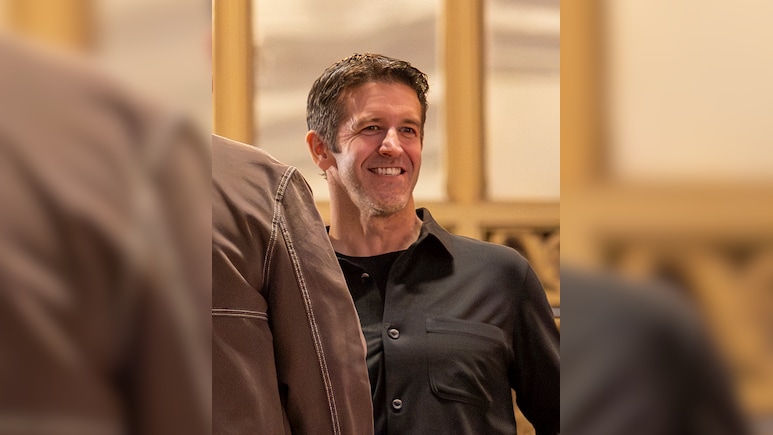
John Ternus will lead Apple as its next CEO, the company announced on Monday, with Tim Cook set to move into the executive chairman's role on Sept. 1.
Ternus, 50, who has been with Apple for 25 years, joined the executive team in 2021 as senior VP of hardware engineering.
“John Ternus has the mind of an engineer, the soul of an innovator, and the heart to lead with integrity and with honour. He is a visionary whose contributions to Apple over 25 years are already too numerous to count, and he is without question the right person to lead Apple into the future. I could not be more confident in his abilities and his character, and I look forward to working closely with him on this transition and in my new role as executive chairman,” Tim Cook said in Apple's press release.
Also Read | Layoffs Are Rising In Tech, But These Skills Are Helping People Unlock Better Pay
On his appointment as the next Apple CEO, Ternus said, “Having spent almost my entire career at Apple, I have been lucky to have worked under Steve Jobs and to have had Tim Cook as my mentor. It has been a privilege to help shape the products and experiences that have changed so much of how we interact with the world and with one another…I am humbled to step into this role, and I promise to lead with the values and vision that have come to define this special place for half a century.”
ALSO READ: From $350 Billion To $4 Trillion: How Apple Stock Performed Under Tim Cook
Who Is John Ternus?
Ternus, who hails from California, completed his mechanical engineering at the University of Pennsylvania in 1997. His senior project focused on creating a feeding device intended for quadriplegic users and those with limited movement, controlled via head motion.
Ternus began his career at Virtual Research Systems, a fledgling company focused on virtual reality. In his role as a mechanical engineer, he contributed to the development of headsets and accessories in a field that was still finding its footing.
The work is thought to have laid the foundations for his later involvement in Apple's mixed-reality ambitions, including Vision Pro and the much-rumoured Apple Glass. He remained there only a short time before joining Apple less than four years after graduation.
Ternus arrived at Apple in 2001. Among his first assignments was work on the widely acclaimed Apple Cinema Display. His progression was swift; within roughly three years, he had stepped into a managerial position.
According to Steve Siefert, who initially supervised Ternus at Apple, the engineer deliberately avoided an authoritarian management style. Speaking to The New York Times, Siefert recalled how Ternus turned down a closed office during a floor move, preferring to stay close to his team in an open setting to encourage collaboration. The pattern continued after Siefert stepped down in 2011, when Ternus again refused a private office.
In 2005, Ternus advanced further within Apple, leading a team responsible for engineering the G5-series iMacs. His role also saw him engage extensively with manufacturing partners across Asia, where he developed a deeper appreciation of the challenges involved in turning Apple's concepts into finished products.
His next significant promotion came in 2013, when he was appointed Vice President of Hardware Engineering, working closely with Dan Riccio.
Ternus's elevation brought broader responsibilities, with oversight extending beyond Macs to include the iPad unit.
Apple states that he has been involved in the development of every iPad generation released. In a March 2026 Bloomberg feature, he was described as instrumental in pushing for iPadOS, arguing that iOS did not fully use the device's screen size or processing power.
A management overhaul in January 2021 reshaped Apple's hardware operations and had a direct bearing on Ternus. Dan Riccio moved on from his role as Senior Vice President of Hardware Engineering, transitioning to oversee engineering on a new, as yet unannounced, project.
Ternus was tapped to fill the sizeable void, taking on the position of SVP of Hardware Engineering. By April, Apple had added him to its official leadership roster. The role placed him in charge of all hardware engineering operations, reporting directly to Tim Cook.
Ternus's recent work includes Apple's MacBook Neo, a lower-cost addition to its laptop line-up. The device achieves its price point by making strategic design adjustments, notably by incorporating an iPhone chip as its core processor.
ALSO READ: Apple's Next CEO Faces Three Big Tests As John Ternus Prepares To Take Over
Essential Business Intelligence, Sharp Market Insights, Practical Personal Finance Advice, Daily Fuel, Gold and Silver Prices and Latest Stories — On NDTV Profit.